
Google Files Patent for a Slider That Dials Your AI Chatbot Between Budget and Luxury
Ask a chatbot where to eat dinner and you get the average person's answer. Google's patent application adds a slider so you can shift that answer toward budget or luxury.
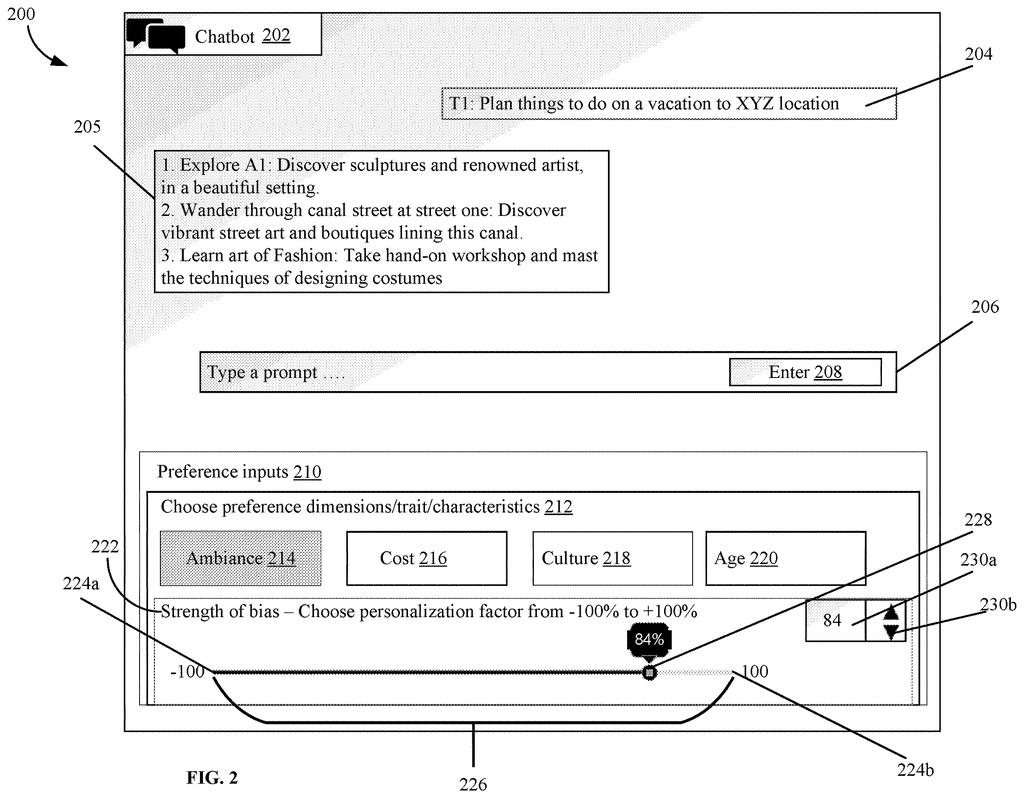
What Google's chatbot preference slider does
Someone types “Where should I eat dinner?” into a chatbot and gets a list of pricey tasting menus. She meant something cheap and casual, but the chatbot has no way to know, and explaining it means writing a paragraph of instructions most of us never bother to write.
A new Google patent application describes a fix: a dial. Pick a topic like cost, and the chatbot shows a slider running from budget at one end to luxury at the other. Slide it 80% toward cheap, and the answers shift to match.
If you don't want to fiddle with a slider, the filing offers two other routes. The chatbot can show you two sample answers and ask which you like better, or it can simply listen. Say “something more affordable,” and it adjusts its own dial for you.
… determining, based on an input, a position within a range defined using the first feature and the second feature; providing the position within the range to a model to modify generation of a response to the prompt based on the position …
Translation: The system reads where you set the slider and tells the AI to adjust its output to match.
How the slider nudges the model's inner workings
The filing covers a method for steering a chatbot's answer along a scale between two opposite traits, such as budget vs. Luxury, casual vs. Formal, or simple vs. Detailed. The system identifies a preference tied to your prompt, works out a position on that scale from your input, hands that position to the model, and shows you the response.
The position isn't pasted into your prompt as text. It becomes a number that scales a steering vector (a pre-computed direction inside the model's internal math that stands for a trait like luxury). That scaled vector is added to the model's residual stream (the running set of values the model passes along as it builds an answer) while it writes. Negative numbers push toward one end, positive numbers toward the other. The filing says this needs no retraining and no stored history about you.
There are three ways to set the position:
- Select: you move a slider, which runs from -100 to 100.
- Calibrate: the chatbot writes two answers from opposite ends, you say how strongly you prefer one, and it narrows the gap. This repeats two or three times.
- Learn: the system reads the sentiment in your messages and adjusts the position, optionally showing a label like “52% Asian.”
The filing also describes starting from a default, such as a saved budget preference, which you can override.
This position, which indicates which feature is favored and by how much, is set via interactive user interface inputs across multiple modalities: direct selection of candidate preferences (select implementation), iterative calibration between model-generated responses (calibrate implementation), or learning from interactions (learn implementation).
Translation: You can move the slider directly, compare different outputs, or let the AI learn your style over time.
Why a slider beats writing longer chatbot prompts
For you, the practical gain is a chatbot that adapts without a long prompt or months of chat history. Think of how often you ask for recommendations: restaurants, gifts, recipes, trips. The filing says this works for brand-new users and is light enough to run on phones and head-mounted displays, since it avoids retraining and extra data lookups.
The evidence in the filing is early. A study with 14 people found the slider matched people's stated preferences 86% of the time, while the chat-reading mode reached 57%. The filing also notes that pushing too hard degrades the quality of the writing, so each model has only a limited safe range.
Google's 77th filing we've tracked in AI assistant and agent patents since May builds on ideas like TV activation by presence and comparing multiple AI answers.
Chatbots hand everyone the same average answer, and the filing's own example shows the cost: someone says “I want to treat myself” and gets five-star restaurants far outside her budget. The usual fix is typing longer instructions, which most people never do. A slider removes that chore, so the approach fits the size of the problem well.
The evidence is thin. Google's study had 14 participants, and the mode that reads your mood from chat matched true preferences only 57% of the time, barely above random. The slider and the pick-between-two mode both reached 86%.
The slider is the strongest idea here because you can see it and fix a wrong setting yourself. A hidden guess about your taste is much harder to trust or correct.
Get our take in your Top Stories
Liked this breakdown? Add Patentlyze as a preferred source on Google, and our plain-English take shows up more often in your Top Stories the next time Google patent news breaks.
There are more where this came from
We read every patent application Big Tech publishes and send you the ones worth knowing. Plain English, free, every week.
The drawings
23 drawing sheets from US 2026/0320141 A1 · click any drawing to enlarge


Show the other 15 sheets


Want this weekly breakdown for a company we don't cover? Patentlyze Pro →
Be the first to weigh in