
Google Patents Earbuds That Capture What Others Say So an AI Can Recap It Later
Your earbuds could save what the people around you say, then let an AI assistant answer questions about it days later.
What Google's earbud listening patent covers
Ever walked out of a meeting and realized you can't remember what your colleague said about the budget? Google has filed a patent application for earbuds that could help. Once you start a recording session (the filing's example is saying "start listening"), they would listen to the room, separate your voice from everyone else's, and save the other person's words for later.
That evening, you could ask an AI assistant on your phone what your colleague actually said, or what the professor's main points were in a lecture. Because the system keeps track of who said what, the assistant can summarize each person's view separately.
You could also come back the next day with a new question. The assistant remembers your earlier chat about the same recording, so you don't have to start from scratch.
Some implementations can allow users to continue discussions with the AI across multiple sessions and review previous discussions.
Translation: You can pick up past conversations with the assistant and look back at older chats.
How the earbuds separate your voice from the room
The setup has two parts: earbuds and a companion device such as a phone. The earbuds can have a microphone aimed at the wearer to capture your voice, plus separate microphones that pick up the room, including other voices and background noise like a fan or traffic. Claim 1 covers the core steps: identify data from your voice, identify data from the room audio with your voice left out, use both to produce a smaller slice of that room audio, and store it.
The filing describes how the slice gets made. Your voice data is used to subtract your voice from the room recording, and background noise is removed too, leaving mostly another person's speech. One described method uses an inverse Fourier transform (a math step that turns audio from its frequency breakdown back into a waveform that can be analyzed) to find the voices.
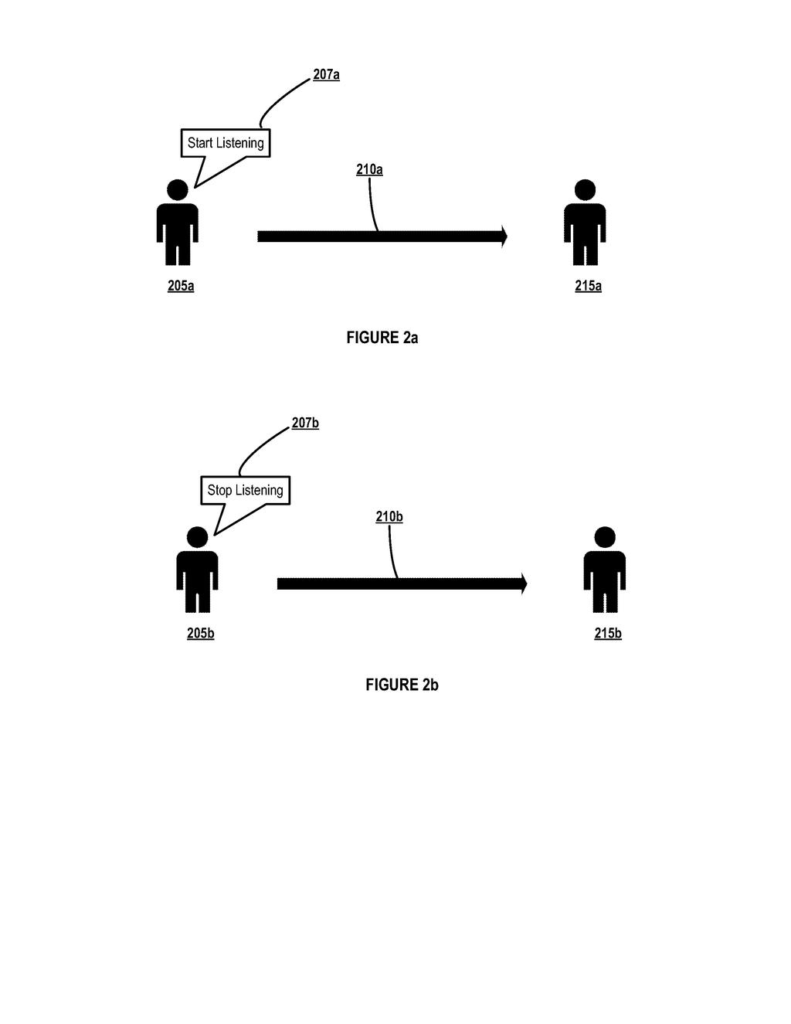
Recording can start with a spoken phrase like "start listening." The filing says that phrase could also switch the earbuds from noise cancellation to transparency mode (letting outside sound in) so you can hear the room, then switch back on "stop listening."
The saved data can go to a generative model (an AI that writes text and answers questions), so you can ask about it across multiple sessions, with earlier chats kept as context.
Why Google's earbud memory raises privacy questions
The practical pitch is a memory aid. The filing's examples are a university lecture and a party: you wear the earbuds, then later ask the assistant what the professor said about a topic or what your friend thought of a movie. Because other voices are separated out, the assistant can summarize each person's viewpoint instead of handing you one blurry transcript.
It also raises an obvious question: the people around you are being recorded. The filing includes standard language saying users can control what information is collected and that personal identifiers can be removed, but it covers the user's own data and doesn't spell out what happens for the people being recorded. It is also only a patent application, so none of this describes a product you can buy.
Google's 36th filing we've tracked in our AI assistants that remember you watchlist since May builds on earlier applications like merging related questions and filling in task details mid-chat.
Claim 1 is wide. It asks for four things: data from your voice picked up by earbuds, data from the room with your voice left out, a smaller slice of that room audio built from the two, and a place to store it. Nothing in that claim mentions an AI assistant, a phone app, or even another person's speech.
The chatbot part shows up only in later claims. One sends the saved slice to a second device running a generative model (the technology behind chatbots), and another narrows the slice to another person's voice.
If granted as written, a claim this broad could reach many earbud products that save a trimmed piece of room audio, whatever they do with it afterward. Broad claims like this often shrink during review, so the narrower later claims may tell you more about what Google is really after.
Get our take in your Top Stories
Liked this breakdown? Add Patentlyze as a preferred source on Google, and our plain-English take shows up more often in your Top Stories the next time Google patent news breaks.
There are more where this came from
We read every patent application Big Tech publishes and send you the ones worth knowing. Plain English, free, every week.
The drawings
5 drawing sheets from US 2026/0311695 A1 · click any drawing to enlarge


Want this weekly breakdown for a company we don't cover? Patentlyze Pro →
Be the first to weigh in