
Samsung Files Patent for Shrinking 3D Photo Sets by Rebuilding Missing Views
Samsung's filing describes sending only a handful of photos from a 3D scene and letting the receiving device rebuild the rest. The hints that make it work include a map of what's hidden behind objects.
What Samsung's 3D photo-shrinking patent does
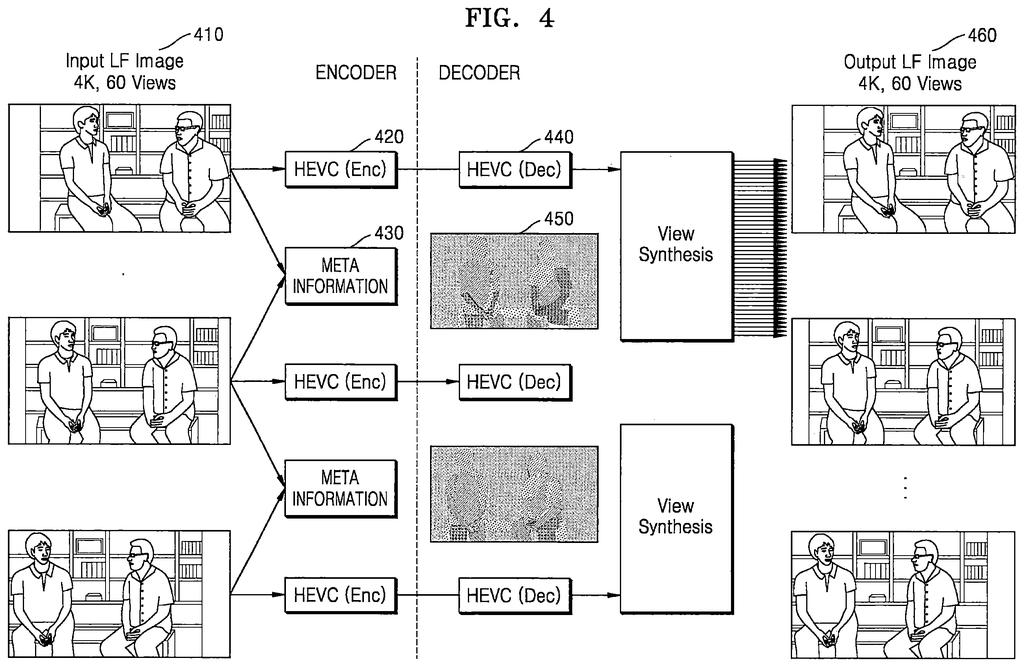
Ever tried to email a friend a huge folder of vacation photos and watched the upload bar crawl? Now multiply that by 60, with every photo showing the same scene from a slightly different angle. That is roughly what a 3D light field image is, and the filing uses 60 views at 4K resolution as an example.
Samsung's patent application skips most of them. Only a few reference photos get sent in full. For the angles in between, it sends a small set of hints: how far things shift from view to view, how to blend the nearby photos, and which spots are hidden behind objects and can't be trusted.
Your device then rebuilds the missing views from those hints. You end up with the full set, but the data that traveled is much smaller.
… decoding the encoded first frame, the encoded second frame, the encoded synthesis parameter, and the encoded occlusion map to reconstruct a first frame, a second frame, a disparity vector, a synthesis weight, and an occlusion map; …
Translation: The system unpacks compressed image files and data maps to prepare them for rebuilding missing angles.
How the decoder fills in the in-between views
The claims cover both ends of the pipeline. On the receiving end, a device gets two encoded reference frames (photos of one scene taken from different positions), plus an encoded synthesis parameter and an encoded occlusion map. It decodes them into the two photos, a disparity vector (a record of how far pixels shift between viewpoints), a synthesis weight (how much each source counts when blending), and an occlusion map (a marker for spots a camera can't see because an object blocks them). It then builds one or more in-between frames and outputs the full set.
To build an in-between frame, the filing describes three steps:
- Shift the pixels of each reference photo toward the target viewpoint using the disparity vector.
- Blend the two shifted images into intermediate images at several sizes (the example uses full, half and quarter size).
- Combine those with a second set of weights into the final frame.
Pixels the occlusion map flags as unreliable are skipped or given less weight. To save space, the encoder can send one key occlusion map that the decoder stretches to fit each view, since hidden regions grow as the viewpoint moves away.
The encoder claim covers the sending side: pick the reference frames, work out the vectors, weights and map, and encode them. The description adds that this is tuned for each scene by comparing rebuilt frames with the originals and repeating.
… generating a synthesis frame based on the first frame, the second frame, the disparity vector, the synthesis weight, and the occlusion map; …
Translation: It creates a brand new view of the scene using the reference photos and mathematical guides.
Why smaller 3D image files could help Samsung
The practical payoff is file size. A 3D light field image is a big pile of photos, and that bulk is a problem the moment you want to send, stream or store one. By sending only a few full photos plus small hints, this approach cuts what has to travel. The receiving device also decodes fewer full frames, which should mean less work on its end.
The filing leans on standard video formats such as HEVC, H.264, VVC and AV1 to carry the reference photos, so it is built to ride on existing video tools. It describes a device that sends or displays the result on a screen, but it names no product.
Samsung's 1466th filing in our Samsung coverage since May adds to a camera thread that includes putting photographers in shots and distance sensing while cropping.
Everything described here is software. The method is math applied to ordinary video files, so any phone, TV, or server running the right code could handle it without new cameras or screens.
The catch is that the content has to exist first. Someone needs to shoot a scene from many angles, and a display needs to show those angles in a way that actually looks three-dimensional to the viewer.
The other constraint is time. The sender has to run a tuning process on each scene before anything goes out, which suits pre-recorded movies far better than a live broadcast. This is a capable piece of the puzzle, sitting patiently for the rest of the puzzle to arrive.
Get our take in your Top Stories
Liked this breakdown? Add Patentlyze as a preferred source on Google, and our plain-English take shows up more often in your Top Stories the next time Samsung patent news breaks.
There are more where this came from
We read every patent application Big Tech publishes and send you the ones worth knowing. Plain English, free, every week.
The drawings
15 drawing sheets from US 2026/0320738 A1 · click any drawing to enlarge


Show the other 7 sheets


Want this weekly breakdown for a company we don't cover? Patentlyze Pro →
Be the first to weigh in