
Microsoft Patents One-Tap Pairing for Devices That Belong Together
Pairing a wireless headset is simple enough, but what about the USB dongle, the charging case, and the companion app that come with it? Microsoft's new patent wants Windows to recognize that all those pieces belong together and ask you to connect them all at once.
What Microsoft's coordinated device pairing actually does
Imagine you just bought a new wireless headset. You open the box, turn it on, and your computer spots it. But then you realize the receiver dongle is also broadcasting, the carrying case has its own battery, and they all show up as separate, unnamed devices in your Bluetooth menu. Which one do you actually connect to?
Microsoft wants to fix that friction. A filing from December 2025 describes a system where Windows, before even showing you a "connect" button looks up whether the device it found is part of a family of related accessories. It checks a local database or a cloud catalog, pulls in details from the manufacturer, and figures out that yes, this headset and its dongle are meant to work together.
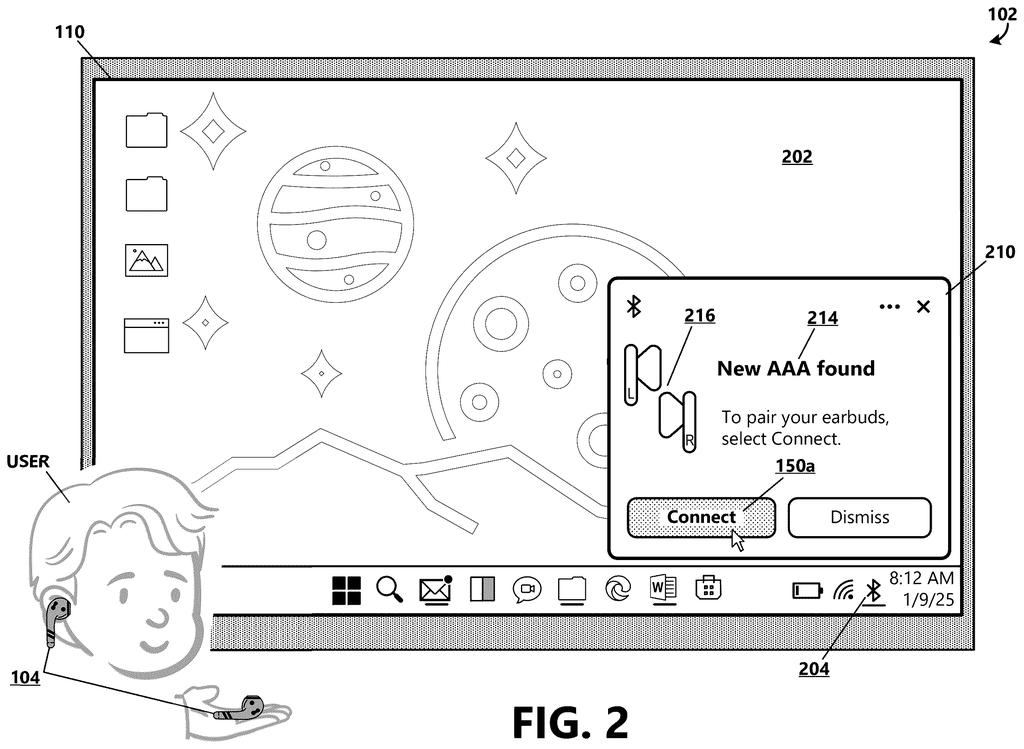
Once it knows that, Windows shows you a single "connect all" button. One tap pairs every piece of the set. You never have to hunt through a list of cryptic device names or wonder why your left earbud connected but the right one didn't.
Selection of the multi-member connect option provides consent from the user to connect to all or a subset of the set members via a single user interaction.
Translation: Tapping once lets you connect multiple related devices at the same time.
How the pairing service detects and groups related devices
The patent describes a pairing service that runs on a Windows host device before the standard Bluetooth or wireless pairing flow begins. When the host discovers a nearby peripheral, the pairing service intercepts the process and queries for product-specific metadata, essentially a detailed profile of the device that goes well beyond the generic name a radio chip broadcasts.
That metadata includes whether the device belongs to a coordinated set, which is the patent's term for a group of accessories designed to work together (think earbuds plus a charging case, or a keyboard plus a dedicated wireless receiver). The service checks two sources:
- A local catalog already stored on the device, built from past pairings or pre-loaded profiles
- A cloud catalog that can be populated by other Windows hosts or directly by the accessory's manufacturer (the OEM)
If the device is flagged as part of a coordinated set, the UI changes. Instead of a plain "connect" button, the user sees a multi-member connect option that covers all members of the set, or a configurable subset. One user interaction grants consent to pair all of them simultaneously.
The claim is purely software-level. No new hardware protocol is required. The pairing service sits on top of whatever wireless stack is already present (Bluetooth, USB RF, or otherwise) and manages the sequencing behind the scenes.
What this means for Windows Bluetooth setup
For everyday users, the clearest win is in setup time. Wireless accessory kits have multiplied in the past few years, and the pairing experience on Windows has not kept pace. Having to pair a headset, then its dongle, then discover that the case is also a device, is a routine annoyance that makes accessories feel cheaper than they are. A one-tap grouped pairing flow makes the whole category feel more polished.
From a platform strategy angle, this filing is also about Microsoft pulling manufacturer data into Windows setup flows, which is a quiet but meaningful move toward the kind of tight hardware-software integration that has long been a selling point for competitor ecosystems. Peripheral makers who share their device profiles with Microsoft's catalog get a better out-of-box experience on Windows, which gives Microsoft leverage to deepen those OEM relationships. The pairing and device-management corner of Windows is one of the more active areas in new Big Tech patents right now, and this filing fits a clear pattern of platform owners trying to own more of the accessory setup story.
Microsoft's 324th filing we've tracked since May joins our Microsoft coverage alongside AI that learns by watching and in-browser AI models.
Because this is software only, it could reach users through a simple system update, no new hardware required. That makes it faster to launch than most features of this type.
The real hurdle is not technical. It works well only if accessory makers have already grouped and listed their products inside the system, and getting them to do that is a business problem, not an engineering one.
Whether this feature feels useful on day one depends almost entirely on how many accessory companies sign up before it goes live.
There are more where this came from
We read every patent application Big Tech publishes and send you the ones worth knowing. Plain English, free, every week.
The drawings
8 drawing sheets from US 2026/0244580 A1 · click any drawing to enlarge


Want this weekly breakdown for a company we don't cover? Patentlyze Pro →
Be the first to weigh in