
Samsung Files Patent to Let Your Phone Teach Your Robot Vacuum
Your robot vacuum's AI is too small to learn your home, so Samsung's patent application has your phone do the homework and send back the lesson.
What Samsung's phone-teaches-vacuum idea does
A robot vacuum rolls past a water bottle on your living room floor and has no idea what it is. The AI inside was trained on photos of other people's homes, and it is too small and too weak to learn from yours.
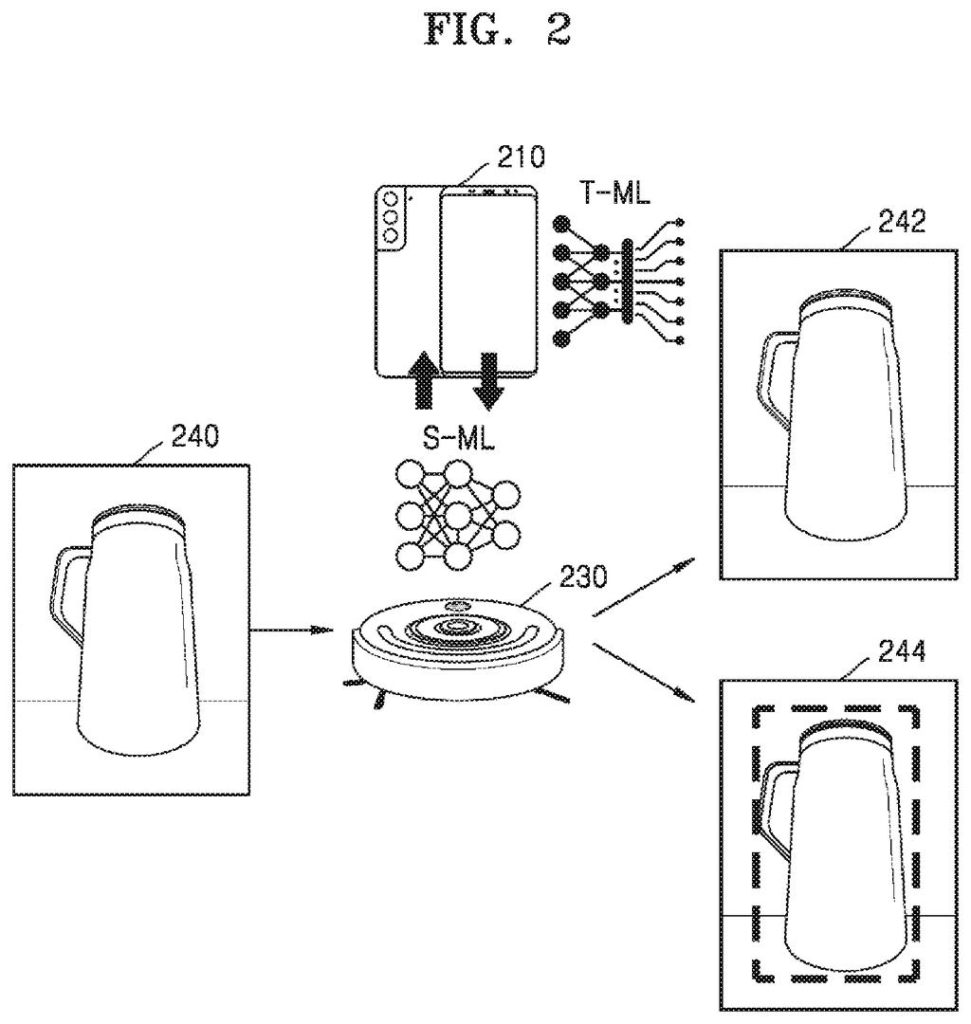
Samsung's patent application offers a workaround: let your phone do the studying. When the vacuum isn't confident about something it sees, it sends the picture to your phone. The phone, which has far more computing power, makes its best guess at the right answer and adjusts a small part of a copy of the vacuum's AI. Then it sends only those adjustments back, and the vacuum swaps them in.
Because both devices belong to you, your photos stay inside your home instead of traveling to a company server. The phone can also wait to do the work until you aren't using it, such as while you sleep.
receiving, from the student user device of the pair of user devices, at least one captured data item and a request for a student machine learning, ML, model to be updated …
Translation: The phone gets data and an update request from the smart appliance.
How the phone retrains only a few settings
The filing describes a pair of devices. The student is a small gadget with a sensor, like a robot vacuum with a camera, running a compact AI model for a job such as spotting objects. The teacher is a stronger device, such as a smartphone. When the student's confidence in a result falls below a set threshold, it sends the captured image and an update request to the teacher.
The teacher keeps a copy of the student's model and updates it in a few steps:
- If the image has no label, a larger teacher model produces a pseudo-label (a best-guess answer).
- The copy of the student model makes its own prediction for the same image.
- The teacher nudges the copy until its answers match the pseudo-label. This is called knowledge distillation (passing know-how from a big model to a small one).
- Only the changed settings are sent back to the student.
The clever part is what gets changed. Most of the student's internal settings (called parameters) stay frozen and quantized, meaning shrunk into low-precision numbers so they fit on a small chip. A few adjustable settings are built as placeholders, with their values fed in as inputs. That lets the student swap in new values without re-shrinking the model or recompiling it for its AI chip. The adjustable parts can be PEFT modules (small add-on pieces designed for cheap fine-tuning), and the teacher can train several and pick the best one.
The filing reports tests on an object-detection image dataset. Results mostly came close to updating the whole model and beat a model with no personalization.
… transmitting the updated subset of parameters to the student device for updating the student ML model.
Translation: The phone sends the newly learned settings back to the appliance.
What this means for your smart home gadgets
The practical payoff is a cheap gadget that gets better at your home without you labeling a single photo or sending pictures of your living room to a server. The filing's main example is a smartphone teaching a robot vacuum, but it also lists a tablet helping a phone and a smart TV advising a wearable.
The design also fits a real hardware limit. Small devices run shrunken AI that is hard to retrain, and this method sidesteps that by changing only a few placeholder settings. For anyone with several connected devices at home, it points to a future where the strongest one acts as a tutor for the rest.
Samsung's 51st filing we've tracked in our home robot patents since May builds on ideas like AI-filled vacuum maps and robots watching each other.
If this works, you'd notice it in small ways. Your vacuum stops treating a cup or a pet as a mystery object, and nothing asks you to tag photos. Few people would ever agree to label pictures for a vacuum, so an approach that needs no labels fits real habits.
The cost lands on your phone. Training an AI model eats battery and processing power, which is why the plan to run it while you sleep matters. It also assumes you own a phone strong enough and a vacuum that can talk to it.
For buyers of budget smart gadgets, the appeal is a device that adapts to your home instead of staying frozen at factory settings. A patent application is only an idea on paper, but this one is easy to picture and sensible.
Get our take in your Top Stories
Liked this breakdown? Add Patentlyze as a preferred source on Google, and our plain-English take shows up more often in your Top Stories the next time Samsung patent news breaks.
There are more where this came from
We read every patent application Big Tech publishes and send you the ones worth knowing. Plain English, free, every week.
The drawings
12 drawing sheets from US 2026/0320497 A1 · click any drawing to enlarge


Show the other 4 sheets


Want this weekly breakdown for a company we don't cover? Patentlyze Pro →
Be the first to weigh in