
Google Patents a Two-Model System That Teaches Robots to Reuse Past Experience
Training an AI agent from scratch for every new task is slow and expensive. Google's latest patent describes a way to let agents carry reusable building-block behaviors from old experience into new situations, cutting down how much fresh trial-and-error they need.
How Google's AI recycles past experience for new tasks
Every time a trained AI agent faces a new problem, it typically has to relearn everything from the ground up, like a surgeon who forgets how to hold a scalpel between operations. That's wasteful, and it's one of the real costs holding back AI systems that need to act in the physical world.
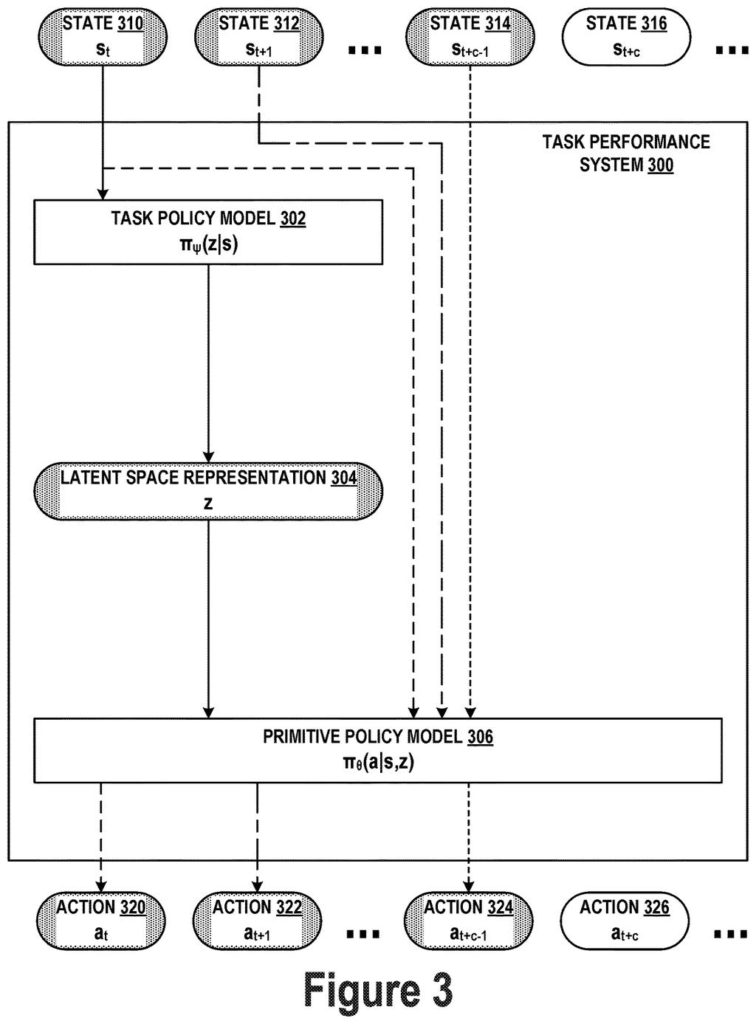
Google's patent describes a system that separates two jobs: one model focuses on understanding the current situation and translating it into a compact internal description, while a second model uses that description to pick a concrete action. The key insight is that the second model, the one choosing actions, was trained on undirected experience, meaning recordings of behavior that weren't collected for any particular goal. It learns general movement patterns, or "primitives," from that data.
When a new task arrives, the system doesn't start from zero. It pulls from those stored primitives and adapts them. Think of it like a chef who knows basic knife techniques and can apply them whether the recipe calls for onions or carrots, rather than learning to chop from scratch each time.
… determining, by a task policy model, a latent space representation of the first state, wherein the task policy model has been trained to define, for each respective state of a plurality of possible states associated with the particular task, a corresponding latent space representation of the respective state; …
Translation: The first model figures out what the current situation means based on past training.
How the encoder and prior model split the training work
The system trains two separate models and combines them at inference time (when the agent is actually doing a task).
The first is a task policy model. Given the current state of the world, this model produces a latent space representation (a compressed mathematical summary of the situation, much like a ZIP file for context). It's trained on the specific task at hand.
The second is a primitive policy model. This model was trained earlier, offline, on an undirected experience dataset: recordings of an agent moving through states without any particular goal in mind. From that data, it learns a broad library of reusable behavioral building blocks. At runtime, it takes both the raw current state and the latent summary from the first model, then decides what action to take.
The training process for the primitive model involves two sub-components:
- An encoder model that looks at recorded sub-trajectories (short clips of past behavior) and estimates a probability distribution over what latent code best explains each clip.
- A prior model that predicts, from just the starting state of a clip, what that latent distribution should look like.
Training pushes the encoder and the prior to agree. That agreement is what lets the system generalize: at test time, you only have a starting state, not the full clip, so the prior has to carry the load alone.
… determining, by a primitive policy model and based on the first state and the latent space representation of the first state, an action to take as part of the particular task.
Translation: The second model uses that understanding to decide what physical move the robot should make next.
What faster AI training means for real-world robotics and agents
Reinforcement learning, where an AI learns by trial and error, is powerful but notoriously data-hungry. Getting an AI to learn a new task well often requires millions of attempts. That's manageable in a video game but expensive and sometimes dangerous in the real world, where a robot arm that tries a million random motions is a liability.
If this approach works as described, it could let AI systems pick up new tasks with far fewer attempts by recycling behaviors from prior experience. That's directly relevant to Google's interest in robotic and embodied AI research, where data efficiency is one of the hardest open problems. For your average user, the downstream effect would be AI assistants and robots that get useful faster, with less training time baked into the product cost.
Google files its third patent in our robot grasping and movement watchlist since August, building on open-ended object commands and a self-watching robot arm.
Teaching an AI agent to do useful work in the real world is staggeringly expensive. Every skill it learns requires vast amounts of carefully labeled examples, and when the task changes, most of that investment evaporates.
Google's approach splits the learning into two stages: one part reads the situation, and a separately trained part decides what to do, having already practiced on cheap, unlabeled data that required no human supervision. That division directly targets where the cost actually lives.
The honest question is whether practice on aimless, unprompted data will hold up against the messiness of real tasks. But the design at least fits the true shape of the problem, which matters more than it might sound.
There are more where this came from
We read every patent application Big Tech publishes and send you the ones worth knowing. Plain English, free, every week.
The drawings
11 drawing sheets from US 2026/0289242 A1 · click any drawing to enlarge


Want this weekly breakdown for a company we don't cover? Patentlyze Pro →
Be the first to weigh in