
Samsung
Samsung · Robotics · Filed Jun 4, 2026 · USPTO published Oct 1, 2026 · Oct 1 release
Samsung Patents a System That Lets Robots Keep an Eye on Each Other
When one robot in a team starts doing something risky, who notices? Samsung's latest patent puts that job on the robots themselves, turning them into mutual safety monitors.
- Publication number
- US 2026/0295839 A1(US20260295839A1)
- Applicant
- SAMSUNG ELECTRONICS CO., LTD.
- Filed · Published
- Jun 4, 2026 · Oct 1, 2026
- Inventors
- Sangyoung HWANG, Woomok KIM, Boseok MOON
- Status when we published
- Waiting for an examiner
- Document
- 20 claims
- US classification
- 700/248
- Parent application
- Continuation of 18/744,132 (filed Jun 14, 2024)(18744132)
What Samsung's robot-watching-robot system actually does
Every time a warehouse robot lifts a heavy pallet or a factory arm welds near a conveyor belt, something could go wrong. Right now, most safety checks rely on fixed cameras or human supervisors watching a screen. Samsung is filing a patent for a different approach: let the other robots watch.
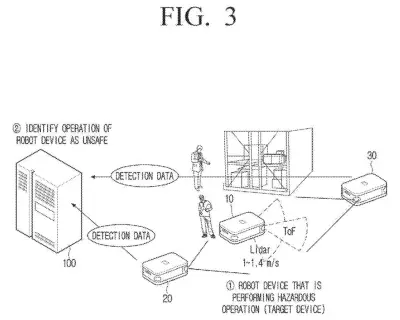
The idea is that a central system, something like a traffic controller for robots, picks one robot as the machine to watch and assigns another robot nearby as the watcher. The watcher sends back live data about what the first robot is doing. If the central system decides the action looks unsafe, it fires off a corrective command immediately.
You end up with a team of robots that don't just do their own jobs but actively provide safety coverage for each other. The central device is the brain, but the robots are the eyes.
… identify at least one first robot device as a target device and at least one second robot device as a monitoring device based on the operation information, control, through the communication interface, the target device to monitor the at least one second robot device …
Translation: The system assigns one robot to watch another robot based on their status updates.
How the central device assigns watchers and reads their data
The patent describes an electronic device (a central controller) that manages a fleet of robot devices. It continuously receives operation information from every robot, things like position, status, and what task each machine is currently performing.
Based on that information, the controller designates roles:
- A target device: the robot whose current operation needs safety oversight
- A monitoring device: one or more other robots assigned to watch the target and stream back what they see
The controller then reads the monitoring data coming from the watcher robot and runs a safety assessment. If the target robot's action is flagged as unsafe, the controller sends a corrective command directly to that robot to adjust or stop its behavior.
A subtle flip in claim 1 is worth noting: the language actually has the target device monitoring the second robot, which appears to be a drafting inversion from the abstract. Either way, the core architecture is the same: one robot watches another, and a central system decides what to do with what it sees.
… identify whether an operation of the target device according to the operation is safe based on the monitoring data, and transmit a command for controlling the target device to the target device based on a result of the identification …
Translation: It checks if the watched robot is acting safely and sends it new instructions depending on what is found.
What this means for warehouses and multi-robot work floors
Multi-robot systems are already common in warehouses, factories, and logistics centers, and the hard part has always been safety: a robot operating correctly in isolation can still cause harm when another machine moves into its path. Fixed cameras miss angles; human monitors miss moments. A system where robots provide mutual real-time surveillance addresses both gaps directly.
If granted as written, claim 1 is fairly broad. It covers any central controller that assigns watcher and target roles to robots and acts on the resulting data, regardless of what sensors the robots use or what industry they work in. That breadth could give Samsung a meaningful position across a wide range of commercial robot deployments, from Samsung's bet on robotics and autonomous systems to third-party hardware built around its software stack.
Samsung's 49th filing in home robot patents we've tracked since May builds on ideas like the robot that reads social cues and the auto mop-swap dock.
Source: US 2026/0295839 A1 at the USPTO (PDF). Full patent text and figures are in the official publication.
Get our take in your Top Stories
Liked this breakdown? Add Patentlyze as a preferred source on Google, and our plain-English take shows up more often in your Top Stories the next time Samsung patent news breaks.
Add Patentlyze on Google
One click.
There are more where this came from
We read the new patents from Big Tech, carmakers and more and send you the ones worth knowing. Plain English, free, every week.
The drawings · 10 sheets
10 drawing sheets from US 2026/0295839 A1 · click any drawing to enlarge


Show the other 2 sheets


More from Samsung
All 1,662 Samsung patents →
More in Camera
All 279 Camera patents →
Sony
Sony Patents a Visual Map That Shows a Robot Every Angle It Can Photograph From
Sony
Sony Patents a Robot That Uses Touch and Distance Sensing Together to Understand Objects
Sony
Sony Files Patent for a Third-Sensor Method That Aligns Mixed Camera and Scanner Arrays
Sony
No comments yet