
Samsung Files Patent for a Camera Fix That Saves Battery Without Adding Photo Noise
The tiny motors that move your phone's camera lens can save battery by running on rapid pulses of power, but those pulses can add noise to your photos. Samsung's patent application is a rule for deciding which motors get the pulses and which don't.
What Samsung's camera patent does for battery
Ever wondered what keeps your phone's camera sharp while your hand shakes? Tiny magnets and coils nudge the lens around, and they draw battery power every time they do.
Samsung's filing describes two ways to power those coils. One is smooth and clean but uses more electricity. The other sends power in rapid pulses and uses less, but the magnetic field it creates can reach the light sensor sitting nearby and add noise to the image.
The patent's answer is a quick check for each coil: how much electricity flows through it, and how far it sits from the sensor. If the coil is far enough away and the current is low enough, it gets the pulsed, battery-saving method. If it's too close, it stays on the smooth one.
based on a first value related to noise of the image sensor based on a first maximum current value flowing in the first coil and a first distance between the first coil and the image sensor being greater than a specified value, applying a driving voltage to the first driving circuitry according to a linear driving scheme …
Translation: If interference risks are high, it uses a smooth continuous power method to keep pictures clean.
How Samsung decides which lens motors get pulses
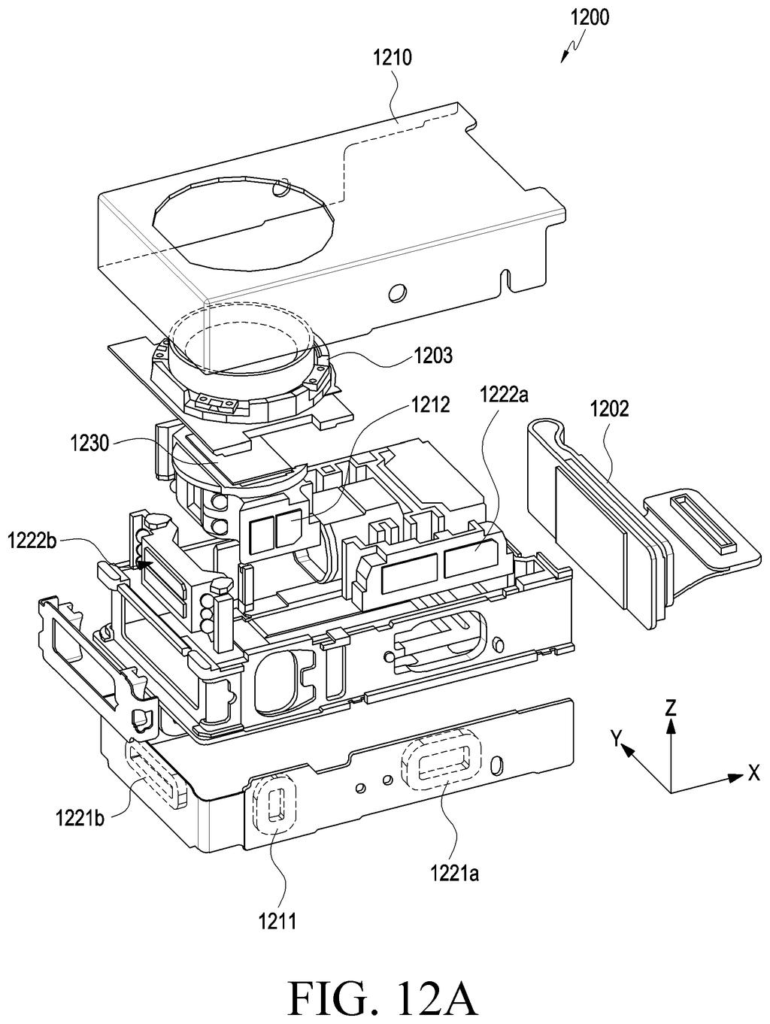
Inside a phone camera, the lens is moved by a coil and magnet pair. Send electricity through the coil and the magnet shifts, which slides the lens to focus (autofocus), cancel out a shaky hand (optical image stabilization), or change the zoom.
The patent describes two ways to feed those coils. In the linear method, the voltage is raised or lowered smoothly. That leaves the image sensor alone but draws more current. In the PWM method (pulse width modulation, where power is switched on and off very fast and the on-time is adjusted), less power is used, yet the magnetic field can add noise to the sensor.
To choose, the camera works out one value per coil:
- Find the coil's maximum current: the voltage divided by the coil's resistance, multiplied by its number of turns.
- Divide that by the square of the distance from the coil's center to the image sensor.
- If the result is above a set limit (the filing gives about 500 mA/mm², and also mentions 441 as an example), use linear. If not, use PWM.
Each coil gets its own answer, so a folded camera (one that bends light with a prism) could run one coil on pulses and another on smooth power. Designers can set the choice ahead of time and store it in memory.
… applying the driving voltage to the first driving circuit according to a PWM method based on the first value not being greater than the specified value.
Translation: When interference is not a concern, it switches to a pulsing power method to save battery life.
What this means for Samsung's phone cameras
For you, the payoff is a camera that spends less battery moving its lens without giving up clean photos. Phone cameras can now combine autofocus, shake correction and zoom, each with its own coils sitting near the sensor, so the choice of how to power each one adds up.
The filing is a design tool as much as a feature. The description says engineers can lock in each coil's power method during product design, based on where the parts sit. That could let a phone maker move coils around inside a camera and still know which ones can safely use the battery-saving method. The filing doesn't say how much power would be saved.
Samsung's 154th filing we've tracked since May in our camera sensor push builds on one model for all sensors and AI that adds the photographer.
Claim 1 is short and wide. It covers any camera with a lens-moving coil and magnet that picks between smooth power and pulsed power based on one number, built from the electricity flowing through the coil and its distance from the sensor. The claim names no limit for that number, so the 500 figure only shows up later, in claim 4.
That makes claim 1 a decision rule rather than a piece of hardware. If granted, it would cover this exact test, and a design that chooses its power method on some other basis would sit outside the wording.
Claims 11 and 17 add two variations: a module that runs every coil on pulsed power, and one that mixes both methods across different coils. Expect a modest payoff. A rule like this adds up to a slightly longer-lasting battery, and nobody will notice the logic behind it.
Get our take in your Top Stories
Liked this breakdown? Add Patentlyze as a preferred source on Google, and our plain-English take shows up more often in your Top Stories the next time Samsung patent news breaks.
There are more where this came from
We read every patent application Big Tech publishes and send you the ones worth knowing. Plain English, free, every week.
The drawings
17 drawing sheets from US 2026/0319338 A1 · click any drawing to enlarge


Show the other 9 sheets


Want this weekly breakdown for a company we don't cover? Patentlyze Pro →
Be the first to weigh in