
Apple Files Patent to Stop Headset Video From Stuttering Under Office Lights
Your ceiling lights blink 100 or 120 times a second, and a headset's cameras can fall out of step with them, making the live video stutter. Apple's patent adds a light sensor so the headset can get back in step.
What Apple's headset does about flickering lights
A person wearing a headset turns their head in an ordinary office. The ceiling lights look steady, but they are blinking about 100 or 120 times a second, too fast for your eye to notice.
A headset that shows you the real world through cameras has a problem here. If its cameras take pictures at a rate close to the lights' blinking, the video you see can stutter, show double images, or smear. Apple's filing says this can make you feel motion sick.
The fix in the filing is a small light sensor that measures how fast, and when, the room lights flicker. The headset then adjusts how often its cameras shoot, and exactly when each shot starts, so the two stay in step. It also scores how bad the stutter is and only changes settings when the problem would be noticeable.
a sensor data processing circuit that processes sensor data on light in a scene to detect a frequency of the light; a control circuit that controls a frame rate of an image sensor in the electronic device based on the detected frequency of the light …
Translation: The headset measures the flicker rate of overhead lights and adjusts its camera frame rate to match.
How the headset syncs its cameras to room lights
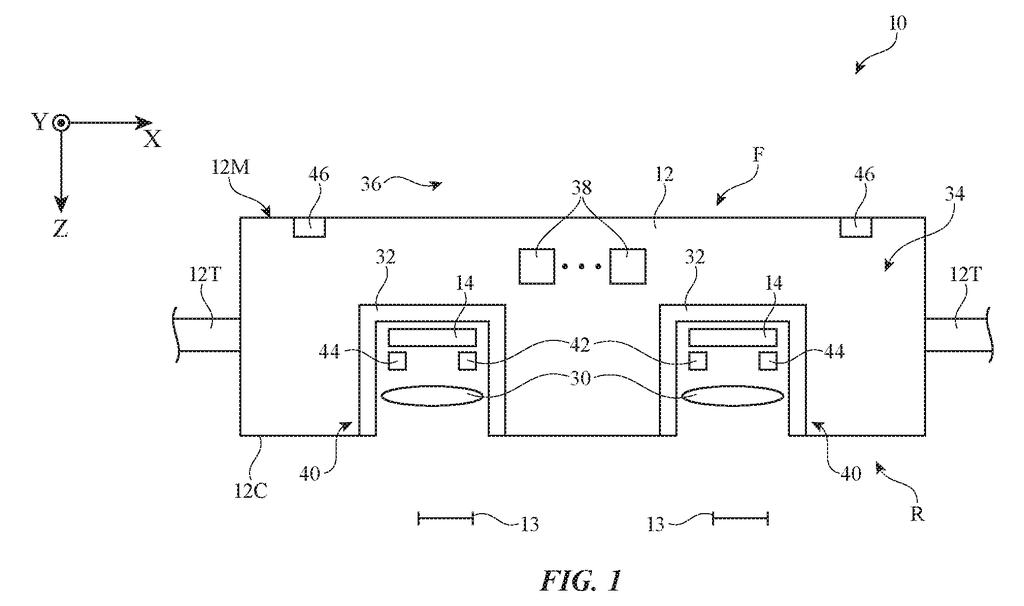
The headset's front cameras capture live video of your surroundings (called passthrough) and show it on the displays in front of your eyes. A dedicated flicker sensor watches the room's light, and a processor works out its frequency (how many times per second it pulses) and its phase (where in that cycle the light is right now).
A judder monitor then computes a severity score from those readings, the camera frame rate and the exposure length, and optionally from motion tracked in the images. If the score stays over a threshold for a set time, the headset switches modes. It can move the camera and display frame rate from a default of about 90 or 96 Hz up to 100 Hz or down to 70 or 75 Hz, or lock it to an even fraction of the lamp's flicker. A 200 Hz lamp, for example, gets 100 frames per second.
The filing describes several other tools:
- Phase locking: shift each exposure so the middle of a light pulse lands in the middle of the exposure.
- Shorter exposures during head movement: cut motion blur by keeping exposures shorter than one flicker cycle.
- Peak and edge alignment: when the frame rate cannot change, time exposures to the peaks or edges of the light wave (this needs global shutter cameras, which capture a whole frame at once).
- Mixed lighting: handle extra lamps by setting exposure to a whole multiple of their flicker period, such as 8 milliseconds for a 250 Hz lamp.
The headset holds off changing frame rates during a game or video call, and also weighs temperature, power use and battery level.
A method of operating an electronic device such as a head-mounted device to mitigate judder, double images, ghosting, and other display artifacts is provided.
Translation: The patent describes a way to stop visual stutters and motion ghosts on headset screens.
Why flicker fixes matter for headset comfort
If you wear a headset that shows you your room through cameras, the lights around you can decide whether the view feels comfortable. Apple's filing links this kind of stutter and doubling to motion sickness, so fixing it is about how long you can keep the device on, not just picture polish. Indoor lighting varies by country (the filing mentions 120 Hz in the US and 100 Hz in Europe), so a device that measures the flicker instead of assuming a value covers more rooms.
The patent names no product. It describes a head-mounted device with front cameras and passthrough video, the same setup as a headset like Apple Vision Pro. For you, success would mean never noticing any of this: no jitter when you turn your head, no ghostly second copy of a lamp, and no reason to stop and take the headset off.
Apple's 96th filing we've tracked in our AR glasses watch since May adds to a picture that includes a headset reading your mood and moving a caller's avatar.
Every fix in this filing costs something. Shorter camera exposures cut motion blur, but they let in less light and can bring back dark bands across the picture, so the filing adds extra correction to hide them. Locking the cameras to a lamp also means the headset may run at a frame rate it would not have picked on its own.
The biggest give-up is the rule that frame rates should not change during a game or a video call. That spares you a visible shift mid-session, but it also means the moments when you are most absorbed are the ones where flicker problems may go uncorrected. Add a dedicated sensor, extra processing, and attention to battery and heat, and the cost list gets long.
Still, the trade reads as worth it. Nausea is a dealbreaker for something strapped to your face, and a cheap light sensor plus some timing logic is a small price for a calmer image.
Get our take in your Top Stories
Liked this breakdown? Add Patentlyze as a preferred source on Google, and our plain-English take shows up more often in your Top Stories the next time Apple patent news breaks.
There are more where this came from
We read every patent application Big Tech publishes and send you the ones worth knowing. Plain English, free, every week.
The drawings
15 drawing sheets from US 2026/0332902 A1 · click any drawing to enlarge


Show the other 7 sheets


Want this weekly breakdown for a company we don't cover? Patentlyze Pro →
Be the first to weigh in