
Qualcomm Files Patent to Keep Meeting-Room Laptops From Talking Over Each Other
Qualcomm's filing has the laptops and phones in a meeting room compare notes on who hears the speaker best, then lets only that one device send audio. Everyone else turns their microphone down automatically.
What Qualcomm's meeting-room mic picker does
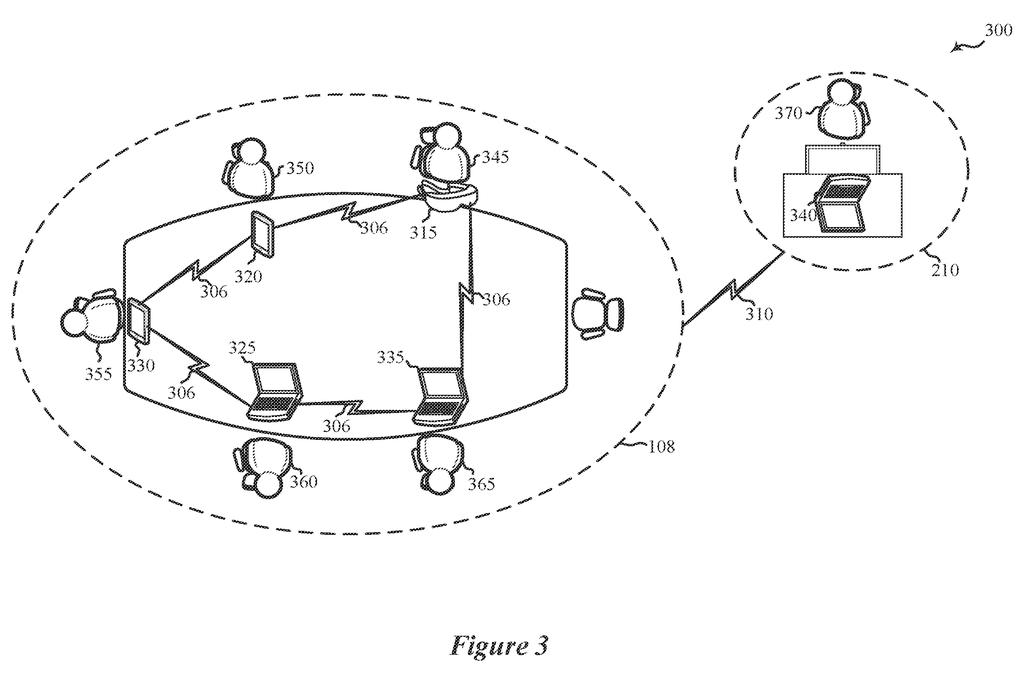
Six people sit around a conference table, and each has a laptop or tablet open with its microphone live. When one person talks, every device in the room picks up the voice, and the people on the other end of the call hear overlapping audio and cross-talk.
You have probably heard this on a hybrid call, or been the one frantically hitting mute. Qualcomm's filing describes a different fix: the devices take turns. Each one reports how loudly it hears the speaker and how confident it is that it recognizes the voice. The device with the best pickup gets to send audio, and the rest turn their microphones down.
Nobody has to touch a mute button. Devices only take part if they share the same meeting code and belong to the same trusted group, so outside devices stay out of the mix.
… receive microphone-related information from the other devices having the communication session identifier in the trusted environment; and grant an audio channel access to a device of the other devices based on the microphone-related information.
Translation: It collects audio data from nearby computers and decides which one is allowed to speak.
How the devices rank each other's microphones
The filing covers devices in a trusted environment (a group of registered, authenticated devices that talk over encrypted links). Devices in one meeting share a session identifier, a unique code marking them as part of the same call. Each then sends microphone-related information to the others: how loudly its microphone hears a voice (amplitude), and a voice recognition percentage, a confidence score for how well the voice matches a known speaker.
One device keeps a ranked table of these readings, called a microphone-amplitude array, and grants audio channel access to one device, such as the one with the highest amplitude and recognition score. A second independent claim has a device adjust its own microphone sensitivity (how much sound it picks up) based on what the others report, then coordinate access among them.
- Microphones below a set threshold get their sensitivity turned down to cut background noise.
- A delay timer stops the system from switching microphones every time the volume wobbles.
- When someone stops talking, sensitivity fades gradually instead of cutting off.
- Noise filtering such as beamforming (focusing on sound from one direction) can clean up the chosen audio.
It can run in a centralized setup, where a hub or cloud server decides, or a decentralized one, where each device keeps its own copy of the table and decides for itself.
… managing microphone access among participating devices in a communication session by analyzing microphone amplitude levels and speaker recognition confidence scores to determine optimal audio transmission.
Translation: The system prevents echo and overlapping voices by analyzing volume levels and speaker confidence to pick the best microphone.
Why hybrid meetings could sound cleaner
If it works as described, your next hybrid meeting could sound cleaner without anyone fiddling with mute. In a conference room full of open laptops, the system would pick the microphone closest to whoever is talking and quiet the rest. The filing is written around Wi-Fi, Bluetooth and cellular devices, so it covers phones, laptops, tablets and room hubs. The speaker-recognition part also means devices compare voices against stored voice profiles, a detail some offices will want to read closely.
Remember that this is a patent application, not a product. The examiner's first review rejected the claims as filed, which is routine at this stage and usually followed by amendments. The filing names no product, so what it becomes, if anything, is open.
Qualcomm's 533rd filing in our Qualcomm coverage since May continues the AI-over-wireless thread seen in the noisy-signal accuracy patent and the garbled-data detection filing.
Hybrid meetings have a real, daily annoyance. When several devices in one room are live, remote listeners get overlapping voices, cross-talk and keyboard clatter. Most people fix it by muting by hand, which depends on someone remembering, and people forget.
Picking one microphone at a time is a proportionate answer to a problem of that size. The filing's details show the authors thought about how a meeting actually sounds: a delay timer stops the mic from flipping back and forth, and a gradual fade replaces an abrupt cutoff.
The catch is that every laptop and phone has to run the same software and share the same meeting code. That limits the idea to rooms where someone controls the setup, which still covers a lot of offices.
Get our take in your Top Stories
Liked this breakdown? Add Patentlyze as a preferred source on Google, and our plain-English take shows up more often in your Top Stories the next time Qualcomm patent news breaks.
There are more where this came from
We read every patent application Big Tech publishes and send you the ones worth knowing. Plain English, free, every week.
The drawings
12 drawing sheets from US 2026/0331117 A1 · click any drawing to enlarge


Show the other 4 sheets


Want this weekly breakdown for a company we don't cover? Patentlyze Pro →
Be the first to weigh in