
Qualcomm Files Patent for Training Cell Networks to Predict When Radar-Style Sensing Works
Cell networks can double as radar, but echoes off buildings and trees muddy the picture. Qualcomm's filing covers how a tower and your phone swap test signals to train an AI that predicts when an echo-cleaning trick will work.
What Qualcomm's radar-style sensing patent does
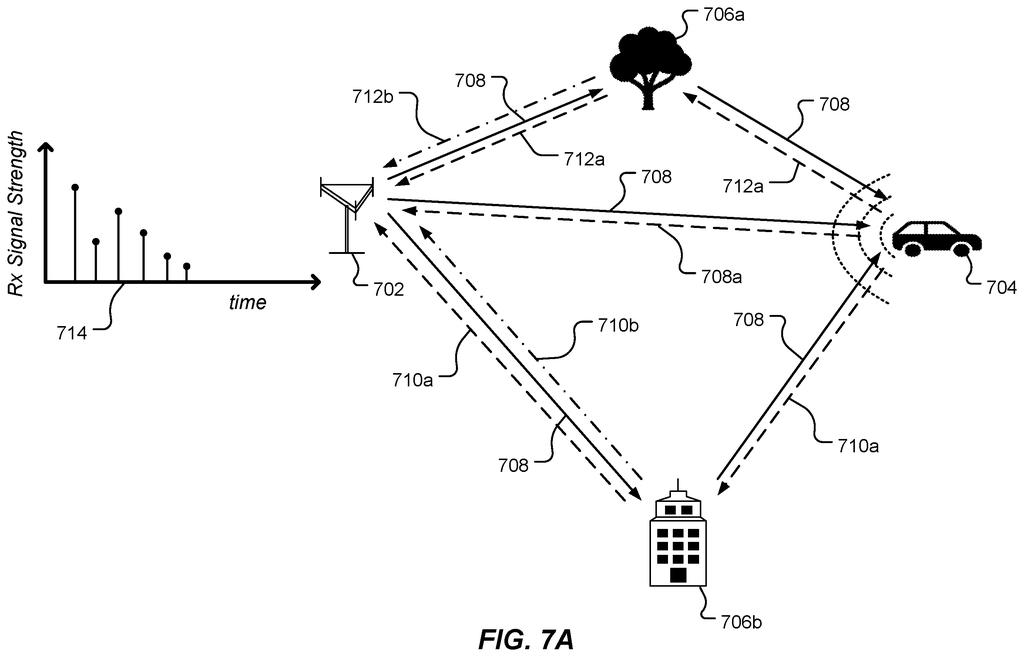
Imagine you're standing on a city street while a cell tower tries to spot a passing car by bouncing radio signals off it. The signal also ricochets off buildings and trees, so the tower hears a muddy jumble of echoes instead of one clean reply.
Qualcomm's patent application builds on a fix called time reversal, where a signal is pre-shaped using what the network has learned about those echoes, so they tighten up instead of smearing out. The catch is that the trick only helps when the radio path from tower to phone behaves like the path from phone to tower.
So the filing describes training an AI to predict when that is true. The tower sends a test signal, your phone measures how it arrived and reports back, then your phone sends one of its own and the tower measures that. Both readings go to a server that uses them as training examples.
transmitting a first radio frequency sensing signal; receiving a first channel metric based on the first radio frequency sensing signal; receiving a second radio frequency sensing signal; determining a second channel metric based on the second radio frequency sensing signal …
Translation: The system sends out radar signals and measures how the wireless channel responds to them.
How the phone and tower swap test signals
The claims cover a training routine for a channel reciprocity prediction model. That is a machine learning model (software that learns patterns from examples) that guesses whether the radio path between two devices behaves the same in both directions. It matters because time reversal precoding (shaping an outgoing signal using a flipped copy of the channel's echo pattern) depends on that.
In the description's main example, the steps look like this:
- A base station sends a first sensing signal, such as a standard 5G reference signal (a known pilot pattern used to measure a connection).
- The phone measures it and reports a first channel metric, for example a channel impulse response (a record of how the signal arrived, including the timing and strength of each echo).
- The phone sends back its own signal, and the base station determines a second channel metric from it.
- Both metrics go to a network entity, such as a sensing server.
The metrics can also include signal to noise ratio (how loud the signal is against background hiss) and Doppler observations (frequency shifts caused by movement). Non-radio details such as a time stamp, the weather, or sensor data can be added too.
One dependent claim has the network send back an indication of time reversal precoding, in effect a signal to turn the trick on or off. The description also mentions switching it on by zone and sending the trained model to devices.
Techniques are provided for training a channel reciprocity prediction model for radio frequency (RF) sensing operations in a communication system.
Translation: Methods are outlined to help wireless networks figure out when radar style sensing will actually work well.
What this means for 5G radar-style sensing
If cell networks are going to double as radar, the sensing has to work in messy places like city streets and living rooms. The filing lists uses such as tracking heartbeat and breathing, recognizing gestures, and collision avoidance for cars, all of which need clean readings from signals that bounce everywhere. A model that predicts when the echo-cleaning trick will succeed lets the network decide in advance.
There is a battery angle too. The description says that when the model predicts the two directions behave differently, devices can skip the trick, which saves processing and battery power on your phone. Phones without the right hardware can opt out as well. Nothing in the filing says when, or whether, any of this reaches a product.
Qualcomm's 521st filing in our Qualcomm coverage since May adds to a run that includes a backup AI plan and faster photo sending.
Echoes are a real headache for anyone trying to use cell signals as radar. In cities and indoor spaces, signals bounce off everything, and the filing itself says that can create ghost targets, objects that show up on the radar but aren't there. A network that guesses wrong about when its echo-cleaning trick works wastes processing for little gain.
The approach is modest next to a problem that size. The claims cover only the data-gathering step: swap two signals, record two readings, send both to a server. That is groundwork for a prediction model, and the model's actual predictions live in other parts of the filing.
Whether it matters depends on whether carriers ever offer sensing as an everyday service, and the document doesn't say how close that is. As a claim, it is routine plumbing aimed at a large problem.
Get our take in your Top Stories
Liked this breakdown? Add Patentlyze as a preferred source on Google, and our plain-English take shows up more often in your Top Stories the next time Qualcomm patent news breaks.
There are more where this came from
We read every patent application Big Tech publishes and send you the ones worth knowing. Plain English, free, every week.
The drawings
21 drawing sheets from US 2026/0322657 A1 · click any drawing to enlarge


Show the other 13 sheets


Want this weekly breakdown for a company we don't cover? Patentlyze Pro →
Be the first to weigh in