
Intel Files Patent to Keep Self-Driving Cars' Laser Sensors From Confusing Each Other
When every self-driving car fires lasers at the same road, how does any of them know which flash is its own? Intel's answer is to give each beam a coded name tag.
What Intel's laser name tags actually do
Ever tried to hold a conversation in a packed restaurant where everyone is talking at once? Self-driving cars face a version of that. Many of them measure distance by firing laser light at the world and timing the bounce, and on a busy road one car's laser pulses can look just like another's.
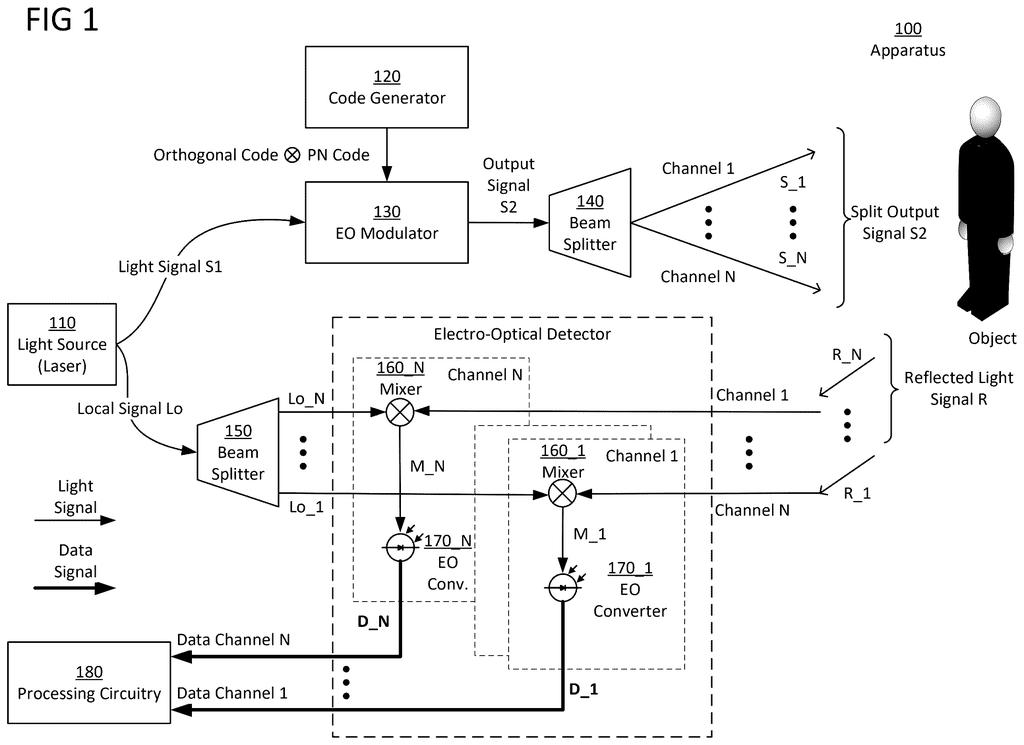
Intel's filing gives each laser its own coded signature. The outgoing light is stamped with two patterns: one that helps measure distance, and one that works like a name tag for that particular beam. When light comes back, the car's computer looks for its own name tag and ignores everything else.
The filing says the name tag can be picked at random and swapped out every so often, to avoid conflicts between cars. In Intel's simulated test, a stray signal from another source was filtered out and only the real reflections were left.
an electro-optical modulator configured to phase modulate a light signal with a range measurement code and a light beam isolation code; …
Translation: This hardware stamps the laser beam with a unique code so sensors can tell whose light is whose.
How the car finds its own signal in the noise
The system is a lidar (light detection and ranging) sensor, which measures distance by firing a laser and timing how long the light takes to bounce back. Intel adds a twist: before the light leaves, an electro-optical modulator (a part that nudges the timing of the light waves, known as phase modulation) stamps it with two codes.
- Range measurement code: a pseudorandom number sequence (a long pattern that looks random but is known in advance), used to work out the delay.
- Light beam isolation code: an orthogonal code such as a Walsh code (a set of patterns built so that each one matches itself clearly and matches the others not at all), used as the beam's name tag.
On the way back, the detector mixes the reflected light with a sample of the original laser light, which the filing says makes the signal bigger and extends detection range. The processor then correlates the result (slides a known pattern against the signal to look for a match), first with the isolation code, which removes interfering signals, and then with the range code. The position of the energy peak gives the time delay, and so the distance.
A beam splitter can divide the light into several channels, each with its own isolation code, to widen the vertical field of view, since a laser beam spreads out only a little. The codes can be assigned randomly and reassigned periodically. In the filing's simulation, with an 8191-long range code and two-bit isolation codes, the stray signal disappears and only the real reflections remain.
… processor means for correlating the electronic data signal with the light beam isolation code and the range measurement code to obtain a range to the object.
Translation: A computer chip matches the returned laser light against the code to safely calculate distances.
Why crowded roads make this problem worse
As more cars carry laser sensors, crowded roads become a place where one car's laser can be mistaken for another's. The filing's own background says that raises the risk of a wrong distance reading and, with it, more accidents. A coded signature gives each sensor a way to pick out only its own light, which could mean more reliable readings in dense traffic, whether you are a passenger or a pedestrian.
The filing also describes a longer detection range from mixing in the original laser light, and says the idea could apply to robots and drones, though cars are the main example. Intel does not name a product, so treat this as a design on paper for now.
Intel's ninth filing we've tracked since September in our self-driving sensing race watchlist follows one fixing map gaps and one that pulls cars over.
The code math is the easy part of this filing. Matching a known pattern against a messy signal is old signal-processing work that an ordinary chip can handle, and the only test described is a computer simulation with one real signal and one stray one.
The hard part is the hardware. The design needs a laser whose light waves stay in step, a fast modulator to stamp codes onto the light, and extra mixers for each beam. That adds up to a new sensor, so the road from this document to a car on the street is long.
The shortest route to a product is a sensor maker building this into a next-generation unit. Even then, the filing says codes are handed out at random and does not say what happens if two nearby sensors draw the same one. The goal is easy to grasp and the fix looks tidy on paper, but nothing here shows it has left the simulation stage.
Get our take in your Top Stories
Liked this breakdown? Add Patentlyze as a preferred source on Google, and our plain-English take shows up more often in your Top Stories the next time Intel patent news breaks.
There are more where this came from
We read every patent application Big Tech publishes and send you the ones worth knowing. Plain English, free, every week.
The drawings
3 drawing sheets from US 2026/0328941 A1 · click any drawing to enlarge


Want this weekly breakdown for a company we don't cover? Patentlyze Pro →
Be the first to weigh in