
Samsung Files Patent to Help Robots Find a Charger You Moved
Move your robot's charging pad, and a typical robot drives to the old spot and gets stuck. Samsung's patent has the robot slow down, spin in place, and hunt for the pad by its 3D shape.
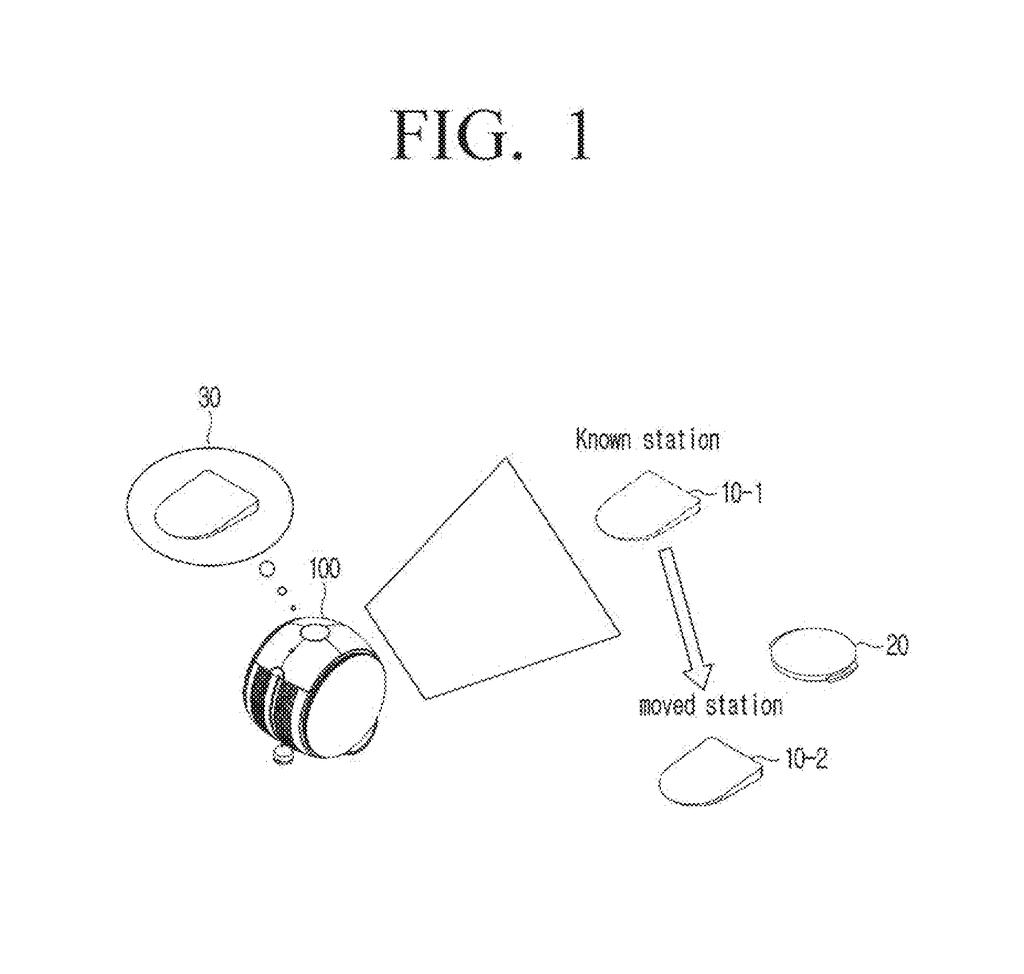
What Samsung's robot does when its charger moves
Every time a home robot's battery runs low, it drives back to the exact spot where it last charged. That works fine until the charger is a movable pad and you nudged it across the room to clear a walkway.
Samsung's new patent gives the robot a backup plan. It cruises at normal speed until it gets close to the old spot, then slows down and looks. If the pad isn't there, the robot spins in place, scans the room in 3D, and checks each object it sees against a stored model of its own charger.
Once it finds a match, it drives over, works out which way the pad is facing, and docks. The goal is a robot that finds its own charger on its own, even after you rearranged things.
… control the driver to move the electronic apparatus at a first speed in the second area while returning to the charging station, control the driver to move the electronic apparatus at a second speed lower than the first speed upon entering the first area …
Translation: The robot speeds along normally, but slows down when it gets close to where the dock is supposed to be.
How the robot recognizes a charger by its shape
The robot remembers where it first spotted its charging station. It draws a circle around that point (the filing gives 0.5 meters as an example) and treats everything outside the circle as the normal travel zone. Outside, it moves at its default speed. Once it crosses into the circle, it slows down so its sensor gets a good look.
If the charger isn't where it should be, the robot rotates and takes a series of 3D snapshots called point cloud images (clouds of dots, each with a position in space, usually from a depth camera). It can pick which way to spin first by checking which side has fewer obstacles, such as a wall.
Then the robot sorts through what it saw:
- It keeps only objects that appear completely inside a snapshot, so a chair leg that happens to look like part of a charger doesn't fool it.
- It cleans up the dots and finds each object's center and which way it points.
- It runs Iterative Closest Point matching (a method that slides and turns one 3D shape over another until they line up) against a stored model of the charger.
- If the match score clears a threshold, the object is the charger.
The same alignment step also shows how much the pad is rotated, which tells the robot which direction to approach for docking.
… obtain images corresponding to different search areas through the sensor while rotating the sensor, based a candidate object being identified in the images, identify the charger by comparing information about the candidate object with pre-stored reference information …
Translation: When the dock isn't in its usual spot, the robot spins its camera around to scan the room and match what it sees against memory.
Why movable charging pads change the robot's job
If you own or may someday own a robot vacuum or similar helper, the practical payoff is fewer stranded robots. A charging pad that can be picked up and moved is handy for you, but it breaks the old assumption that the charger stays put. Older robots relied on infrared signals, which the filing says struggle to track a charger that has changed location.
The filing describes a robot, a charging pad, and a depth camera, and says the approach finds a moved charger faster and more accurately than infrared. It also lists projectors, tablets, and delivery-style robots as possible devices, so the idea could apply beyond one product.
Samsung's 53rd filing we've tracked since May in our home robot work watchlist follows the convoy route planning application and the phone-trained vacuum application.
A robot that can't find its charger ends up dead in the middle of the floor, and that is a real annoyance for anyone who owns one. The problem gets bigger once chargers stop being bolted to a wall corner and become pads that people shuffle around the room.
The fix is sized well for that problem. Slowing down near the old spot, spinning to scan, and checking shapes against a stored model of the charger are all steps a robot with a depth camera can do. The heavy math, shape matching, is a standard tool that the filing itself calls well established.
The limit is that it only helps robots that carry a depth sensor, which not every home robot does. Within that group, it deals with a specific, frequent failure, and that makes it a useful, if modest, piece of engineering.
Get our take in your Top Stories
Liked this breakdown? Add Patentlyze as a preferred source on Google, and our plain-English take shows up more often in your Top Stories the next time Samsung patent news breaks.
There are more where this came from
We read every patent application Big Tech publishes and send you the ones worth knowing. Plain English, free, every week.
The drawings
16 drawing sheets from US 2026/0329302 A1 · click any drawing to enlarge


Show the other 8 sheets


Want this weekly breakdown for a company we don't cover? Patentlyze Pro →
Be the first to weigh in