
Wing Files Patent for Delivery Drones That Work Out Which Charging Pad They're On
A delivery drone that has just powered on often can't tell which of dozens of identical charging pads it is sitting on. Wing's patent has it look down at the tags around the pad and ask a server to work out the answer.
What Wing's pad-spotting drones actually do
Every time a delivery drone powers on, it faces the same puzzle: it is sitting on one of many look-alike charging pads and has no idea which one. GPS is unreliable down at ground level. Climbing to about 20 meters for a clean signal can bring aviation rules into play.
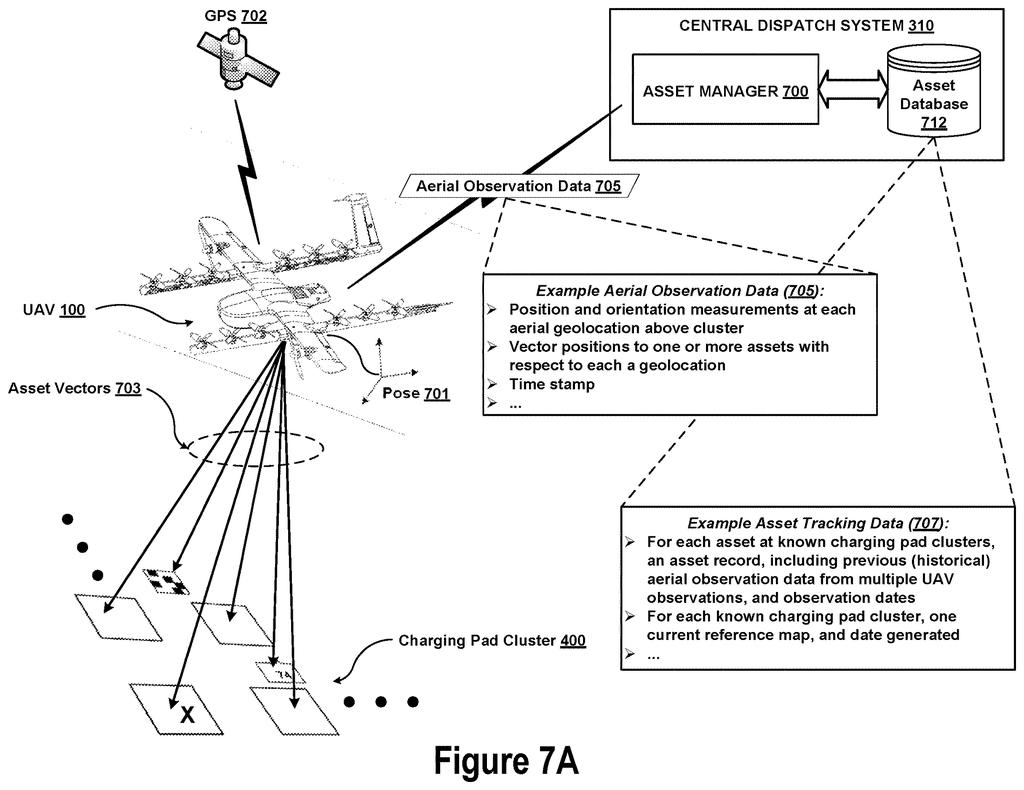
Wing's patent has the drone hop just a few meters up and snap a photo of the ground around it. It boils the picture down to a short list of positions: where its pad is, and where nearby fiducial markers sit and which way they face. Those markers are barcode-like tags placed around the site. The drone sends that list to a server, not the photo.
The server compares the pattern to a stored map of the site, works out which pad the drone is on, and replies with its location. The drone can then set up its navigation and get on with the job.
obtaining, by an aerial vehicle, an aerial image of a portion of a ground-based cluster of ground-based assets, wherein the portion includes a ground-based asset and one or more fiducial markers …
Translation: The drone takes a picture of a charging pad and nearby visual markers on the ground.
How a photo of the ground becomes a location
When a Wing drone powers on, the patent says it may not know its own location, and ground-level GPS can be too degraded to trust. So the drone lifts a few meters (the filing gives 1 to 5 meters as an example), hovers over its pad, and photographs the pad and the tags nearby.
It then reduces the image to cluster-portion observation data, a compact summary in place of the photo. Under claim 1, that summary contains:
- The pixel locations of the pad (or another ground asset) in the image
- The pixel locations of each marker
- An orientation indicator for each marker (which way it is turned)
Dependent claims say the summary can leave out the actual image pixels entirely, so the photo itself is never sent. It can carry outlines of the pad and markers instead.
The server (per claim 13) builds an outline image, rotates it using the markers' orientations to line it up with a stored reference map of the site, and matches the pad to a known one. Markers don't need unique labels, because their relative layout can tell pads apart. The drone can also send a rough GPS fix to narrow the candidates, or send several images so the server picks the pad identity most of them agree on.
Once the drone has its answer, it calibrates its navigation. It then climbs higher, takes a normal satellite fix, compares that with the server's answer, and updates its mission based on the result.
An uncrewed aerial vehicle (UAV) may be configured to hover above a particular charging pad within a portion of a cluster of charging pads for UAVs.
Translation: A delivery drone hovers over one specific charging station among a large group of them.
Why this matters for drone delivery sites
For a delivery fleet, the first minute after a drone powers on is easy to overlook, but nothing else can happen until the drone knows where it is. This filing gives it a way to find out without climbing high enough to trigger aviation rules. The patent itself points to the 20-meter range as the height where those rules may apply.
It also fits real-world messiness. The tags don't need unique labels or precisely surveyed positions, and a damaged or dirty tag doesn't necessarily break the match, so sites should need less upkeep. Sending a small summary instead of a photo also keeps cellular data use low, which matters when every drone is sending these reports.
Google's 16th filing in our robotics coverage we've tracked since May adds to a run that includes a drone safety camera and a two-model robot trainer.
You would almost never notice this working. You would notice it failing: a drone that lands on the wrong pad, or sits on the ground waiting for a location fix while your order waits with it. Fixing the delay at the start of a trip is a small, practical benefit, and for a service people use because it is fast, small delays add up.
The design holds up against everyday messiness at a delivery site. A scuffed tag or a leaf on a marker won't stop the drone from recognizing enough of a pattern to know where it is. That tolerance for imperfect conditions is what makes the system useful in the real world rather than only in a clean test environment.
No new gadget for you to buy, no step added to your order. If it works, your package leaves a little sooner and a little more reliably.
Get our take in your Top Stories
Liked this breakdown? Add Patentlyze as a preferred source on Google, and our plain-English take shows up more often in your Top Stories the next time Google patent news breaks.
There are more where this came from
We read every patent application Big Tech publishes and send you the ones worth knowing. Plain English, free, every week.
The drawings
18 drawing sheets from US 2026/0310203 A1 · click any drawing to enlarge


Want this weekly breakdown for a company we don't cover? Patentlyze Pro →
Be the first to weigh in