
Sony's New Patent Teaches Pet Robots to Walk Without the Clomping
Sony is working on a way to make legged robots walk almost silently by briefly cutting power to each leg just before it lands, letting the foot fall softly instead of stomping down.
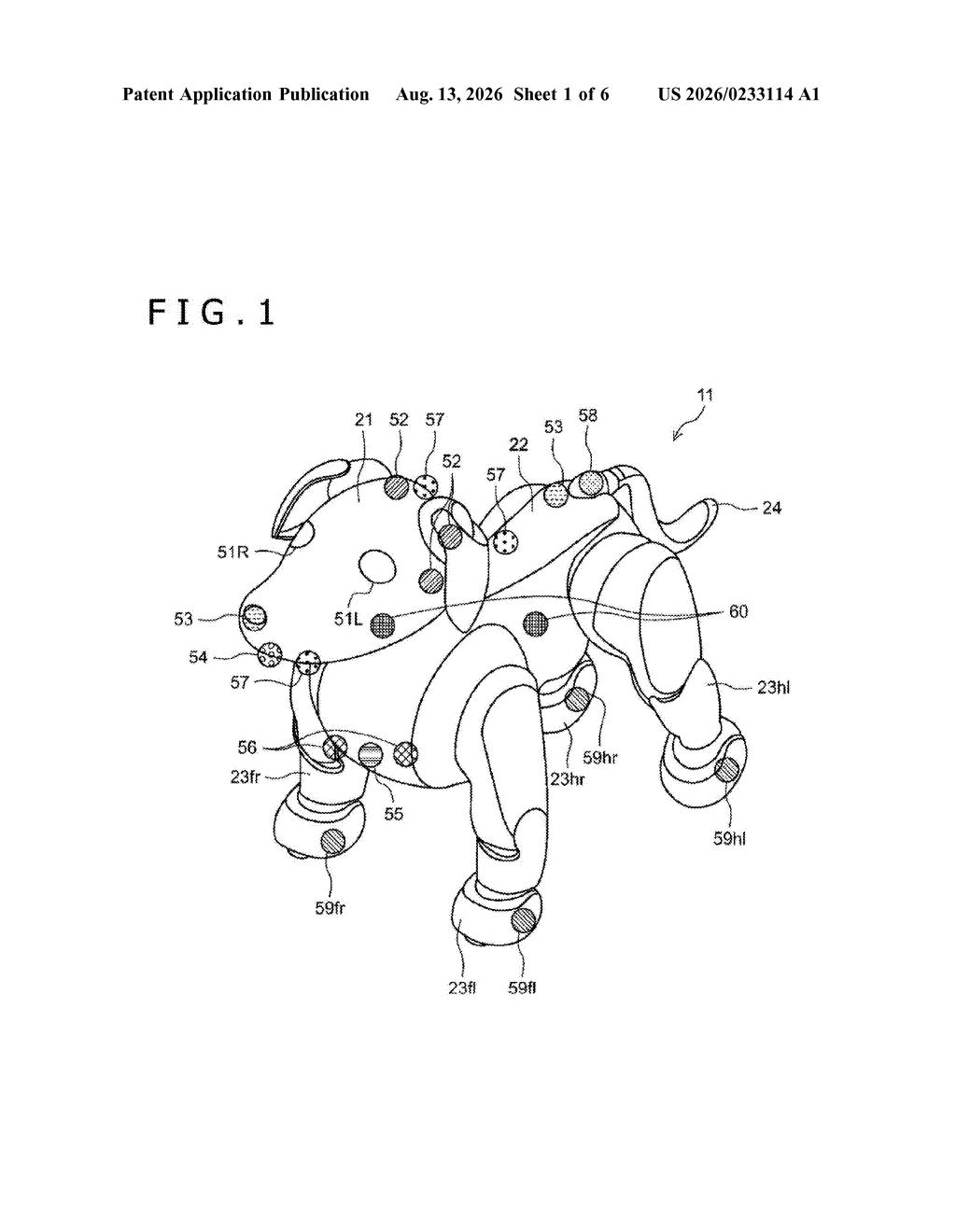
How Sony's robot silences its own footsteps
You're sitting in your living room at night and your robot pet clomps across the hardwood floor like it's wearing boots. Every step is a little thud that cuts through the quiet. That's the problem Sony is trying to fix.
Sony's patent describes a walking system where each leg is put into a relaxed, unpowered state just before it touches the ground. The moment the foot lands, the leg's motors kick back in. The idea is that a leg with no tension in it makes a much softer landing than one that's actively pushing down.
Think of the difference between catching yourself with a stiff arm versus bending your knees when you jump off a step. Sony is essentially teaching its robots to bend their knees, taking the hard edge off every footfall so the robot can move around a home without waking anyone up.
… a motion control unit that controls each of the legs such that a force of a free leg out of the legs is released before ground contact of the free leg and the force of the free leg is applied after the ground contact of the free leg.
Translation: The system softens the robot's steps by dropping tension right before its foot touches the floor.
How the leg release-and-catch cycle reduces impact noise
The patent describes a motion control unit, the software brain that coordinates leg movement, which manages each leg in two phases around the moment of ground contact.
In the first phase, as a free leg (the leg that's swinging through the air) approaches the ground, the control unit releases the force being applied to it. In mechanical terms, this means the motors driving that leg stop actively pushing, so the leg becomes effectively limp. A limp limb hits a surface with far less impact force than one that's being actively driven downward.
In the second phase, the instant after the foot contacts the ground, the control unit reapplies force to that leg. At that point it becomes a support leg, bearing the robot's weight for the next part of the stride.
The result is a two-beat pattern per step:
- Power off just before landing (soft contact)
- Power on just after landing (stable support)
Sony notes the system is designed for pet-type robots specifically, which makes sense: a robot dog or cat moving around a home at night has much stricter noise requirements than, say, an industrial machine.
The present technology relates to an automated moving body and a movement control method enabling suppression of footstep sound of the automated moving body.
Translation: This patent describes a method for making a walking robot much quieter.
What quieter robot pets mean for real living spaces
For anyone who has ever owned or considered a robot companion, noise is a genuine friction point. A device that clatters around the house disrupts sleep, annoys roommates, and generally breaks the illusion that the robot belongs in a domestic space. Sony's approach addresses that at the mechanical level rather than by making the robot slower or adding sound-dampening foam to the feet, which means it could work across a range of floor types without hardware changes.
Sony has been in the robot pet space for decades (Aibo launched in 1999), and quieter movement would be a concrete improvement for that product line in particular. Robotics patents addressing everyday livability rather than raw capability are part of a broader wave of new Big Tech patents focused on making autonomous machines genuinely tolerable to live with, not just technically impressive.
This one has a plainly visible payoff: a robot that doesn't wake your household up every time it crosses the room is one people will actually keep switched on. Sony is solving a domestic usability problem that matters more than many headline-grabbing capability upgrades, because a feature you mute or disable out of annoyance is no feature at all. The timing mechanism is elegant in its simplicity, which is also why it's likely to make it into actual products.
There are more where this came from
We read every patent application Big Tech publishes and send you the ones worth knowing. Plain English, free, every week.
The drawings
6 drawing sheets from US 2026/0233114 A1 · click any drawing to enlarge


Want this weekly breakdown for a company we don't cover? Patentlyze Pro →
Be the first to weigh in