
Apple Files Patent for a Scratch-Resistant, Glare-Cutting Coating on Curved Glass
Curved glass looks great on a phone, but it is hard to protect without weakening it. Apple's filing describes a thin coating that fights scratches and glare, and gets thinner right where the glass bends.
What Apple's curved-glass coating actually does
A phone sits in a pocket full of keys and loose change all day. Its glass back and curved edges take the abuse, and then the sun hits the screen and all you see is your own reflection.
Apple's filing describes a clear coating for curved glass that tackles both problems. It is hard enough to resist scratches and designed to cut glare. The tricky part is the curve itself, since the bent edges of glass are where stress builds up and where an ordinary coating could make the glass weaker.
So the coating can be thinner at the curved edges, tapering down gradually, and a soft cushioning layer can sit between the glass and the coating. The idea is protection without giving up the strength of the glass underneath.
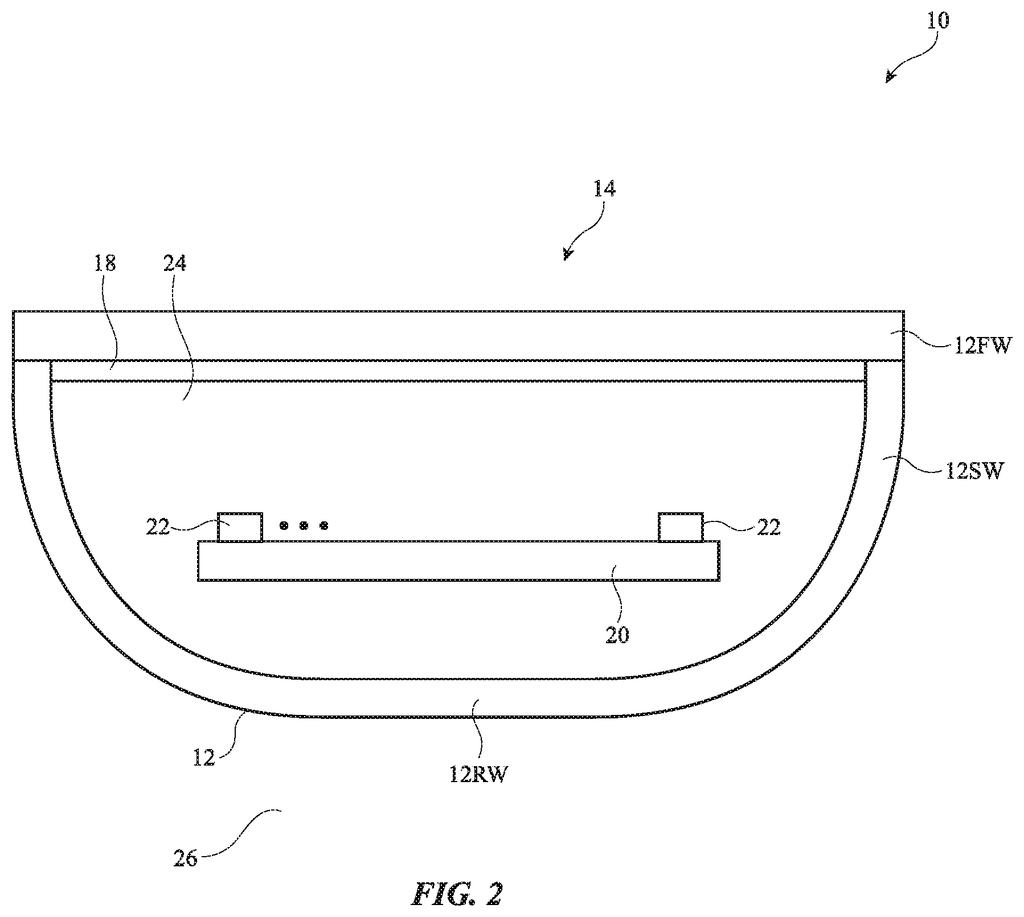
a housing that separates the interior from an exterior, wherein the housing comprises a curved housing wall with a first surface that faces the interior and an opposing second surface that faces the exterior; a display in the housing; and a hardcoat and anti-reflective coating on the second surface of the curved housing wall.
Translation: The device uses a curved outer wall to protect the screen, coated to block reflections and scratches.
How the coating thins out where glass bends
The filing covers a device with a curved glass (or similar) wall, a display, and a single coating on the outer surface that serves as both a hardcoat (a layer harder than the glass, so it resists scratches) and an anti-reflective coating (a layer that cuts the glare bouncing off the surface). The claims also cover a curved glass layer with a single-layer hardcoat on it.
The coating can be even in thickness, varying by less than 5% in one example, or it can taper at the curved edge. In the tapered version the thickness at the edge can differ from the flat area by more than 10%, 25%, or 50%. The description says a thinner coating in high-stress areas lets those areas keep their strength.
A buffer layer with a low modulus of elasticity (meaning it is soft and flexible) can sit directly on the glass, with the coating on top of it. The coating itself can be one layer, made from materials like silicon oxynitride, or a stack of hardcoat and anti-reflective layers in various orders.
One option is a nanolaminate: alternating ultra-thin layers, each 25 nanometers or less, of materials with high and low refractive index (how much they bend light), such as SiO2 and SiN. The filing says this can reflect less light than SiN alone and be harder than SiO2 alone.
The hardcoat and anti-reflective coating may have a uniform thickness across the curved housing portion(s) or may be tapered across curved portion(s). A buffer layer may be interposed between the hardcoat and anti-reflective coating and the curved portion, if desired.
Translation: The protective coating can be applied evenly or tapered across the curves, with an optional buffer layer underneath.
Why curved glass needs its own scratch armor
If you have ever picked a scratch off the back of a glass phone or squinted at a glare-covered screen outdoors, this is the problem the filing goes after. Curved glass is a design trend across phones, watches and headsets, and the curved parts are the hardest to protect.
The filing says the coating could go on any device with a curved glass surface, from phones and tablets to watches and head-mounted devices. For you, the result could be glass that keeps its look longer and is easier to see in bright light. Whether it lands in a product depends on manufacturing, since depositing layers this thin across a curve is hard to do evenly and at scale.
This is the 53rd Apple filing in our cell phone coverage we've tracked since May, adding to work like location by activity and tilt and hand control.
Cracked and scratched screens are among the most common and expensive problems phone owners face, and glare that makes a display unreadable in bright sunlight is the sort of daily friction that erodes how people feel about a product they paid hundreds of dollars for.
The meaningful detail here is that curved glass edges are where protective coatings tend to fail first. This approach addresses that directly by thinning the coating at bends and adding a softer underlayer to absorb stress, which is a precise fix for a precise failure point rather than a broad, unfocused improvement.
Whether millions of people actually benefit comes down to whether this can be applied consistently at factory scale. The problem is costly, the failure point is well understood, and the ambition of the approach is proportionate to what is actually at stake for ordinary consumers.
Get our take in your Top Stories
Liked this breakdown? Add Patentlyze as a preferred source on Google, and our plain-English take shows up more often in your Top Stories the next time Apple patent news breaks.
There are more where this came from
We read every patent application Big Tech publishes and send you the ones worth knowing. Plain English, free, every week.
The drawings
11 drawing sheets from US 2026/0343768 A1 · click any drawing to enlarge


Show the other 3 sheets


Want this weekly breakdown for a company we don't cover? Patentlyze Pro →
Be the first to weigh in