
Samsung Files Patent to Shrink Photo Data by Removing Each Patch's Average Color First
Before Samsung's AI squeezes a photo, it subtracts the average brightness from every small patch, leaving only the fine detail to compress. The averages travel separately and get added back at the end.
What Samsung's average-color trick actually does
You're on a video call, or flipping through photos you just shot, and your phone is shuffling huge amounts of image data around inside itself. Every bit that moves costs a little battery and takes a little time.
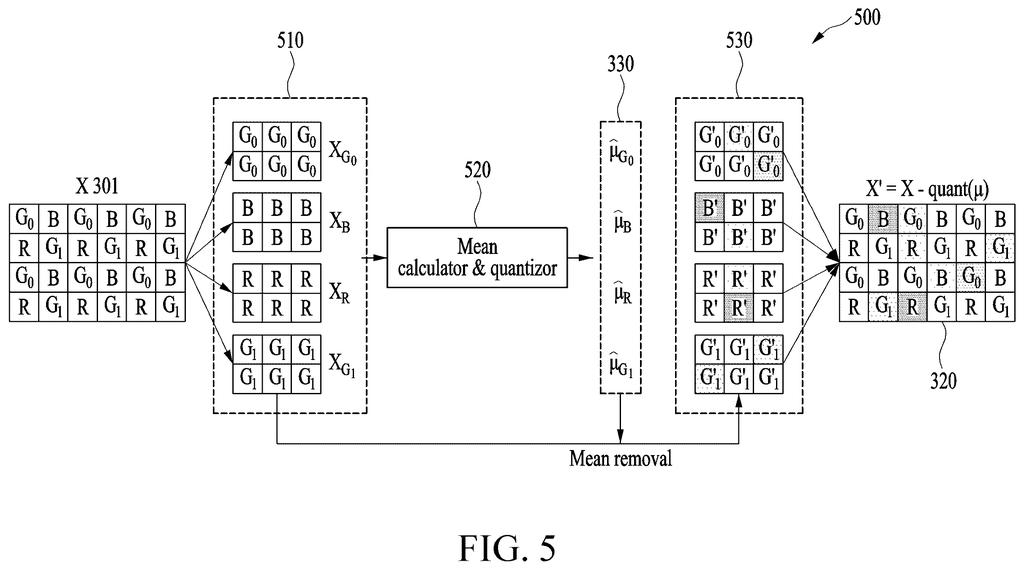
Samsung's filing describes a prep step before the AI compresses a picture. The image is cut into small patches, and for each patch (and each color) the device works out an average value. It subtracts that average, so what's left is mostly fine detail, like edges and texture.
The AI squeezes that leftover detail into a compact package. The averages are sent along beside it, and the receiving side adds them back to rebuild the picture. The filing says this makes the AI's job more predictable, so you get smaller files with fewer visible glitches.
calculating representative values by dividing input image data into image blocks based on statistical characteristics corresponding to a type of the input image data; generating a residual image by removing the representative values from the image blocks, respectively; …
Translation: The system breaks a picture into blocks and finds the average color of each block to subtract it first.
How the encoder strips out the average first
The method starts by splitting an image into blocks. How it splits depends on the type of image: a camera sensor's raw Bayer pattern (a mosaic where each pixel records only one color), a YUV image (brightness plus color-difference channels), or a standard RGB image. For each block, per color channel, it calculates a representative value, usually the mean (the average).
Those averages are then quantized, meaning rounded to fewer bits to save space. The filing says the precision can differ by color. In one example, green averages get 8 bits while red and blue get 10. Subtracting the averages leaves a residual image of fine detail, which a neural encoder squeezes into a latent vector (a compact numerical summary of the image).
On the receiving end, a neural decoder rebuilds the residual image from the latent vector, and the averages are added back.
To save more space, the system can send only the difference from the previous sub-block's average when the difference is small, marked with a one-bit flag. In the filing's example, that cuts 64 bits down to 47. The description says this is aimed at compressing image data as it moves between chip components and memory, which saves power.
Why this matters for phone cameras and streaming
The practical payoff is mostly invisible. The filing says its target is frame buffer compression, which means shrinking image data as it moves between parts of a phone's chip and its memory. Less data moving around means less power drawn, which could mean longer battery life while you shoot video or watch streams.
The filing also lists uses like video calls, broadcasting, and sending images between devices over Wi-Fi or cellular networks. Because it handles raw camera data as well as ordinary color formats, it could slot in at several points in a phone's image pipeline. It is a technical refinement, and the filing gives no product plans.
That makes this Samsung's 161st filing we've tracked since May in our camera sensor push, adding to work like the single-camera projector and multi-camera data loss fix.
Each image block carries its own color summary, and those summaries must travel alongside the compressed picture. More blocks sharpen the result but multiply the numbers in transit, and the filing's own example shows even a modest block requiring 32 of them.
The design tries to recover that overhead by sending only the gap between neighboring summaries when they are close, using a small flag to tell the receiver which type of number is coming. If that flag arrives corrupted, the receiver misreads everything downstream, and that fragility is the direct cost of the savings.
The filing shows a meaningful reduction in data size for orderly content like documents or screenshots, but the gains shrink fast on chaotic footage like a crowded sports scene. For a phone pushing images to a nearby display chip under controlled conditions, that tradeoff reads as worth it. For unpredictable, high-motion content, it reads as much less so.
Get our take in your Top Stories
Liked this breakdown? Add Patentlyze as a preferred source on Google, and our plain-English take shows up more often in your Top Stories the next time Samsung patent news breaks.
There are more where this came from
We read every patent application Big Tech publishes and send you the ones worth knowing. Plain English, free, every week.
The drawings
14 drawing sheets from US 2026/0343006 A1 · click any drawing to enlarge


Show the other 6 sheets


Want this weekly breakdown for a company we don't cover? Patentlyze Pro →
Be the first to weigh in