
Samsung Files Patent for a Touch-Sensitive Projector That Needs Only One Camera
Samsung wants a pocket projector to turn any wall or floor into a touchscreen, and it found a way to do it with a single camera instead of two.
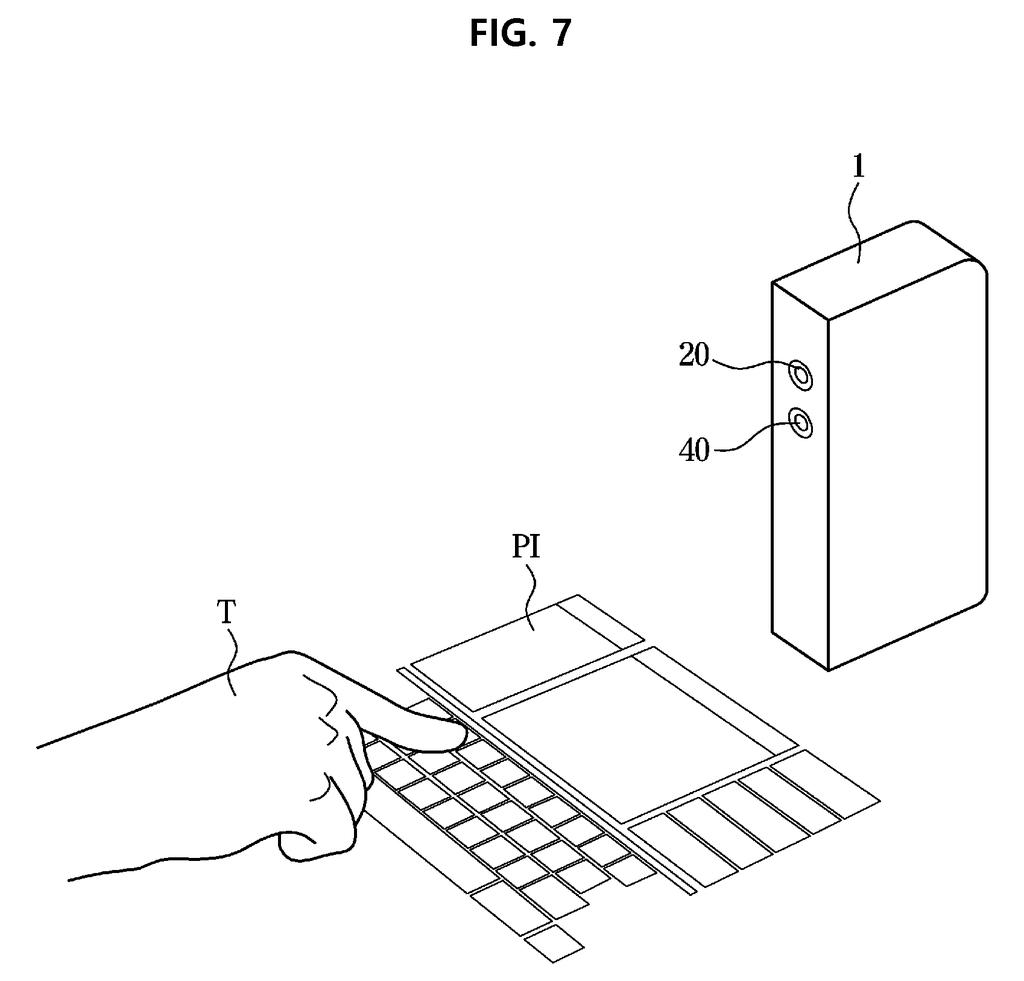
What Samsung's one-camera touch projector does
Every time you tap a projected button on a wall, the projector has to answer two questions at once: where is the picture, and where did your finger land? Today's touch-enabled projectors typically use two separate cameras to figure that out, one for normal color and one for infrared light.
Samsung's filing squeezes both jobs into one camera sensor. A special filter blocks red light but lets blue, green and infrared through. The camera then takes quick turns, first looking at the picture, then looking at the infrared glow your finger scatters.
Because one sensor sees both, the picture's edges and your fingertip are measured from the same viewpoint. Samsung says that should make touches more accurate, and cheaper to build.
… an image sensor comprising a dual band pass filter, the image sensor being configured to obtain an image of the projection area; memory storing instructions; and at least one processor operatively connected to the memory …
Translation: The device uses a special filtered camera and a processor to process what is happening on the screen.
How one sensor sees both the image and your finger
The patent covers a projector with a lens, an infrared light emitter and an image sensor with a dual band pass filter (a filter that blocks one slice of the light spectrum, here red, and lets two other slices through: blue and green, plus infrared). The projector throws an infrared pattern across the same surface as the picture, so a finger touching it scatters the infrared light.
The sensor works in two sensing modes. In the first, the camera uses a longer exposure (about 62.5 msec in the example) and higher gain (about four times more, meaning its electrical signal is amplified) to capture blue and green light. From that visible light image, the device finds the border of the projected picture.
In the second mode, exposure drops (about 7.8 msec in the example) so visible light is dimmed. The device strips the blue and green from the image, leaving a red-looking signal that is really infrared. From that infrared image it finds the touch point.
Combining the border and the touch point gives the finger's position, which the device treats as a tap, swipe, pinch or similar gesture. The filing also describes a second use: a camera system that recognizes objects or authenticates users by shape.
… recognizes position information of a touch point by a subject in the projection area on the basis of the acquired visible light image and infrared image …
Translation: It figures out exactly where you touched the projected screen by combining regular and infrared pictures.
Why a cheaper touch projector matters for your home
If you want a portable projector that works like a tablet on your wall, table or floor, cost and accuracy decide whether it feels good or frustrating. Using one sensor instead of two could trim parts and manufacturing cost, and measuring the picture and your finger through the same view could cut missed or misplaced taps.
The filing describes a laser-based projector that stays bright in daytime and at night, aimed at portable use at home, in parks or at campsites. It also describes a speaker responding to touch, so you could tap a projected control to change the volume. Samsung's filing only describes the idea; it names no product.
This is the 160th Samsung filing we've tracked since May in our camera sensor push watchlist, building on work like one that saves multi-camera image data and one that fixes blinks in photos.
The problem here is real but modest. Touch-enabled projectors need to line up two views of the same surface, and doing it with two cameras means extra cost and tiny mismatches between what the projector sees and where your finger actually lands.
Samsung's answer fits the size of that problem well: one camera, a filter that sorts the light, and two quick exposure settings. It is a clever, economical fix rather than a leap, and the saved hardware is what a mass-market portable device cares about.
The open question is speed. The camera has to switch between its two modes for every touch reading, and the filing does not say how fast that must happen. If it feels laggy, the cost savings will not matter to you.
Get our take in your Top Stories
Liked this breakdown? Add Patentlyze as a preferred source on Google, and our plain-English take shows up more often in your Top Stories the next time Samsung patent news breaks.
There are more where this came from
We read every patent application Big Tech publishes and send you the ones worth knowing. Plain English, free, every week.
The drawings
12 drawing sheets from US 2026/0343110 A1 · click any drawing to enlarge


Show the other 4 sheets


Want this weekly breakdown for a company we don't cover? Patentlyze Pro →
Be the first to weigh in