
Samsung Files Patent for a Phone That Folds Twice and Still Works Closed
Samsung's filing describes a phone that folds into a stack of three panels and keeps its cover screen, rear camera and side button on the outside, where you can use them.
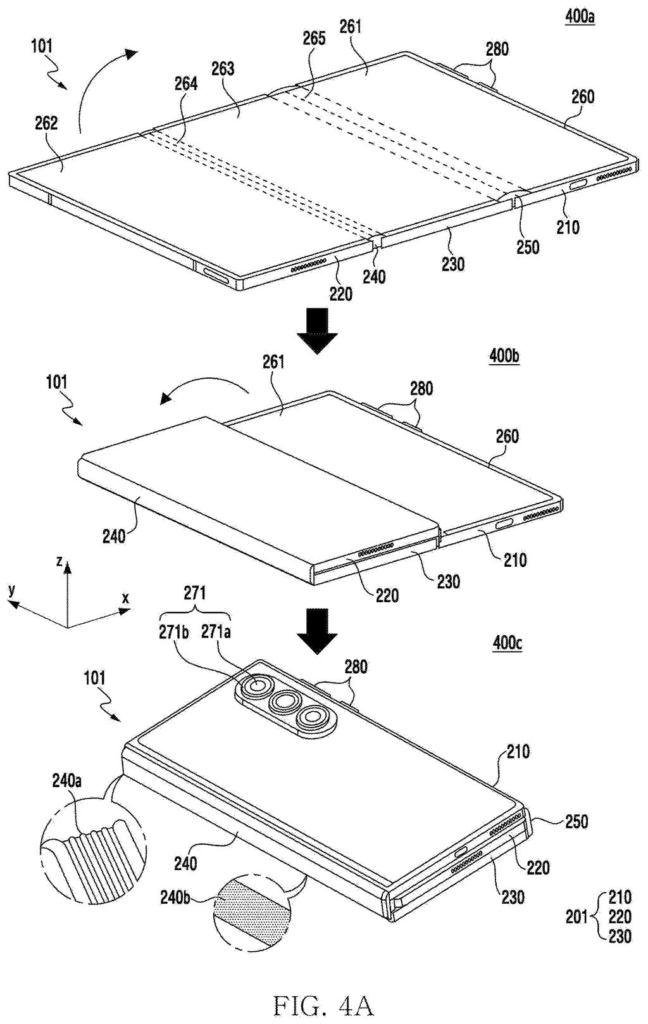
What Samsung's two-hinge folding phone does
A phone sits folded in a coat pocket, and a call comes in. On most foldables you would have to open the thing just to see who is calling. Samsung's filing describes a phone with two hinges and three panels that keeps a cover screen, a camera and a side button usable while it is closed.
The trick is where each part goes. The middle panel carries the cover screen on its back. The end panel with the camera also holds the side button, so both stay reachable whether the phone is flat or folded up. The second hinge is made wider so one panel can slot between the other two, a bit like folding a letter in thirds.
Inside, the filing spends a lot of effort on wiring and batteries, so a phone with this many seams still holds a good charge and passes signals between panels without waste.
… a flexible display disposed in the first housing part, the second housing part, and the third housing part; a processor disposed in the first housing part and configured to control a plurality of electronic components of the foldable electronic device; …
Translation: The phone uses one continuous screen spanning all three sections and a main brain located in just the first part.
How the three panels share one wiring strip
The phone has three rigid housing parts in a row, joined by two hinges, with one flexible display stretched across all three. When folded, the front of the middle panel faces the front of one end panel, and the front of the other end panel faces the back of that first end panel. The hinge next to the camera panel is wider, which leaves room for one panel to sit between the other two.
A second, smaller screen sits on the back of the middle panel and is the one you see when the phone is closed. The rear camera and a side key button sit on the end panel that stays on the outside in both the open and closed positions. The filing says this also stops the phone from rocking on a table when you tap it open, because the camera bump sits near an edge instead of the center.
The main processor (the phone's brain chip) lives in that same end panel, close to the camera. The filing explains that high-resolution camera data gets worse when it travels a long way over a bendable cable.
One flexible printed circuit board (a thin, bendable strip of wiring) runs through both hinges and has three ends, one for each panel's circuit board. The processor's commands for the other two panels travel straight down this strip. The filing compares this with a daisy-chain layout, which has a longer path and more connectors. Each panel also holds its own battery, in three different sizes, and a USB port on the processor panel feeds all three through one power chip.
In a folded state of the foldable electronic device, a front side of the third housing part faces a front side of the second housing part, and a front side of the first housing part faces a rear side of the second housing part.
Translation: When closed, the three sections fold together in a zig-zag pattern where different parts face each other.
Why Samsung's tri-panel layout matters to you
If you have ever wished a big foldable could still take a call, show a notification or snap a photo without being opened, this layout is aimed at that. Keeping the camera, power button and cover screen on the outside means the folded phone stays useful, not just pocket-sized. The table-wobble fix and the camera placement away from where your hand rests are small, practical choices you would notice in daily use.
For Samsung, the wiring and battery details are the real story. A phone with three panels has less room and more places for things to go wrong, so shorter signal paths and fewer connectors free up space for bigger batteries. That matters for anyone who has watched a thin foldable lose charge by dinnertime.
This is the 93rd Samsung patent we've tracked on our foldable phone watchlist since May, following applications like one shrinking screen gaps and one stopping screen bulge.
This filing is almost entirely about where parts sit, and that is good news for how close it is to a real product. Cameras, batteries, a USB port, a fingerprint-capable key button and a cover screen already exist in modern phones. No new software or new kind of component has to be invented first.
The hard part is the body itself. A second hinge, a wider hinge on one side, a display that wraps across three panels and a wiring strip that passes through both hinges all have to survive years of folding at a thickness people will accept. The filing does not say how that will be done, so the shortest route to a product runs through hinge and display testing, not through anything in this document.
Treat it as a sensible floor plan for a three-panel phone. The choices make sense and are well explained, but the document describes a layout, not a finished device, and most of the cost and risk sits in parts it only mentions in passing.
Get our take in your Top Stories
Liked this breakdown? Add Patentlyze as a preferred source on Google, and our plain-English take shows up more often in your Top Stories the next time Samsung patent news breaks.
There are more where this came from
We read every patent application Big Tech publishes and send you the ones worth knowing. Plain English, free, every week.
The drawings
24 drawing sheets from US 2026/0342901 A1 · click any drawing to enlarge


Show the other 16 sheets


Want this weekly breakdown for a company we don't cover? Patentlyze Pro →
Be the first to weigh in