
Samsung Files Patent for a Foldable Phone That Rests Its Cover Screen on the Battery
Foldable phones carry two screens and little spare room inside, so Samsung's new patent rests the back screen right on the battery and moves the chip clutter out of the way.
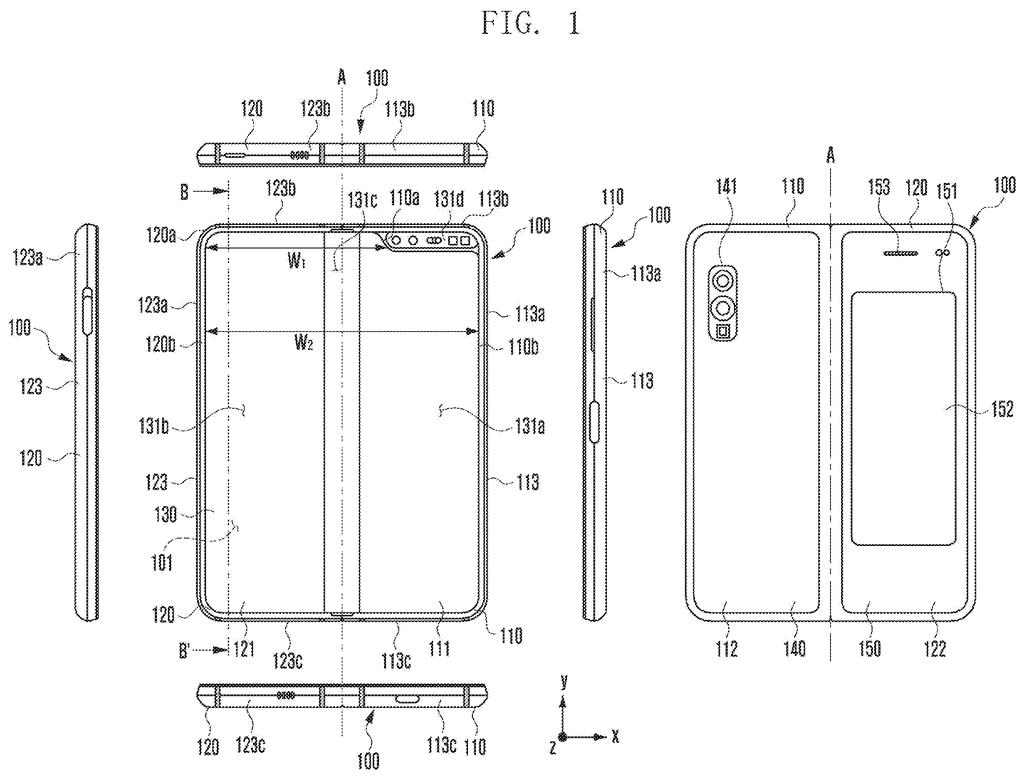
What Samsung's two-screen foldable layout does
Ever wonder why a foldable phone feels so much thicker than a regular one? Part of the answer is that many of them now carry two screens, a big folding one inside and a small cover screen on the back, and both need room for their wiring and chips.
Samsung's patent rearranges that clutter. Each screen has a thin ribbon of circuitry with a patch of tiny chips on it. Samsung moves those chip-covered patches off to the side, away from the battery, so the battery gets the middle of the phone to itself. The cover screen can then rest directly on the battery.
The filing describes the payoff as a choice. The extra room can go to a bigger battery, or, if the battery stays the same size, to a slimmer phone.
… a second display disposed between the battery and the fourth plate to be visible from the outside through at least a part of the fourth plate. At least a part of the second display may be disposed to face the battery.
Translation: The cover screen sits right on top of the battery so it can be seen from the outside.
How the screen wiring stays off the battery
The claims cover a foldable phone with two halves joined by a hinge. A big inner display bends when the phone folds, and a second display faces the opposite way on the back of one half. A battery sits in that same half, between the inner display's section and the cover display.
Each display connects to the phone's main circuit board through a flexible printed circuit board (a thin, bendable strip of wiring). Each strip has a patch, called a device arrangement area, where small parts are mounted. The filing lists a touch chip, a bit of flash memory, a diode that guards against static shocks, and small passive parts. Those parts have thickness, so placing them over the battery would either bulge the phone or shrink the battery.
The key claim is that the cover display's patch of parts does not overlap the battery when you look at the phone from above. The two strips overlap each other instead, and the dependent claims describe their overlapping sections as roughly perpendicular. The inner display's patch can also tuck into a recess (a shallow pocket) in the housing's support part.
With the cover screen's parts out of the way, the rest of that screen can be supported by the battery itself. The filing says a cushion, insulating layer or adhesive may sit between them. It also says the same layout could work in a regular bar-shaped phone with a back screen.
Why a foldable's battery and thickness matter
If you carry a foldable, you know the trade: it is thicker than a regular phone, and its battery has to power two screens. This filing goes after both complaints with one internal rearrangement. The extra space can go to battery capacity, or the phone can simply get thinner.
Nothing here adds a feature you would see on screen. It is internal layout work, and you would feel it, if it ships at all, as longer battery life or a slimmer body. A patent application does not promise a product, but the problem it targets is one that foldable owners already notice.
Samsung's 88th filing we've tracked on our foldable phone watchlist since May follows the smart ring charger idea and the mixed spring hinge.
The problem is real. A foldable has to squeeze two halves of a phone into one pocket-sized package, so every fraction of a millimeter inside is contested, and a second screen on the back takes its own slice of that room. Battery life and thickness are two things shoppers weigh when they look at a foldable.
Samsung's fix matches the size of that problem. Moving a few patches of tiny chips out from under the battery is a small, practical change, and the filing itself promises only a modest payoff: more battery or a slimmer body.
Don't expect a headline feature from it. It is careful interior packing, and that is what the complaint calls for. Whether it ever reaches a phone is impossible to tell from a patent application, but the idea is sensible.
Get our take in your Top Stories
Liked this breakdown? Add Patentlyze as a preferred source on Google, and our plain-English take shows up more often in your Top Stories the next time Samsung patent news breaks.
There are more where this came from
We read every patent application Big Tech publishes and send you the ones worth knowing. Plain English, free, every week.
The drawings
13 drawing sheets from US 2026/0319553 A1 · click any drawing to enlarge


Show the other 5 sheets


Want this weekly breakdown for a company we don't cover? Patentlyze Pro →
Be the first to weigh in