
Samsung Files Patent to Shrink the Gap Around a Foldable Phone's Screen
Foldable phones leave a hairline gap between the screen and the frame, and that gap exists for a reason. Samsung's filing guards it with a hardened resin strip set roughly 0.05 to 0.15 millimeters from the screen edge.
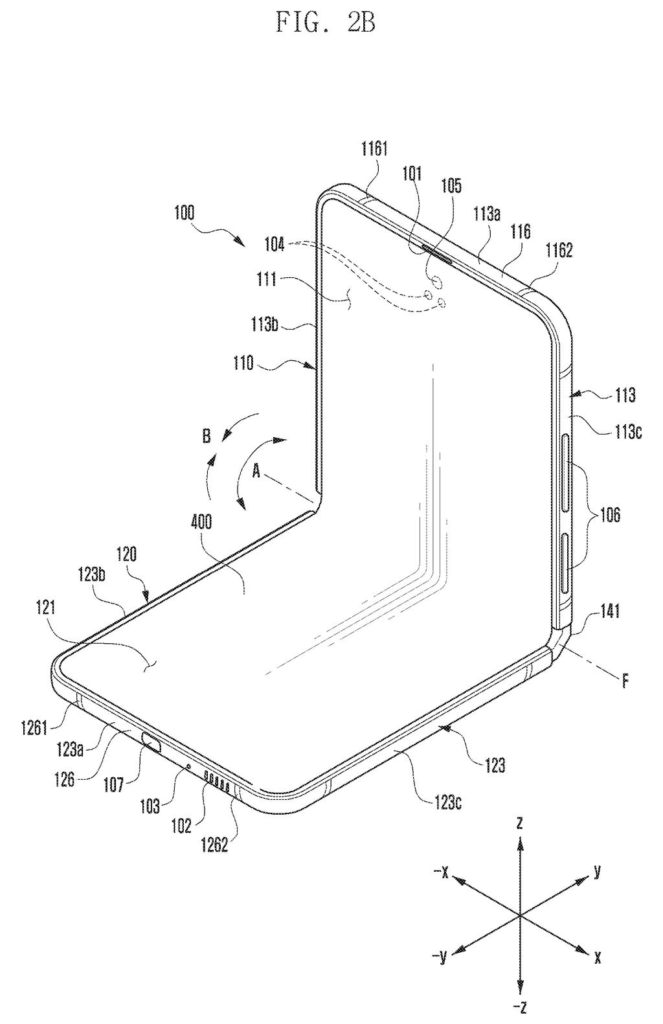
What Samsung's foldable screen-edge strip does
Imagine you knock your foldable phone against the corner of a table. The screen is the priciest part, and its edge sits right beside the metal frame with only a hairline gap between them. Almost nothing guards that edge.
That gap is on purpose. A folding screen is a stack of thin layers glued together, and when the phone bends, the layers slide a little against each other. They need room to move, and a gap that is too wide can feel uncomfortable to use.
Samsung's filing adds a thin strip of hardened resin along the frame, close enough to take a hit and far enough away to stay out of the layers' way. The strip is built into the frame before the screen goes in, so a repair doesn't mean digging out filler glued to an expensive display.
a first housing; a second housing coupled to the first housing to be rotatable about a folding axis by using a hinge device; a flexible display disposed to be supported by the first housing and the second housing and including a plurality of layers; …
Translation: The phone uses two halves connected by a hinge to support a multi-layered bending screen.
How the resin strip gets built into the frame
The phone has two halves (housings) joined by a hinge, with one flexible display spread across both. That display is a stack of glued layers: a cover window, a polarizer (a film that cuts glare), the display panel and a support plate. When the phone folds, those layers slide slightly against each other, which the filing calls interlayer slip.
Along the two edges that run parallel to the fold, each half gets a protective member, a strip of hardened filler. With the phone flat, the strip sits a set distance from the screen edge, preferably about 0.05 to 0.15 millimeters. Fully folded, that gap shrinks and may close to a light touch.
The filing describes several strip shapes:
- A rounded top edge, giving the polarizer room to slide
- A sloped face, flat or curved, that leans toward the screen
- A stepped profile, farther from the screen at the top and closer lower down
- A strip that sits partly in a recessed groove in the frame
To make it, a placeholder piece (a dummy member) with a hollow shaped like the strip goes into each half, and everything is clamped together in a fixture. Filler is injected through a port on the back, with the port facing up, then cured with UV light or heat, and the placeholder is removed. The screen goes in afterward.
… wherein the first protective member is spaced apart from a first edge of the flexible display facing the first inner portion by a predetermined distance, and wherein the second protective member is spaced apart from a second edge of the flexible display facing the second inner portion by the predetermined distance.
Translation: Protective pieces are placed a precise distance away from the edges of the flexible screen.
Why a tenth of a millimeter matters for repairs
For you, the payoff would show up in two places: a foldable whose screen edge is better shielded from bumps, and a screen that is easier to replace. The filing says older approaches, where filler was applied after the screen was installed, meant removing all of it during repairs, and the expensive display could be damaged while the filler was pulled off.
Samsung already sells foldable phones, so this targets a trouble spot in an existing product category. A tighter gap also means less of a hairline edge you might feel with your thumb, which the filing ties to user discomfort. Building the strip before the screen is installed also protects the display during assembly, which the filing says improves productivity.
This is the 92nd Samsung foldable phone patents we've tracked since May, adding to earlier work like keeping screens from bulging and protective edge coatings.
Every choice here is a bet on a tenth of a millimeter. Put the strip too far from the screen and it protects little, and the gap stays easy to feel. Put it too close and the screen's layers, which slide as the phone folds, can rub against it and make the surface look worse.
The cost shows up in the factory too. Samsung adds a placeholder piece, a clamping fixture, resin injection and a curing step to every frame before the screen can be installed. That is more work per phone than a bare frame.
The payoff is a screen that can be swapped without digging out hardened filler first. For a part this expensive, the trade is worth making. The strip still leaves a small gap, so the screen edge is only partly shielded, and a hard enough hit could still find it.
Get our take in your Top Stories
Liked this breakdown? Add Patentlyze as a preferred source on Google, and our plain-English take shows up more often in your Top Stories the next time Samsung patent news breaks.
There are more where this came from
We read every patent application Big Tech publishes and send you the ones worth knowing. Plain English, free, every week.
The drawings
24 drawing sheets from US 2026/0343760 A1 · click any drawing to enlarge


Show the other 16 sheets


Want this weekly breakdown for a company we don't cover? Patentlyze Pro →
Be the first to weigh in