
Sony Files Patent for One Game Invite Link That Works on PlayStation, Xbox and PC
Getting a friend on a different console into your game usually means friend requests and menu digging. Sony's filing swaps that for one link you can send in a text message.
What Sony's one-link game invite actually does
You're halfway through a match on your PlayStation 5 when a buddy texts asking to jump in. He plays on a PC. Today that can mean friend requests, matching accounts, and an invite that only shows up inside the game.
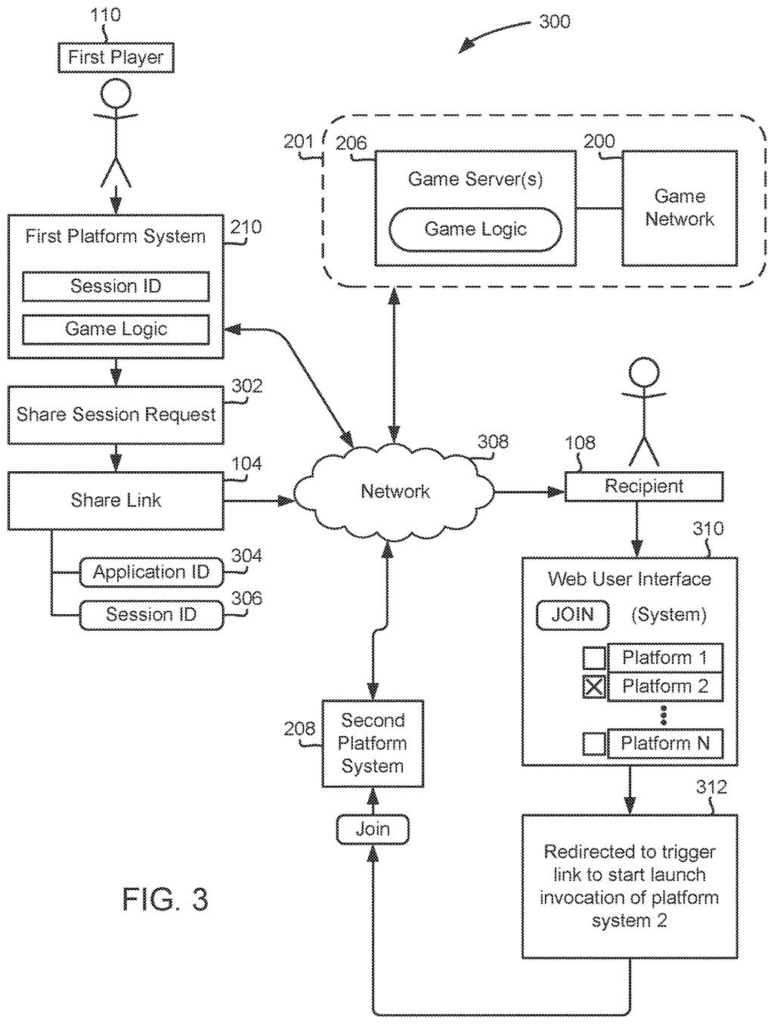
Sony's patent application describes a simpler route. You tap a share option, and the game produces a single link you can send through any text or chat app. Your friend taps it, lands on a web page, and picks where he wants to play: PlayStation, Xbox, or a PC. One more tap launches the game and drops him into your session.
The link doesn't care whether you two are friends on any platform, and your friend can pass it along to someone else. The idea is to make joining a game as casual as sending a photo.
… includes a system type-agnostic universal resource link that is invariant with respect to different system types and different recipient devices …
Translation: The share link works across any gaming device without changing its address.
How the link finds the right console or PC
The filing covers what happens after a player asks to share a live game. The system builds a share link with two pieces of hidden information baked in: an ID for the game and an ID for the specific session (the running match you're in). Claim 1 describes the link as one universal address that stays the same no matter what kind of system the recipient uses.
When the recipient opens it, a web page asks which system they want to join from. After they choose, the system does three things:
- Redirects them to a trigger link (a platform-specific address that tells the console or PC app to start the game), passing the session details along.
- Optionally shows who is already in the session and how many spots are open before they commit.
- Uses a credentials token (a digital pass from a login service) so the game server can add the new player to your session.
The claims and description also cover optional extras: signed, single-use trigger links that expire, picking the platform automatically from a user's profile, a landing page listing at least three system types, and links that can be re-shared. The description adds a QR code on your TV screen that you scan with your phone. Game developers have to code their titles to let "anyone" join this way.
… embedded metadata that identifies an application identifier for the game and a session identifier for the session of gameplay by the first player …
Translation: The link hides specific data inside it to track the exact game and match.
Why cross-platform invites still feel clunky
If something like this ships, the change for you is small and welcome: you could invite someone the moment you think of it, from your phone, without checking what they play on or whether you're friends on the same service. Anyone who has tried to organize a game night across different consoles knows how much friction sits in that first step.
For Sony, the pitch is reach. The link works for people who aren't on PlayStation Network at all, which could pull more players into games Sony's customers already own. The description also mentions counting how many shares turn into joins, a handy number for game studios.
This is the 662nd Sony filing in our Sony coverage since May, adding to work like the voice matchmaking patent and the self-correcting laser sensor.
On the ship-path scale, this one sits close to shore. Nothing in the filing needs new hardware: it is a web page, a link format, and a handoff to launch commands that the filing says various platforms already support.
The hard parts involve people. Each game has to be coded to let anyone join, and each platform has to cooperate when a link tries to start its app. The filing's example network is Sony's own, but the Xbox and Steam examples depend on rivals playing along.
The shortest route to a product is probably a version for games that already run on several platforms, built on the session system Sony has. For you, that would mean an invite that works from a text message instead of a menu.
Get our take in your Top Stories
Liked this breakdown? Add Patentlyze as a preferred source on Google, and our plain-English take shows up more often in your Top Stories the next time Sony patent news breaks.
There are more where this came from
We read every patent application Big Tech publishes and send you the ones worth knowing. Plain English, free, every week.
The drawings
5 drawing sheets from US 2026/0335772 A1 · click any drawing to enlarge


Want this weekly breakdown for a company we don't cover? Patentlyze Pro →
Be the first to weigh in