
A New Sony Patent Picks Teammates by Skill, Mic, Location and Free Time
What if finding a squad took one sentence? Sony's filing describes a console that hears something like 'players near me at silver rank, free Monday' and builds the lobby for you.
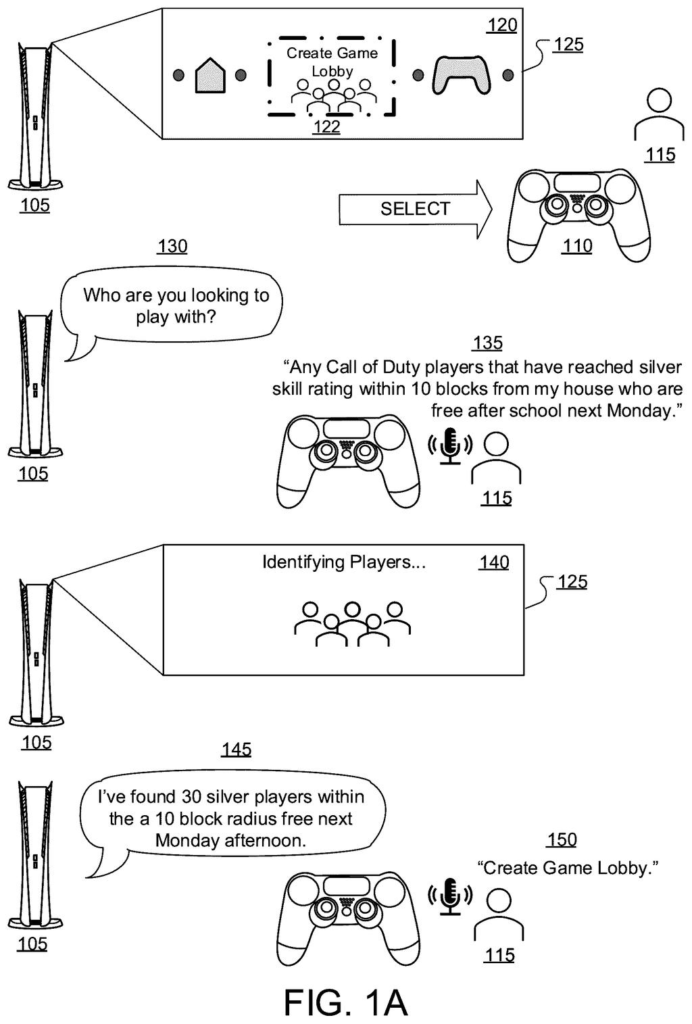
What Sony's ask-for-teammates feature does
Ever tried to find someone online who plays your game at your level, lives nearby, and is free on Monday after school? Today that usually means scrolling friends lists, posting on forums, or giving up and playing alone.
Sony's patent application tries to shrink that into one sentence. You say or type something like, 'Any Call of Duty players at silver rank within 10 blocks of my house who are free next Monday.' The system searches its player data, tells you how many matches it found (the filing's example is 30), and lets you invite some or all of them.
Anyone who accepts lands in a shared lobby, a chat space where you can pick a time, plan a strategy, and start the game together. Along the way, an AI double-checks its own results so you don't get players who only half match what you asked for.
receiving a request from a first user, wherein the request comprises a set of one or more criteria for identifying candidate users for associating with the first user; …
Translation: The system listens to what you are looking for in a teammate.
How the AI checks its own player search
The claims describe a method with four moves. A user sends a request with one or more criteria, which can be plain spoken or typed language. A language model (the AI technology behind modern chatbots) turns each criterion into a rule, such as a database query. The rules run against a gaming database to find candidates, and the system picks a subset and links them to the requester. The description lists the kinds of criteria it can handle: skill level, location, free time, shared traits like a college or a language, and setup details such as having a microphone or a fast connection.
If a requested trait is already stored in the database (a precomputed attribute), the lookup is fast. If it isn't, the system builds a new attribute on the fly from existing data using reusable query templates. The description says narrowing the search first, for example to players who are online or friends of friends, could cut the work from hours to seconds on a database of one billion accounts.
Then comes a self-check. The AI reviews the matches one requirement at a time, a method called chain-of-thought prompting (asking a model to work through a task in small steps). In the filing's example, a player with the wrong rank or the wrong free day is dropped, and the faulty rule is corrected.
- Candidates are ranked, for instance by how often they accept invites.
- Invitations go out as small pop-ups.
- Accepted players share a lobby with chat and a start button.
If too many or too few players match, the system asks you to tighten or loosen your request.
… applying the set of initial rules to a database to identify one or more candidate users, selecting a subset of the one or more identified candidate users, and establishing an association between the first user and the selected subset of the one or more candidate users.
Translation: It searches through player records to pick a matching group and connects you with them.
Why this matters for PlayStation lobbies
For you, the practical gain is less hunting. Finding a co-op partner, a coach who has already beaten the boss you're stuck on, or a team that is free at your hour could happen from the console menu, with no outside apps or forums. Because you can just talk to it, you don't need to know how to build a database search.
For Sony, the filing spells out the business goal: more play, better player satisfaction, and stickier communities. It also covers the guardrails you'd expect, including an opt-in setting so players can choose to be findable, chat moderation, and limits on requests that break fair-play or minor-protection rules. The filing names PS5 and PlayStation Portal among its example devices.
This is the eighth Sony filing in our AI recommendation coverage we've tracked since May, joining ideas like a concert stream near parking and a game AI that explains itself.
Nothing in this filing needs new hardware. It describes a console, a controller with a built-in microphone, and a server running a language model, so the road to a feature is software and data.
The harder pieces sit at the edges. Someone has to store play history, rankings, free hours and rough location for every account, and players must agree to be found. A request like 'within 10 blocks of my house' raises privacy questions that the document answers only with an opt-in flag and chat moderation.
The shortest route to a product looks like a typed request that searches only players who are online or friends of friends, since the filing says that shortcut turns hours of searching into seconds. Voice requests and neighborhood matching would likely come later. As a concept it is a modest upgrade to finding teammates, and it could ship in stages.
Get our take in your Top Stories
Liked this breakdown? Add Patentlyze as a preferred source on Google, and our plain-English take shows up more often in your Top Stories the next time Sony patent news breaks.
There are more where this came from
We read every patent application Big Tech publishes and send you the ones worth knowing. Plain English, free, every week.
The drawings
5 drawing sheets from US 2026/0335773 A1 · click any drawing to enlarge


Want this weekly breakdown for a company we don't cover? Patentlyze Pro →
Be the first to weigh in