
Sony Files Patent to Pause Your Cloud Game When Your Connection Drops
When a streamed game loses its connection, the game on the server keeps running without you. Sony's patent application has the server pause itself instead, then lets you pick up where you left off, or a few seconds earlier.
What Sony's pause-on-bad-signal idea does
A player is ten seconds from beating a boss when the train carrying them enters a tunnel. The signal dies, the screen freezes, and the game on the far-away server keeps running without them. If you've played on a phone, you know the feeling.
That's the problem Sony Interactive Entertainment is going after. In this patent application, the company's cloud server watches the connection to your device. If it goes dead for a set amount of time, the server pauses the game and your controller stops sending button presses.
Once the connection looks healthy again, the game can pick back up. You may even get to choose whether to resume right where it stopped or rewind a few seconds, so you don't come back to a character that already lost.
… stop executing the game processing upon detecting a failure in the communication status between the server and the terminal device for a predetermined length of time …
Translation: The server halts your cloud game if your internet connection drops out for too long.
How the server decides to stop and restart
Cloud gaming works like a relay. Your device sends button presses (the filing calls this operation data) to a server, the server runs the game and sends back video frames, and your screen shows them. When the link stalls, the server can keep playing a game that nobody is controlling.
The claims cover a server that monitors the connection and stops the game when a failure lasts a predetermined length of time. When the game stops, the device also stops sending operation data. In one example the server notices it has received no input for a set number of seconds. In another, the device notices that video has stopped arriving and asks the server to stop.
The recovery steps are described in detail:
- While paused, each side sends small test signals (confirmation signals) at the same pace as normal traffic: every 4.16 milliseconds from the device and every 16.6 milliseconds from the server.
- The connection counts as healthy when enough data gets through. The filing's examples use 5 Mbps (megabits per second, a speed measure) for video and 1 Mbps for button presses, held for 100 milliseconds.
- The device then sends a resumption notice and the server restarts the game.
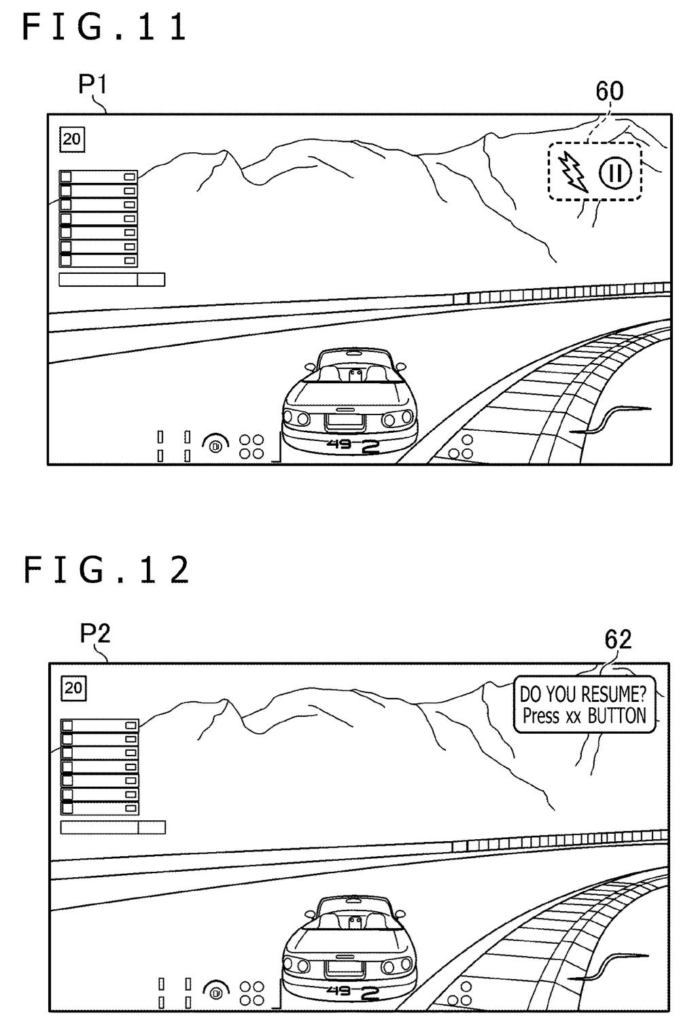
The description also covers an on-screen pause message, a prompt to resume or quit, and a choice to resume from the stop point, 5 seconds earlier or 10 seconds earlier. A replay button would let you scrub back through recent footage and pick the exact frame to restart from.
… reducing a disadvantage which is caused by temporal deterioration of a communication situation and suffered by a user …
Translation: The system prevents bad internet connections from ruining your gaming session.
Why dropped signals shouldn't cost you a game
If you play on a phone or over a mobile network, your signal wobbles all the time. Today that can mean a lost match, a dead character or a missed save point through no fault of yours. A game that pauses itself when you vanish removes one of the most irritating parts of streaming a game instead of installing it.
The filing says the problem is especially likely on 4G and 5G connections, and it also covers Wi-Fi. That suggests Sony sees cloud gaming on the go as a place where it needs to earn trust. The rewind option stands out most: it treats the lost seconds as something you can get back, which makes a shaky connection feel less costly.
Sony's 647th filing in our Sony coverage since May follows work on robot arms that reroute mid-motion and road warnings tied to a sender.
Losing saved progress because a Wi-Fi signal hiccupped for thirty seconds is a small injustice, but it happens often enough that it erodes trust in streaming games as a category. Players blame themselves or their routers, then go back to owning physical discs.
Pausing the game on the server when the connection weakens, then resuming cleanly, matches that problem at exactly the right scale. No new hardware, no new subscription tier, just software catching a failure before it becomes a loss.
Where it gets complicated is multiplayer. Freezing a match for one struggling player is not something other participants will accept, and this filing does not address that. For solo play, though, the case is straightforward and overdue.
Get our take in your Top Stories
Liked this breakdown? Add Patentlyze as a preferred source on Google, and our plain-English take shows up more often in your Top Stories the next time Sony patent news breaks.
There are more where this came from
We read every patent application Big Tech publishes and send you the ones worth knowing. Plain English, free, every week.
The drawings
13 drawing sheets from US 2026/0325963 A1 · click any drawing to enlarge


Show the other 5 sheets


Want this weekly breakdown for a company we don't cover? Patentlyze Pro →
Be the first to weigh in