
A New Samsung Patent Swaps In Open Eyes When Someone Blinks
Samsung describes a phone camera that catches a blink in your photo and pastes in the person's open eyes from another frame of the same burst, all from one press of the shutter.
What Samsung's blink-fixing camera actually does
Ever taken a group photo, checked it, and found one friend mid-blink? You end up asking everyone to hold still, again and again, while the moment slips away.
Samsung's filing describes a phone that handles this for you. When you press the shutter, the camera actually grabs a quick run of frames. The phone studies them, saves close-ups of anyone's open eyes, then picks the sharpest frame as its starting point. If somebody is blinking in that frame, it swaps in their saved open eyes.
The finished photo is a blend of all the frames, built to cut blur and noise. You see one result on screen, and in the filing's version of events you don't need to retake it.
… obtain a second reference image by combining a prestored eye area image with an eye area of the at least one object in the first reference image …
Translation: The software digitally pastes open eyes from an older photo onto the blinking person.
How the phone picks a base photo and patches eyes
Modern phone cameras already take several frames per shutter press and merge them into one cleaner picture. This is called multi-frame processing (stacking a burst of photos to cut noise and blur). The filing points out a gap: the merge is built around one reference image (the base frame everything else is lined up to), and nobody checks whether the person in that base frame has their eyes shut.
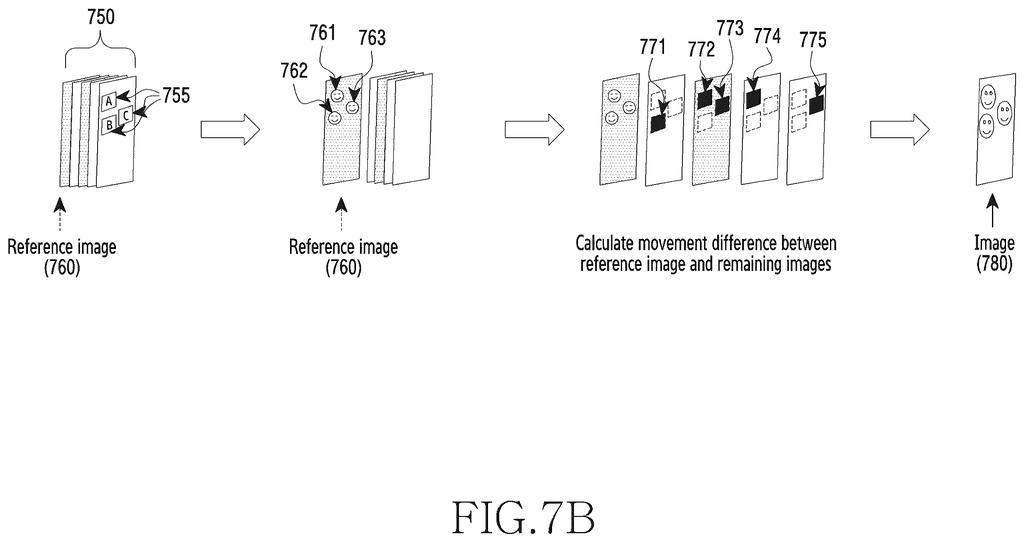
The patent adds an eye check. The phone first scans all the frames and saves an eye area image (a cropped patch covering both eyes and eyelids) of each person from a frame where their eyes are open. It then picks the base frame using sharpness, brightness, or capture time, and looks for anyone with closed eyes in it.
If it finds a blinker, it pastes that person's saved open-eye patch over the closed eyes, resizing it to fit and matching the brightness first if the frames differ. That patched image becomes the second reference image.
The phone then measures how much the other frames moved compared with it, skipping any eye regions that show closed eyes, and blends everything into the final photo. The claims also cover a second route: swapping the whole base frame for a sharp one where the eyes are open.
… calculate a movement difference between the second reference image and remaining images while excluding eye areas identified as closed …
Translation: It compares the edited base photo with other shots while ignoring the areas with closed eyes.
Why one tap instead of three could matter to you
The practical payoff is fewer retakes. If this ended up in a Samsung phone's camera app, the fix for a blink would happen automatically at the moment you tap, so you would not discover it later when the group has already walked away.
It also matters for crowds. The filing describes handling several people at once, taking one person's open eyes from one frame and another person's from a different frame. That is the case where blinks are hardest to avoid, such as family portraits and big group shots.
The filing also describes bundling the burst frames into a single moving-image file, which hints at a Live Photo style option.
Samsung's 158th filing we've tracked since May in our camera sensor push watchlist adds to earlier work on pulling hidden color data and catching the sharpest jump moment.
The trade here is truth for convenience. The finished photo can show eyes that were never open at the exact moment you pressed the shutter, pulled instead from a slightly earlier or later frame, making the result a quiet composite rather than a single captured instant.
That swap has to land perfectly to go unnoticed. A borrowed eye patch needs to match the face's position, the light falling on it, and where the person was looking, and if someone turned their head between frames, the pasted eye can look subtly wrong. The filing addresses brightness mismatches but says nothing about head angle or gaze direction, which are real ways this could go soft.
Even so, the cost is small and the benefit is one almost everyone has felt. A small risk of an odd-looking eye is a fair price for not asking everyone to hold still one more time.
Get our take in your Top Stories
Liked this breakdown? Add Patentlyze as a preferred source on Google, and our plain-English take shows up more often in your Top Stories the next time Samsung patent news breaks.
There are more where this came from
We read every patent application Big Tech publishes and send you the ones worth knowing. Plain English, free, every week.
The drawings
15 drawing sheets from US 2026/0330603 A1 · click any drawing to enlarge


Show the other 7 sheets


Want this weekly breakdown for a company we don't cover? Patentlyze Pro →
Be the first to weigh in