
Microsoft Files Patent to Lock Down Only the Sensitive Parts of Your Data
A camera watching an empty hallway doesn't need the same lock as the frame showing who just walked in. Microsoft's patent filing builds a whole system around that idea.
What Microsoft's tiered encryption actually does
A home security camera records an empty hallway for hours. Then a person walks in, and suddenly one frame holds something far more private than the thousands before it. Yet most privacy systems lock every frame with the same heavy protection, which drains battery and slows things down on small devices like your camera or your phone.
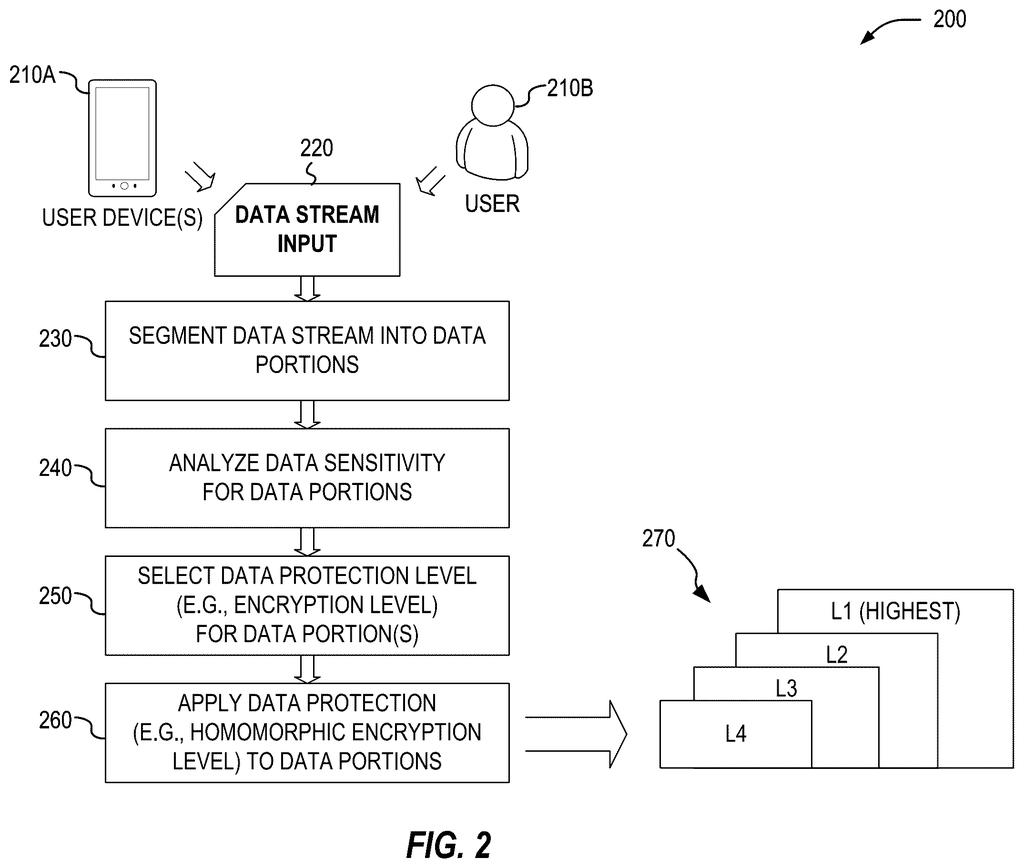
Microsoft's filing sorts the data first. It chops a stream into pieces, gives each piece a privacy score, and picks an encryption strength to match. The boring hallway frames get light protection. The frame showing who just walked in gets the strongest kind, the sort that lets a computer work on data without ever unscrambling it.
The patent also rearranges the AI's work so pieces with the same protection level get handled together, which saves effort. The goal is to keep your private data private while a small device still keeps up.
segmenting the data stream into data portions; assigning sensitivity scores to the data portions based on a sensitivity of data contents, wherein a respective sensitivity score is assigned to a respective data portion; selecting security levels for data protection of the data portions based on a respective sensitivity score assigned to a respective data portion …
Translation: The system breaks down data and rates each piece to figure out how much protection it needs.
How the patent sorts frames into privacy tiers
The method starts by segmenting a data stream (a video feed or a run of sensor readings) into portions, such as single frames or sections of an image. A trained machine learning model then gives each portion a sensitivity score. In the description, that score weighs how harmful exposure would be, which privacy rules apply, and how much information the piece holds, each with its own weight.
Each score maps to a security level, meaning an encryption strength. The claims name three:
- Full homomorphic encryption (data stays scrambled even while a computer does math on it) for the most sensitive data.
- Partial homomorphic encryption (only some kinds of math work on scrambled data) for moderate sensitivity.
- Ordinary encryption without homomorphic features for low sensitivity.
The second piece is kernel fusion. A kernel is a small building block of a neural network (the AI model), and fusing kernels means merging neighboring steps into one so they run faster. This filing only fuses steps that share a security level. The system may raise or lower a piece's level so more steps can be merged, while keeping privacy boundaries intact. A fusion that would cross a boundary is rejected.
Moving data between levels goes through gateway checks. Going up, data is re-encrypted more strongly. Going down, sensitive parts are filtered out first and the downgrade is written to an audit log.
Techniques and systems are disclosed to optimize aspects of data protection, including with the use of homomorphic encryption and other privacy-protecting measures.
Translation: Advanced encryption methods are used to keep sensitive data safe while still letting computers process it.
What this means for home cameras and wearables
If this works, your smart home camera, wearable or phone could get strong privacy protection without draining the battery or lagging. The filing's own example is a home security system: motion detection runs with light protection, and only when a person shows up does the identity-matching step switch to the strongest encryption. A simple "known person detected" flag can travel freely, while who the person is stays locked.
For Microsoft, it points at private AI work on small devices and in data centers, where privacy rules and limited power collide. The examiner's first review rejected the claims as filed, which is routine and usually followed by amendments, so the final scope could shrink.
That makes this Microsoft's 19th filing we've tracked since August in our on-device AI privacy push watchlist, following patents for hiding private apps and a voice-filtering recorder.
The cost here is trust in the sorting step. Everything depends on a model correctly scoring each piece as sensitive or harmless, and a miss means a private frame gets light protection. A wrong guess in the cheap direction does far more damage than a wasted bit of battery.
Mixing strengths also adds moving parts: gateway checks, re-encryption when data moves up, filtering when it moves down, and an audit log. Each one is another place for a bug to hide, and the filing gives no figures on how much battery or time the approach saves.
Still, putting one heavy lock on every frame is expensive on a small device, and spending the effort where the risk sits makes sense. The trade is worth it, provided the scoring is reliable.
Get our take in your Top Stories
Liked this breakdown? Add Patentlyze as a preferred source on Google, and our plain-English take shows up more often in your Top Stories the next time Microsoft patent news breaks.
There are more where this came from
We read every patent application Big Tech publishes and send you the ones worth knowing. Plain English, free, every week.
The drawings
8 drawing sheets from US 2026/0340180 A1 · click any drawing to enlarge


Want this weekly breakdown for a company we don't cover? Patentlyze Pro →
Be the first to weigh in