
Google Patents an AI Reviewer That Grades How Good Your Videos Look
Google describes an AI that watches a video roughly the way a viewer would. It scores how interesting the footage is, how damaged it looks, and how heavily it has been squeezed, then uses the result to decide how the video gets sent out.
What Google's video-quality scorer actually does
Right now, working out whether a video looks good is surprisingly hard to do at scale. The patent says one common method is to hire a team of people to watch clips and write down any visible problems, which is slow and tedious. Google's filing describes handing that job to an AI instead.
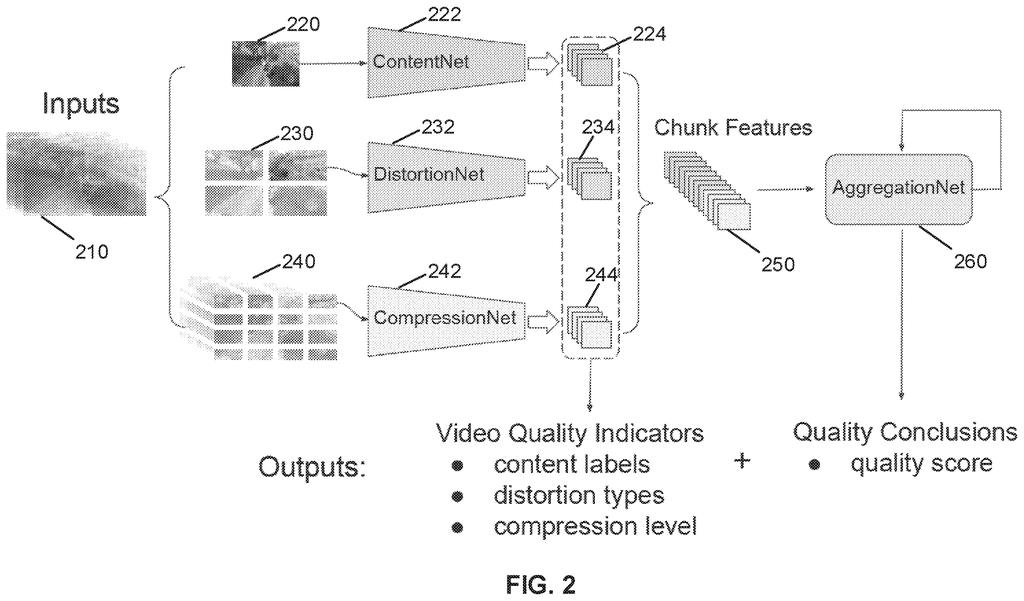
The AI checks each video in three ways: what is in it (a dance performance counts as interesting content), what flaws it shows (blur, jitter, noise), and how heavily it has been compressed (squeezed into a smaller file). Those three readings combine into a quality score.
A video service could then use that score to decide how to send the video to you, or to tell the person who uploaded it which flaws to fix.
… determining, by the computing system and using a first subnetwork of a deep neural network, a content quality indicator for one or more frames of the plurality of frames of the video content item, wherein the content quality indicator corresponds to one or more semantic content indicators for the one or more frames of the plurality of frames of the video content item …
Translation: An AI subnetwork analyzes the video frames to understand what visual content is actually inside them.
How three AI checks grade each video frame
The claims cover a system that takes a video, pulls out frames, and runs them through a deep neural network (a kind of AI that learns patterns from examples) split into smaller parts called subnetworks. One subnetwork produces a content quality indicator, a score tied to what appears in the frame, such as "dance" or "outdoor recreation." A second produces a video distortion indicator, a score for how much damage the frame shows, such as blur or noise.
Based on those two scores, the system then changes something. The first claim lists the options: adjusting the bitrate (how much data is sent per second), adjusting the resolution, making a compressed copy, applying distortion correction, or converting the video to a different format. A narrower claim adds a third subnetwork that scores compression, which the description puts on a scale from 0 (none) to 1 (heavy).
The description adds specifics. Content is checked on one frame per second, shrunk to a lower resolution. Distortion is checked on one frame per second at full resolution, so resizing does not add flaws of its own. Compression is checked on five frames per second at full resolution to catch changes over time. In one example, a dance video scored 3.621 for content, 3.16 for distortion and 2.862 for compression, giving 2.955 overall, which the filing calls a poor watching experience.
… generate a quality level for each frame based on at least the content quality indicator and the video distortion indicator for the frame; and output an indication of quality for the video content item based on the quality level for each frame.
Translation: The system combines the content and flaw analysis to output an overall quality score for the video.
Why a video-quality grade could shape your uploads
If you watch or upload video online, this kind of scoring could shape how sharp your video looks and how much data it uses. The filing says a high-scoring portion of a video could be sent at higher resolution, while a low-scoring portion goes out at lower resolution with little visible difference. Videos that score poorly could be compressed further to save bandwidth.
If you upload videos, the filing also describes feedback. Labels such as "Gaussian blur" or "color saturation" would show what dragged your score down, so you could fix those parts before posting. It also says a service could use the scores to tune its recommendations.
Google's 76th filing we've tracked in our AI photo editing race since May builds on earlier applications like the group zoom fix and AI blur repair.
Getting this from filing to working feature requires no new hardware, only software running on servers that already handle every upload.
Before it ships, engineers need a trained model and evidence that its automated quality scores actually match what real viewers think looks good. The document describes how that training would work but stops short of showing those results.
The most likely first version would feed quality scores into decisions about how a video gets compressed and delivered, meaning viewers might notice only that things load a little sharper or smoother than before.
Get our take in your Top Stories
Liked this breakdown? Add Patentlyze as a preferred source on Google, and our plain-English take shows up more often in your Top Stories the next time Google patent news breaks.
There are more where this came from
We read every patent application Big Tech publishes and send you the ones worth knowing. Plain English, free, every week.
The drawings
8 drawing sheets from US 2026/0352898 A1 · click any drawing to enlarge


Want this weekly breakdown for a company we don't cover? Patentlyze Pro →
Be the first to weigh in