
Google Files Patent to Keep AI Photo Repair From Inventing Fake Details
Google's photo-sharpening AI has a weakness: when a blurry patch could be fur or tongue, it can guess wrong. This filing hands it a caption and three kinds of map to check its guesses against.
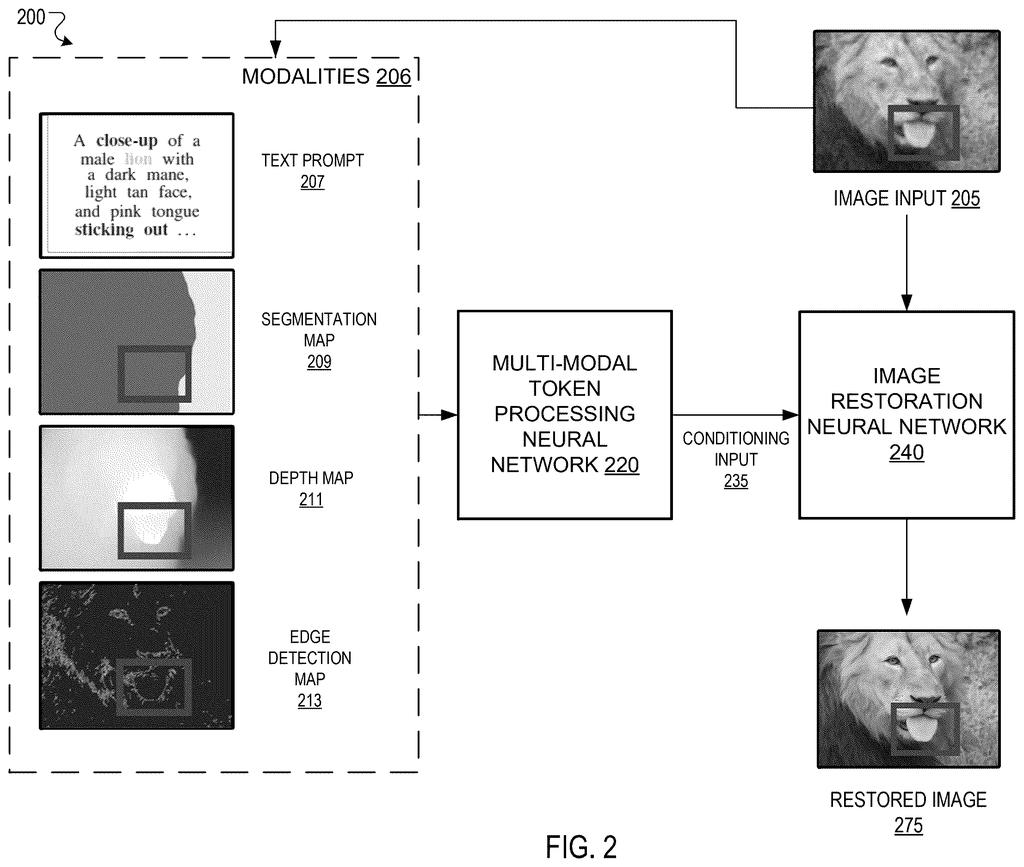
What Google's four-clue photo repair does
A grainy, low-resolution photo shows a lion with its tongue sticking out. Software that sharpens the picture has to guess what that blurry pink patch is, and sometimes it guesses wrong, giving the tongue a furry texture borrowed from the mane. If you have looked at an AI-enhanced photo and felt a face or texture was slightly off, a wrong guess like this may be why.
Google's patent application describes giving the sharpening AI more clues before it starts. First it writes a short caption of the photo. Then it builds three maps: one outlining the objects, one tracing the edges, and one estimating how far away each part is. The AI reads all four clues together while it rebuilds the image.
The idea is that knowing this region is a tongue and this is where it ends keeps the AI from borrowing the wrong texture. The filing says the same approach can also remove grain, fix blur, and fill in damaged areas.
receiving an input image; obtaining, for each of a plurality of modalities, a respective context input belonging to the modality and characterizing the input image; and performing an image restoration task on the input image by generating a restored image from the input image using an image restoration neural network …
Translation: The system takes a photo and analyzes multiple different types of data about it before fixing the image.
How the AI merges a caption with depth maps
The core claim is simple: take a damaged image, collect several kinds of information about it (each kind is called a modality), and feed all of it to the neural network that produces the repaired version. The main example uses four: a text caption, a segmentation map (a map labeling each region, such as "lion" or "background"), an edge map (where the outlines are), and a depth map (how far away each part is).
Each clue is converted into a set of tokens (small chunks of numbers the AI can read). A separate network then squeezes all those tokens into a shorter, fixed-length summary using cross attention (a method where a small set of learnable slots picks out the most useful parts of a longer list). That summary steers the repair network.
The repair network is a diffusion model. It starts from random noise and cleans it up over many steps, with the damaged photo and the summary guiding each step. The filing also describes:
- A negative prompt, such as "blurry, distorted face, closed mouth," blended with the normal caption to steer away from unwanted looks.
- Dials that make one clue count more or less in the final result.
- Training that randomly hides clues, so the system still works when one is missing.
Tasks named include super resolution (adding pixels), denoising, deblurring, and inpainting (filling in missing areas).
Why fewer invented details matter for your photos
If you zoom into an old family photo or a shaky phone shot, today's AI sharpeners can fill in details that look convincing and are wrong. The approach described here gives the AI a written description plus maps of outlines and depth, so it has better grounds for deciding what belongs where. The filing names no product, but photo-enhancing apps and camera software are the obvious places this kind of tech could show up.
The filing also says the extra clues add little size to the existing model, and that a user can set how much each clue counts. In Google's own comparison, shown on a lion photo and six quality measures, its model beat the other methods tested on all six. Those numbers come from Google's own tests.
Google's 72nd filing we've tracked in the AI photo editing race since May follows work like fixing far-away coworkers on camera and matching AI images to text.
If you have ever enlarged a photo and watched the software turn a patch of fur into something plasticky, or invent a smile that was never there, this filing targets that failure. Giving the AI a caption and maps of outlines and depth means it checks its guesses against what the picture actually contains.
You would notice the difference where mistakes hurt most: faces, animal fur, skin, textures. A blurry photo at least looks blurry. A sharpened photo with an invented detail looks crisp and wrong, and you may never catch it.
The proof in the filing is one lion photo plus Google's own scores, so treat it as a promising idea. The option to set how much each clue counts, and to name looks to avoid, could give you a real say in how aggressive the repair gets.
Get our take in your Top Stories
Liked this breakdown? Add Patentlyze as a preferred source on Google, and our plain-English take shows up more often in your Top Stories the next time Google patent news breaks.
There are more where this came from
We read every patent application Big Tech publishes and send you the ones worth knowing. Plain English, free, every week.
The drawings
7 drawing sheets from US 2026/0330607 A1 · click any drawing to enlarge


Want this weekly breakdown for a company we don't cover? Patentlyze Pro →
Be the first to weigh in