
Adobe Files Patent for AI That Swaps a Video's Food and Scenery to Suit Another Country
Hand this system a clip of biryani on a marble table, tell it the audience is in Japan, and Adobe's filing describes AI that returns sushi on a tatami mat, with the camera moving the same way.
What Adobe's video culturalization patent does
Ever watched an ad that felt made for somebody else's country? Brands usually fix that by reshooting, or by paying people to find local footage and edit it in by hand. That is slow, and the results vary from one editor to the next.
Adobe's filing describes a shortcut. You hand over a short clip and pick a country. The system watches the video by describing a handful of its still frames in words, spots things with cultural meaning, such as food or birds, and rewrites the description for the target place. The filing's own example turns a plate of biryani on a marble table into sushi on a tatami mat.
Then an AI video generator builds a new clip from that rewritten description. It starts from a freshly made first frame, so the camera move and the layout still match the original.
… identifying, via a cultural concepts component, cultural concepts from a corresponding image description of the image descriptions based on applying, to the language model, a second prompt comprising the corresponding image description; …
Translation: The AI looks at the video's details to spot cultural items like local food or scenery.
How Adobe chains AI models to rebuild a clip
The claims describe a chain of AI steps, each one feeding the next. First the system picks key frames, the handful of stills that differ most from each other. One described method groups frames by their brightness patterns (pixel intensity histograms) and picks the best frame from each group.
- Describe: A vision language model (an AI that reads images and writes about them) describes each key frame, including a guess at the camera angle, such as panning left and zooming out. A language model then merges those into one description of the whole clip.
- Spot cultural concepts: From the first frame's description, a language model picks out categories like food, birds or urban scenery from a predefined list.
- Rewrite: Using the target region and a stored set of cultural guidelines, it writes a new image description and a new video description.
- Rebuild: A text-to-image model makes a new first frame that keeps the original frame's layout, then a generative video model produces the clip from it.
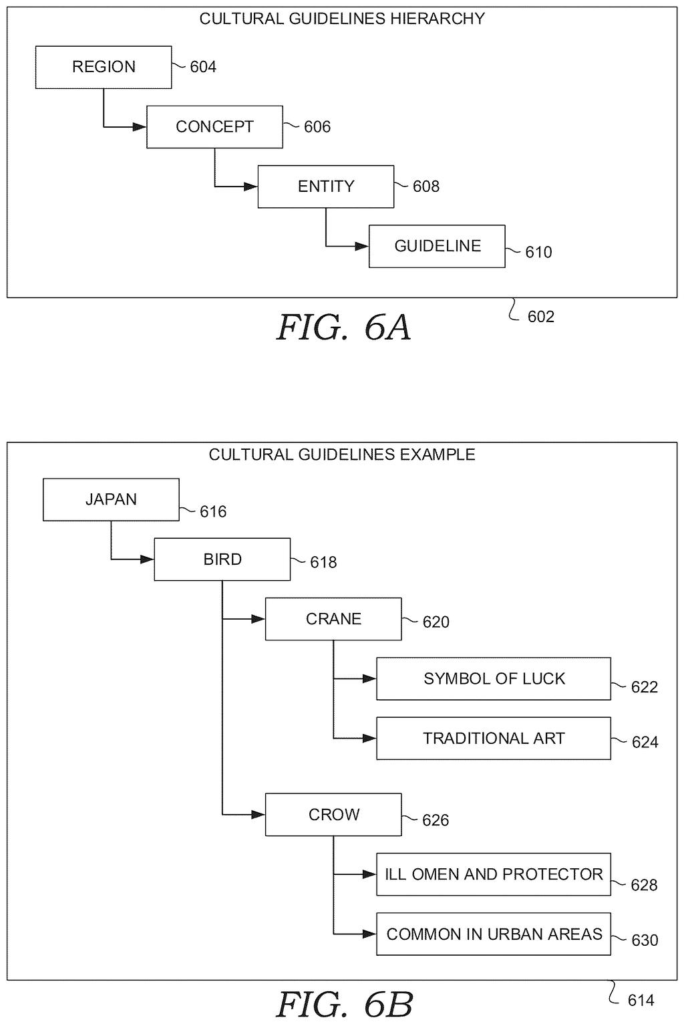
The guidelines are organized as a hierarchy: region, then concept, then specific entity, then notes on how that entity is viewed. In the filing's example, for Japan and the concept of birds, a crane signals luck while a crow is common in cities, so an urban scene might get a crow.
A culturalized video is generated based on the culturalized video description and the culturalized image as the initial seed frame of the culturalized video.
Translation: It then builds a brand new version of the video tailored to fit the target country.
What this could mean for global ads and creators
If you make or run videos for more than one country, this targets a slow chore: making each version feel local. The filing says the steps run automatically, with no human in the loop, so one clip could yield a version for each country with consistent results, instead of a fresh round of editor judgment calls every time.
The filing names Adobe Firefly as one example of the video generator, which ties the idea to Adobe's own AI video tools. It is a patent application, so nothing here says a feature is coming. The output also depends on the guideline lists someone writes, which leaves open whose idea of a country's culture gets built in.
Adobe's 45th filing we've tracked since May joins earlier applications on describing selected photo areas and guessing a room's lighting, all part of our AI photo editing race watchlist.
If you watch ads or streaming clips, the benefit you would notice is a video that looks made where you live, with the food, birds and settings of your own country. That beats the usual dubbed or subtitled version of a foreign clip, and it is the clearest payoff in this filing.
The risk shows up in the swapping itself. An AI that decides a crow suits a Tokyo street, or that sushi should stand in for biryani, is making a judgment about a whole culture. A viewer who lives there will spot a clumsy guess right away. Whether the result feels thoughtful or cartoonish depends on how good the guideline lists are, and the filing shows only a tiny example.
It is a filing, not a product, so nothing here says when or whether you would see it.
Get our take in your Top Stories
Liked this breakdown? Add Patentlyze as a preferred source on Google, and our plain-English take shows up more often in your Top Stories the next time Adobe patent news breaks.
There are more where this came from
We read every patent application Big Tech publishes and send you the ones worth knowing. Plain English, free, every week.
The drawings
11 drawing sheets from US 2026/0320850 A1 · click any drawing to enlarge


Show the other 3 sheets


Want this weekly breakdown for a company we don't cover? Patentlyze Pro →
Be the first to weigh in