
OpenAI Patents a Chat Window That Builds Working Apps and Lets You Tweak Them
OpenAI describes a chat window that writes an app, runs it right beside the conversation, and lets you reshape any piece of it by hovering and typing a request.
What OpenAI's chat-built app patent actually does
Ever asked a chatbot to build you a little calendar app, then had to copy the code somewhere else just to see if it works? This OpenAI patent application describes skipping that step.
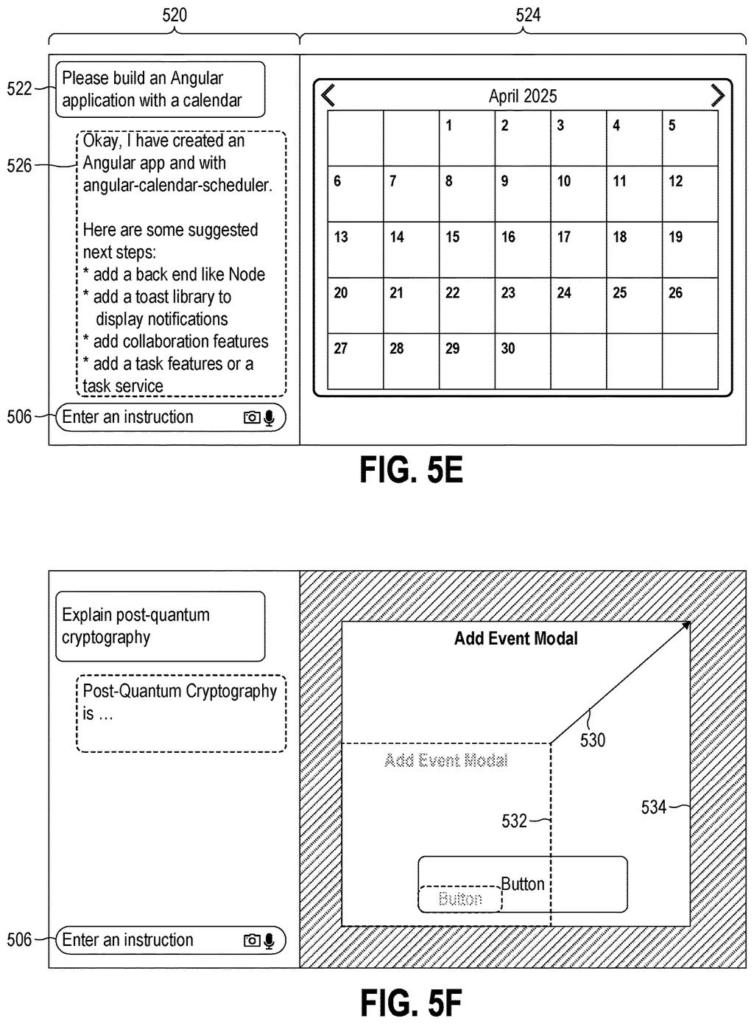
You type what you want into a chat panel, and the finished app shows up in the main part of the screen, running and clickable. Want to change something? Hover over a piece of it, like the calendar box, and a small control panel pops up right beside it with options such as font size and color, plus a text box.
Type something like 'turn this single date picker into a date range,' and the app updates on the spot. The filing says data you already typed into the app can stay put while it changes. The app also runs in a walled-off area, so it can only reach what the chat tool allows on your device.
receiving, at an outer application, a first prompt to generate an inner application using a generative response engine; responsive to the first prompt, obtaining code for the inner application, wherein the code includes at least one function corresponding to a natural language description within the first prompt; …
Translation: The main chat window takes a text request and turns it into working software code.
How the inner app runs inside the chat window
The claims describe two layers. An outer application (the chat-style tool you work in) takes your prompt and asks a generative response engine (an AI model that writes content, code included) for code. The outer app runs that code and draws the result, called the inner application, in its own main area.
Edits work the same way. A modification request can come from your input or from an agentic action (a step the AI decides to take on its own). The AI sends back instructions, often a patch (a bundle of changes to specific pieces of code) that can include a dependency graph (a map of which pieces rely on which). The outer app applies the patch and redraws the inner app, and the claims say it can keep the running state of a component through the update.
The filing and claims also describe:
- A sandbox: the inner app runs in a controlled environment that limits its access to the host device's resources, and supports live previews.
- Hover controls: an input event on a component shows controls nearby, and the request is scoped to that component or the pieces inside it.
- Long tasks: for bigger jobs, like adding a weather feed, the AI drafts a plan, you approve it and supply any needed key, and quick edits can continue in the meantime.
The description adds that patches can be merged out of order, with a merge screen if two changes conflict.
… receive a first input into a component of the user interface to adjust a visual aspect of the component; and generate a modification to a first code subset to correspond the visual aspect of the user interface.
Translation: You can click and tweak parts of the app, and the system automatically updates the underlying code.
Why hover-to-edit matters for non-coders
If you have ever wanted to change one button in an app an AI built for you, you usually go back to the chat and describe it, or dig into the code yourself. The filing's own complaint about today's online coding tools is that edits still happen by hand in a code area separate from the app. Here, you point at the thing and ask, which makes small changes feel closer to editing a document.
For OpenAI, this ties a chat product to something people can build with, and not only talk to. The filing names ChatGPT as one example of the AI engine involved, and it is a continuation of an application filed in August 2025, so the idea has been in the pipeline for a while. Nothing in it says when, or whether, a product appears.
OpenAI has filed its sixth patent we've tracked under Enterprise AI since May, adding to a set that includes a self-repair tool for apps and a thinking-effort slider.
Software only, and mostly built from pieces that already exist. The AI part writes code today, and the filing itself notes that online coding tools already offer live previews and sandboxes. No new hardware is needed, so the distance to a shippable feature is short.
What still has to be built is the glue: the hover controls, a way to keep your typed data when the app changes, and a patch system that merges edits made at the same time. The filing describes all three, which points to a chat product with a live app beside the conversation as the shortest route to something real.
The open question is trust. An app that rewrites itself while you click around needs strong walls, and the claims put the app in a sandbox that limits what it can reach on your device. How well any of this behaves with a messy, real-world app is impossible to judge from a patent.
Get our take in your Top Stories
Liked this breakdown? Add Patentlyze as a preferred source on Google, and our plain-English take shows up more often in your Top Stories the next time OpenAI patent news breaks.
There are more where this came from
We read every patent application Big Tech publishes and send you the ones worth knowing. Plain English, free, every week.
The drawings
15 drawing sheets from US 2026/0349689 A1 · click any drawing to enlarge


Show the other 7 sheets


Want this weekly breakdown for a company we don't cover? Patentlyze Pro →
Be the first to weigh in