
Microsoft Files Patent for an AI Chat That Lets You Keep Talking While It Thinks
Ask an AI a hard question and you usually sit there watching a spinner. This Microsoft patent application describes a chat where a second AI keeps answering you while the first one is still working.
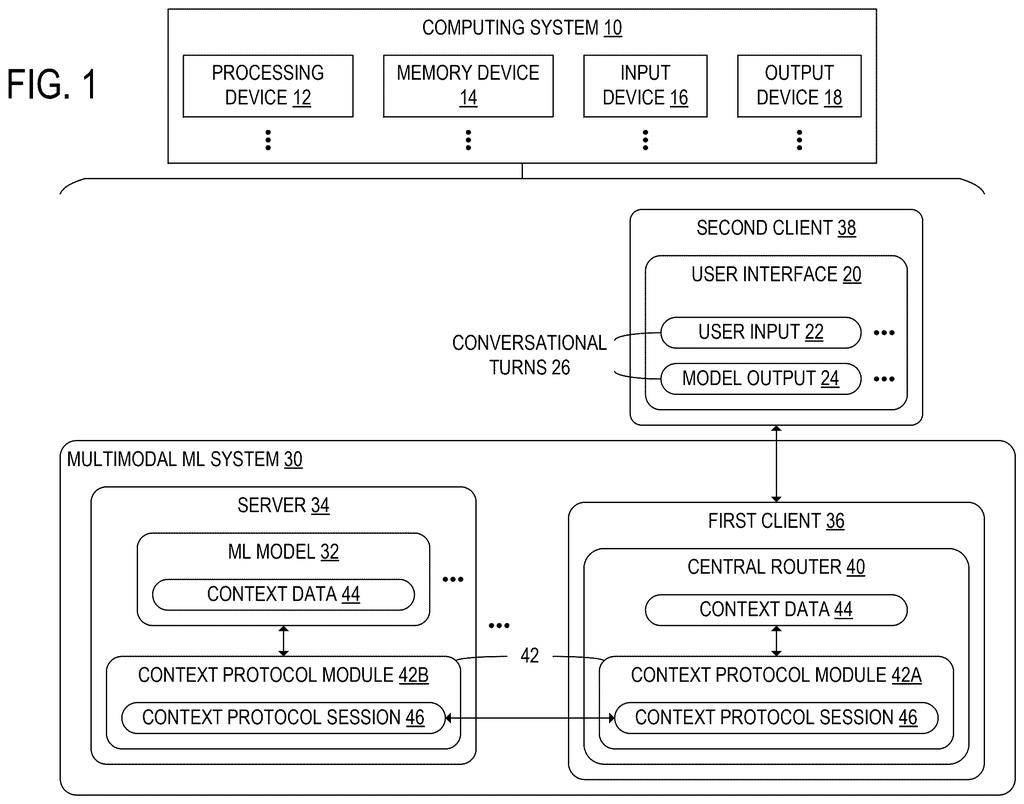
What Microsoft's keep-chatting AI setup does
Today, when you ask an AI chatbot a hard question, you mostly wait. These systems answer one message at a time, so a slow job, like deep reasoning or a web search, can freeze the whole conversation until it finishes.
Microsoft's filing describes a different setup. After you send your first request, you can keep typing. A second AI model picks up your new messages and answers them while the first model is still busy. When the slow answer finally arrives, it lands in the same chat.
The filing also describes a few extras: a time estimate for how long the slow answer will take, a peek at a half-finished result, and a waiting line so two replies don't try to use your speaker or screen at the same moment.
… during execution of the first model call: receive one or more second user inputs; perform one or more second model calls to a second ML model included in the ML system to compute one or more second model outputs based at least in part on the one or more second user inputs; and output the one or more second model outputs to the user interface …
Translation: The system lets you type more messages and gives you answers while the main AI is still working on your first prompt.
How a central router juggles two AI models
The patent covers a chat system built from several AI models instead of one. When you send a first message, the system starts a model call (a request telling one model to begin working) on the first model. While that call is still running, your next messages go to a second model, which answers right away. The first model's answer is shown afterward, whenever it is ready.
Behind the scenes, a central router (a traffic-director program) passes context between the models, which can run on different servers. They share it through a context protocol (a common format for handing over a conversation's history; the filing names Model Context Protocol as an example). The router can also pass the second model's replies to the first, so the slow model can use what came up in the meantime.
The claims describe several add-ons:
- Partial results: the system can ask the first server for a half-finished answer, show it to you, and feed it to the second model.
- Time estimate: the first server reports how long it expects to take, and you see it.
- Hang up and reconnect: the router disconnects from the first server after sending your request and reconnects when the answer is ready, while staying connected to your screen.
- Output queue: if a screen or speaker is busy, the answer waits in line behind earlier outputs of the same type.
A separate independent claim stretches this to many conversations with different models on different servers, all shown in one interface.
Subsequently to outputting the one or more second model outputs, the one or more processing devices receive and output a first model output computed at the first ML model in response to receiving the first user input.
Translation: After handling your newer questions, the system finally delivers the answer to your original request.
Why waiting on slow AI answers could get easier
If you have ever handed a chatbot a long research task, you know the wait. A setup like this would let you keep working in the same chat, ask a quick follow-up, or check how far along the slow job is, instead of staring at a loading indicator. Being able to peek at half-finished work, then stop or restart it, could also save you time when a request is going the wrong way.
For Microsoft, the filing points toward chat tools made of many specialized models, with a coordinator deciding who answers what. The reconnect trick, which skips holding a line open during a long wait, is described as a way to cut bandwidth. It is a patent application, so nothing here says when or whether it becomes a feature you can use.
Microsoft's 40th filing we've tracked in our AI models working in teams since May builds on earlier applications like one on multi-model search suggestions and one on rewriting AI instructions.
The price of this design is order. Answers can arrive out of sequence, and the filing itself describes a reply to your third message showing up before the reply to your second. Keeping track of which answer belongs to which question becomes your job.
The second cost is quality. The fast model filling the gap only knows what the router hands it, so a quick reply could miss context the slow model is still working out. Passing partial results and finished answers between the models helps, and it also adds more moving parts that can break.
The trade reads as worth it. A little confusion about ordering beats minutes of a frozen chat, and the option to stop or restart a half-finished answer gives you real control. The idea is simple and sensible, and the success of it will depend on how clearly the screen shows which reply belongs to which request.
Get our take in your Top Stories
Liked this breakdown? Add Patentlyze as a preferred source on Google, and our plain-English take shows up more often in your Top Stories the next time Microsoft patent news breaks.
There are more where this came from
We read every patent application Big Tech publishes and send you the ones worth knowing. Plain English, free, every week.
The drawings
25 drawing sheets from US 2026/0320475 A1 · click any drawing to enlarge


Show the other 17 sheets


Want this weekly breakdown for a company we don't cover? Patentlyze Pro →
Be the first to weigh in