
Google Files Patent for a Locked Vault That Guards Your Phone's Startup Secrets
Every time a device starts up, it handles secrets that prove it hasn't been tampered with. Google's filing moves those secrets into a separate protected component that does the sensitive math so the rest of the device never sees them.
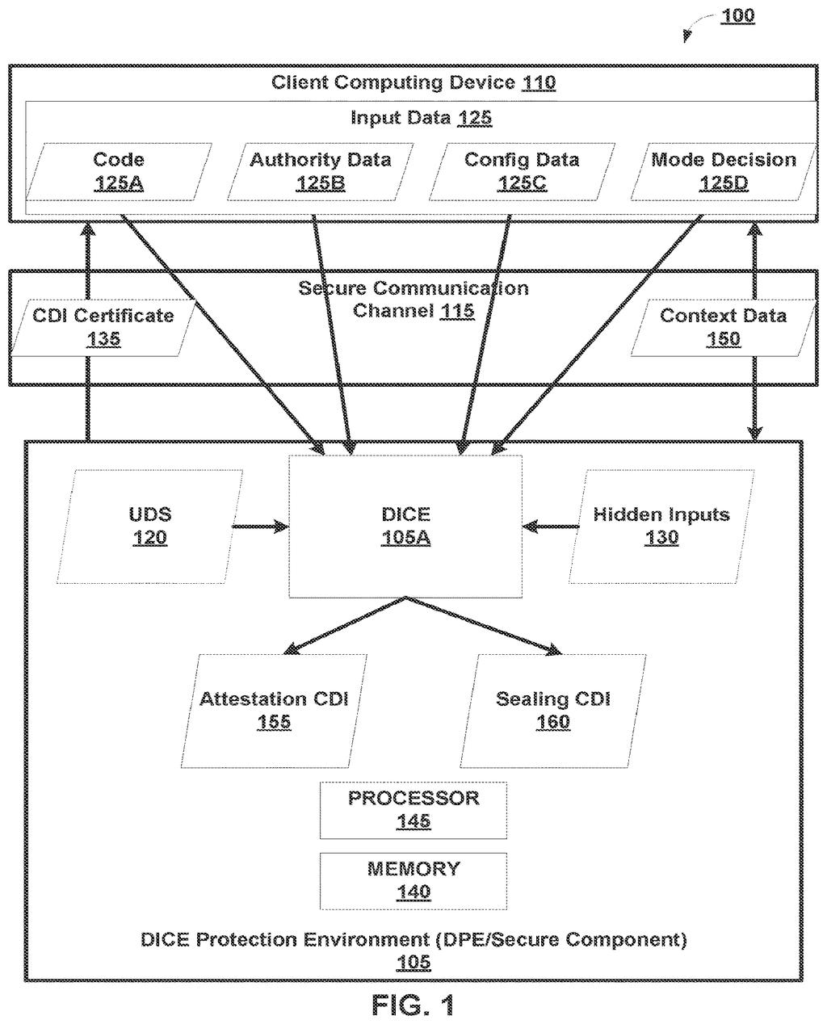
What Google's locked-down startup vault does
A bank teller leaves the vault key on a hook behind the counter. Anyone who walks past could grab it, copy it, or just look at it long enough to remember the shape.
That is roughly how a device treats certain secrets when it starts up. Each program in the startup chain handles secret values that prove the device is genuine and unmodified. If a hacker gets into any one of those programs, those values can be stolen or faked, and nobody can tell.
Google's patent application describes a separate protected component that acts as the vault. The main device never holds the secrets. It holds only a claim ticket, and it asks the vault to do the sensitive work. The vault hands back a signed certificate, a digital ID card showing what is running, and keeps the secrets to itself.
… determining, by the secure component, context data for a cryptographic subtask of a task associated with the DICE protocol, wherein the context data comprises a handle identifying actual data stored in a memory of the secure component …
Translation: The secure hardware checks what data it needs to run a cryptographic check during bootup.
How the vault hands out claim tickets
When a phone or computer boots, it runs a chain of programs, each one checking the next. A standard called DICE (Device Identifier Composition Engine) handles this. It mixes a secret baked into the hardware with a fingerprint of each program to produce an identity value, called a compound device identifier, or CDI. That value is used to sign a certificate, a digital ID card the next program can show to prove what it is.
Google's filing adds a protected helper, called a secure component, that does this work. It starts up during the boot process and receives context data from the main device. That data is either a handle (a claim ticket pointing to information stored inside the helper) or the real data, encrypted so only the helper can unscramble it. The helper decrypts it, works out the CDI, and generates the certificate. The decrypted data never leaves the helper. It then passes control to the next program by handing over the certificate.
The dependent claims and description add more detail:
- The helper and device talk over an encrypted link built on the Noise Protocol Framework (a modern recipe for private connections).
- Messages use a stripped-down data format that rejects anything malformed.
- Each session has a 16-bit ID, and closing a session deletes the keys and context data tied to it.
- Sealed data (information locked to a device state) is tied to version clamps, so older firmware cannot open data locked to newer software.
… executing, by the secure component, the cryptographic subtask based on the input data and the context data; and providing, by the secure component and to the client computing device via the secure communication channel, an output of the cryptographic subtask.
Translation: The secure chip finishes the math puzzle and sends the safe result back to the phone.
Why locking up boot secrets matters to you
If you use a phone, laptop or any connected device, the first moments after you press the power button decide whether you can trust everything that runs afterward. The filing lists ways attackers go after those early secrets: compromised software during boot, leaks from memory saved while a device hibernates, and signals leaking from the chip itself. Keeping the secrets in one guarded place is meant to shut those routes.
The filing also targets a quieter annoyance. Locking data to a device's exact software version breaks every time the software updates, and loosening that rule can let old, buggy firmware open new data. The version clamp idea tries to fix both. The description says the protected component could be a separate chip, a secure app on the device, or a virtual machine, so it is a design that device makers could adapt in different ways.
Google's 63rd filing we've tracked since May in our on-device AI privacy watchlist follows its earlier applications for searchable private cloud storage and on-device ad selection.
A device's startup secrets sit at the foundation of everything else. If an attacker fakes them, your phone can report that it is clean while something hostile runs underneath, and nothing above that layer can catch the lie.
The filing is candid about how the leaks happen: memory saved to disk during hibernation, a frozen memory chip read out afterward, or eavesdropping on a chip's electrical signals. Its answer is to hold the secrets in one guarded place and let the rest of the device see only claim tickets. That fix matches how the weakness actually works, which matters more than it sounds.
You will never see this feature or notice it. Success looks like nothing happening. An invisible fix to a costly, well-understood weakness is a sensible thing for a company that ships phones and cloud servers to spend filings on.
Get our take in your Top Stories
Liked this breakdown? Add Patentlyze as a preferred source on Google, and our plain-English take shows up more often in your Top Stories the next time Google patent news breaks.
There are more where this came from
We read every patent application Big Tech publishes and send you the ones worth knowing. Plain English, free, every week.
The drawings
5 drawing sheets from US 2026/0352496 A1 · click any drawing to enlarge


Want this weekly breakdown for a company we don't cover? Patentlyze Pro →
Be the first to weigh in