
Qualcomm Files Patent for Videos That Carry a Hidden, Locked Copy of Blurred Faces
One video file, two versions of reality: strangers see a blurred face, and anyone holding the right key sees the real one.
What Qualcomm's blur-plus-lock video file does
Imagine your car's dashboard camera records a fender bender, and you need to share the clip. The footage also caught a dozen pedestrians and a few license plates. You want the right person to see the crash, and you want everyone else's faces left out.
Qualcomm's filing describes a way for the camera to handle this while it records. It spots the sensitive parts, such as faces, whole people or license plates, and blurs or blacks them out in the main video. The original pixels from those spots get locked with a digital key and tucked into the same file as a hidden extra.
Anyone who plays the file without the key just sees the blurred version. Someone with the key, and permission switched on, gets the full picture back. One file does both jobs, so nobody has to store two copies.
… extract and encrypt ROI content from the ROI to generate encrypted ROI content; mask at least a portion of the ROI to generate a masked image frame; and generate output media data that includes: an encoded masked image frame corresponding to the masked image frame; an encoded encrypted ROI frame corresponding to the encrypted ROI content; and content protection data …
Translation: The system hides the face and locks the real details away in an encrypted file.
How the hidden frame stays out of sight
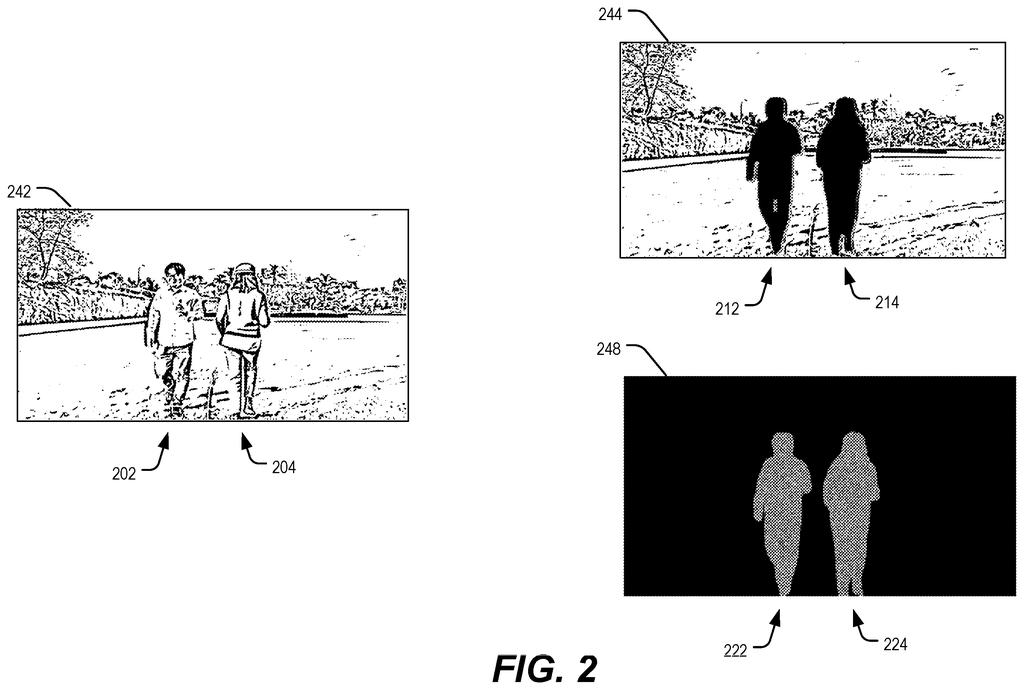
The system starts by looking for a chosen object class, such as a person, face, voice, license plate or document. When it finds one, it marks a region of interest (ROI), the patch of the frame holding that object. It can also build a segmentation frame, a black and white map showing exactly which pixels belong to the object.
Then it does two things to that patch. It copies the pixels out and encrypts them (scrambles them so only a key holder can read them), using a format-preserving method that keeps the data the same size. It also masks the patch in the visible frame with a blur, a solid color, stripes or random-looking noise. The encoder then packs the output into a video bitstream containing:
- The masked frame, which is what normal viewers see;
- An encrypted ROI frame, flagged with a no-display message (a standard tag telling a player to decode a frame but never show it);
- content protection data, including an encryption flag, algorithm details, and optionally the secret key itself, locked with the recipient's public key.
Because the hidden frame carries a standard do-not-show tag, an ordinary player skips it. A player that understands the scheme checks the flag, confirms it has the key and that the user turned decryption on, then decrypts the patch and pastes it back using position data or the segmentation map. The claims cover both the encoding side and this decoding side.
The encoded encrypted ROI frame is indicated as a non-display frame by a non-display indicator.
Translation: A special flag tells video players not to show the hidden part unless unlocked.
Why Qualcomm's one-file privacy trick matters
Cameras now sit in dashboards, on glasses, on doorbells and on police uniforms, and they record a lot of bystanders. Privacy rules differ from country to country, and the filing also points to worries about personal footage being used to train AI. A recording that is blurred for the public and complete for authorized viewers gives device makers a way to follow those rules without keeping two separate files.
The filing also says older approaches often encrypt a whole video, which costs computing power and battery. Locking only the sensitive patches should cost less. The patent lists phones, tablets, smartwatches, cameras, AR and VR headsets and vehicles as places the chip could run, which fits Qualcomm's business of making processors for exactly those devices.
That makes this Qualcomm's 23rd filing we've tracked since July on our watchlist for on-device AI privacy, following their work on hiding faces with a key and keeping AI sharp over wireless.
Every camera sold into a doorbell, a car, or a pair of glasses now records strangers who never consented, and the legal rules governing that footage shift country by country. A maker that wants one device to sell everywhere needs a way to show different viewers different versions of the same footage, without rebuilding the camera for each market.
This approach matches that scale by protecting only the sensitive parts, faces and license plates, at the moment of capture, then packaging both the visible and the hidden versions into a single file. Older devices play the footage normally and simply skip what they cannot read, so nothing breaks.
The real risk sits in the detector itself. A missed face stays visible, and no packaging solution fixes that. Key management determines who actually unlocks the private layer, which is where most real-world disputes will land.
Get our take in your Top Stories
Liked this breakdown? Add Patentlyze as a preferred source on Google, and our plain-English take shows up more often in your Top Stories the next time Qualcomm patent news breaks.
There are more where this came from
We read every patent application Big Tech publishes and send you the ones worth knowing. Plain English, free, every week.
The drawings
18 drawing sheets from US 2026/0340975 A1 · click any drawing to enlarge


Show the other 10 sheets


Want this weekly breakdown for a company we don't cover? Patentlyze Pro →
Be the first to weigh in