
Adobe Files Patent for an AI Writer That Copies a Brand's Voice
A chatbot that writes your marketing emails the way your brand would write them: that is what Adobe's filing describes, built by training on a company's own past emails.
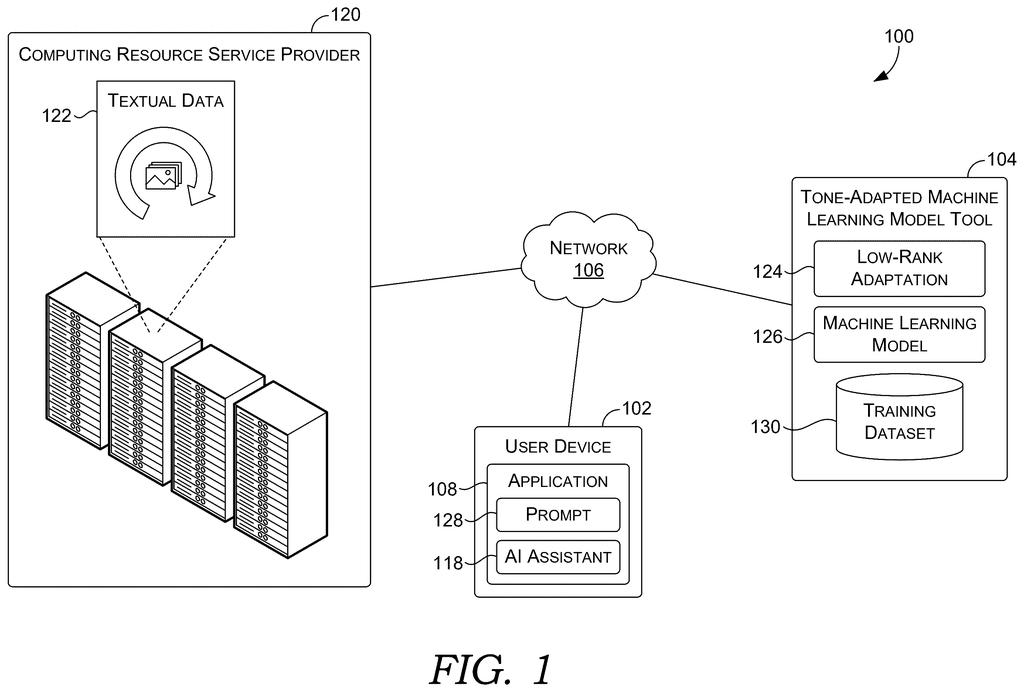
What Adobe's brand-voice AI actually does
Ask a general-purpose AI chatbot to write a marketing email and you tend to get something that sounds like every other marketing email. Adobe's filing says that is the core problem: broadly trained tools produce generic text, and fixing it by hand eats up the time the AI was supposed to save.
Adobe's answer is to teach the AI one brand's voice. You feed it emails and other writing the company has already approved, and the system labels the pieces, such as the subject line, the headline and the 'call to action' (the Explore now part that tells you what to click). It then trains a small add-on from those labeled examples.
That add-on gets attached to a chatbot that already knows how to follow instructions. Ask it for a new-feature email, and the draft comes out in the brand's style and in the shape of a real email.
… generating a low-rank adaptation (LoRA) by at least fine-tuning a pre-trained machine learning model based on the training dataset; and merging the LoRA with an instruction fine-tuned machine learning model to generate a tone-adapted machine learning model.
Translation: The system trains a specialized AI adapter on brand writing samples and merges it with a standard model.
How Adobe bolts a brand's voice onto a chatbot
The filing describes a pipeline in four steps. First, the system collects text that carries a brand's tone, such as marketing emails, ads, chat logs or documentation. It stores that text in a key-value structure (think of a labeled filing cabinet): the key is the role, like 'subject line' or 'call to action,' and the value is the actual text.
Second, it fine-tunes a pre-trained language model on that dataset. Rather than rewriting the whole model, it trains a low-rank adaptation, or LoRA: a compact set of small matrices that records only how the model's weights (its internal settings) should shift. Third, that LoRA is merged into an instruction fine-tuned model, meaning a version already trained to follow requests, built from the same base model.
Fourth, when a user asks for something, guided decoding constrains the output as it is generated. A schema, such as one defining an email's parts and data types, limits which words the model can produce so the result has the expected layout.
The filing also describes a chat assistant inside an application where you can refine a draft over several rounds. It says the same approach could copy an author's or a writing style's tone, not only a brand's.
… textual data generated to represent a particular identity, such as a brand or enterprise, is used to generate the training dataset by at least associating attributes of the tone with particular text segments.
Translation: Company text samples are analyzed to map out the specific characteristics of their writing style.
Why on-brand AI writing matters to marketers
If you work in marketing or customer support, the pitch is fewer rounds of 'make it sound like us.' The filing says generic AI output often needs time-consuming refinement and that writing good prompts takes skill. A model already tuned to a brand's voice, with a chat box inside an app, aims to cut both. It names Adobe Customer Journey Analytics as one example of an application that could host the assistant.
For Adobe, this fits its marketing software business, where customers care a great deal about consistency. A model that holds one voice across emails, ads and support replies is an easier sell to a brand than a general chatbot. The filing gives no test results, so how well it works is unproven.
Adobe's fifth application in the Voice & speech AI space we've tracked since August follows earlier work on locating the right PDF table and showing where an answer came from.
The biggest cost here is that the model learns a brand's past. It copies whatever voice is in the training pile, so if the approved emails are stale or inconsistent, the AI reproduces that faithfully. A brand that wants to change its tone has to gather new examples and train again.
Locking the format has a price too. Forcing every email into a fixed set of parts keeps drafts tidy, yet it leaves little room for a campaign that breaks the template. The filing also relies on a person choosing the examples, so the quality of the output depends on that choice.
Still, the trade reads as worth it for routine business writing, where sounding the same every time is the whole point. Training a small add-on is far cheaper than retraining an entire model, and that is the sensible part. As a technique it looks like a practical combination of existing steps, and the filing offers no results showing how closely the output matches a brand.
Get our take in your Top Stories
Liked this breakdown? Add Patentlyze as a preferred source on Google, and our plain-English take shows up more often in your Top Stories the next time Adobe patent news breaks.
There are more where this came from
We read every patent application Big Tech publishes and send you the ones worth knowing. Plain English, free, every week.
The drawings
9 drawing sheets from US 2026/0350362 A1 · click any drawing to enlarge


Show the other 1 sheets

Want this weekly breakdown for a company we don't cover? Patentlyze Pro →
Be the first to weigh in