
IBM Files Patent for an AI Chatbot That Decides How Hard to Search Before Answering
IBM's filing describes an AI that sizes up each question before it searches, then learns from your clicks whether it dug too deep or not deep enough. Easy questions get a quick lookup, and hard ones get the full treatment.
What IBM's search-depth patent does for AI answers
A librarian gets two requests in the same hour. One person wants to know when the library closes. Another wants everything on how freelance tax rules changed in three countries. Nobody would send both requests through the same process.
Many AI chat tools that look up documents before answering do roughly that, according to this IBM filing: they use one fixed search setting for every question. That can waste computer power on easy questions or leave hard ones with too little to work from.
IBM's patent application describes a program that sizes up each question first, then picks a quick keyword search, a deeper meaning-based search, or a mix of the two. It then learns from your clicks and from how long the answer took, so its choices improve over time.
dynamically determining, using a reinforcement machine learning model, a retrieval depth for a retrieval process of the hybrid retrieval engine based on the query to the hybrid retrieval engine …
Translation: An AI model figures out how deeply to search for information based on the user's question.
How IBM's AI scores a question before it searches
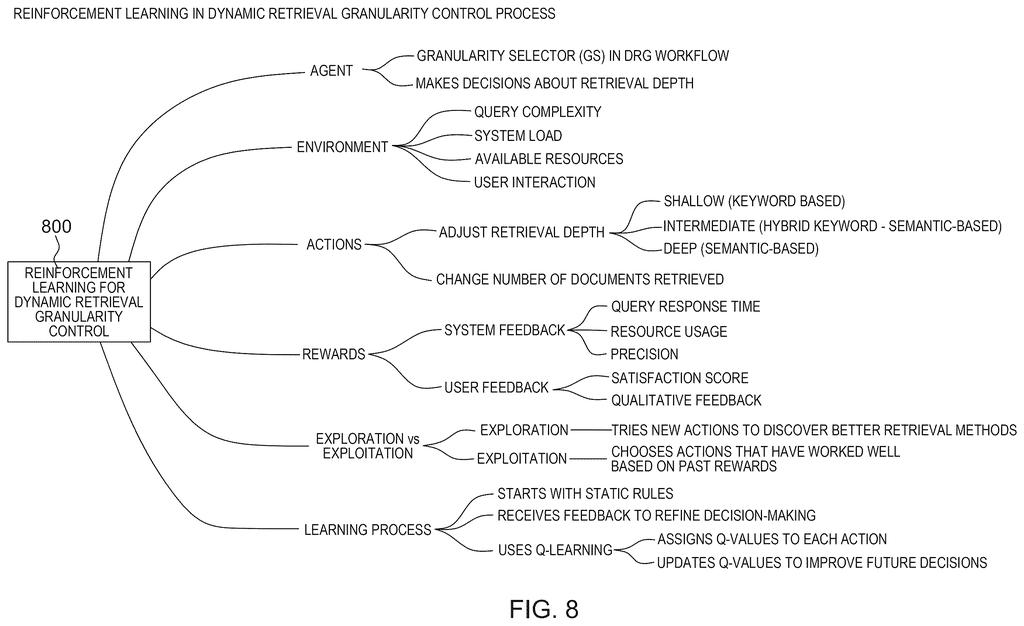
The filing covers a retrieval-augmented generation system (RAG, an AI setup where a chatbot first looks up relevant documents in a database, then hands them to a large language model to write the answer). Claim 1 adds a layer in front of that lookup: a reinforcement learning model (a program that learns by trial, reward and penalty) picks a retrieval depth for each question, based partly on how complex the question is.
The depth is a choice among search strategies:
- Shallow: keyword search, fast but surface-level.
- Intermediate: keyword filtering first to narrow things down, then a meaning-based search on what is left.
- Deep: semantic search, which matches on meaning and costs more computing power.
Complexity is judged using language processing on traits like question length, keyword density and specialized terms. If a question has several parts, the system splits it into sub-questions and picks a depth for each. It can also tune how much time the search gets and how many documents it pulls.
Learning comes from feedback turned into numerical rewards. Clicks on relevant documents earn a positive reward, while high delay or no interaction earns a negative one. The description names Q-learning (a table of scores for each possible choice) and an epsilon-greedy policy (mostly use what has worked, occasionally try something new).
… based, at least in part, on complexity of the query to the hybrid retrieval engine.
Translation: The depth of the search depends on how complicated the question is.
Why faster, cheaper AI lookups matter for IBM
If you have ever waited while an AI assistant chewed on a simple question, this is the problem the filing targets. Matching effort to the question could mean quicker replies to easy asks and more thorough digging for hard ones, with less computing power burned on the easy ones. The filing's own examples lean toward business settings: cloud technical support, troubleshooting automated systems and data engineering.
For companies running these systems, the draw is cost and scale. The description says the control can be added to existing RAG systems and spread across multiple computers, with advance fetching to cut delay on complex questions. The claims also cover learning from user feedback, so the system would adjust to the questions its own users actually ask.
IBM's 48th filing in the AI assistant and agent patents we've tracked since May follows one on grading your AI prompts and one on AI coding memory.
Of everything an AI company could patent, this one sits close to ready. It needs no new hardware: it is a decision layer placed in front of a document search system a company already runs. The parts it relies on (a question scorer, three search modes, a click and delay tracker) are ordinary software, and the filing says it can be added to existing systems.
What has to exist first is the plumbing. A company needs a working lookup setup with both keyword and meaning-based search, plus enough real users to produce click and timing data for the learning to work with. The filing says the model can start with fixed rules and improve from there, which is the sensible shortest route to a product.
The filing gives no test results. Whether the learned choices beat a simple rule like 'short question, quick search' is the open question. Verdict: a routine idea, and a practical one to put into use.
Get our take in your Top Stories
Liked this breakdown? Add Patentlyze as a preferred source on Google, and our plain-English take shows up more often in your Top Stories the next time IBM patent news breaks.
There are more where this came from
We read every patent application Big Tech publishes and send you the ones worth knowing. Plain English, free, every week.
The drawings
11 drawing sheets from US 2026/0350006 A1 · click any drawing to enlarge


Show the other 3 sheets


Want this weekly breakdown for a company we don't cover? Patentlyze Pro →
Be the first to weigh in