
IBM Patents an AI That Decides When to Speak Up in Group Conversations
Most AI assistants answer every question you put to them. IBM's latest patent describes one that watches a group conversation unfold and decides, on its own, whether it actually has something worth saying.
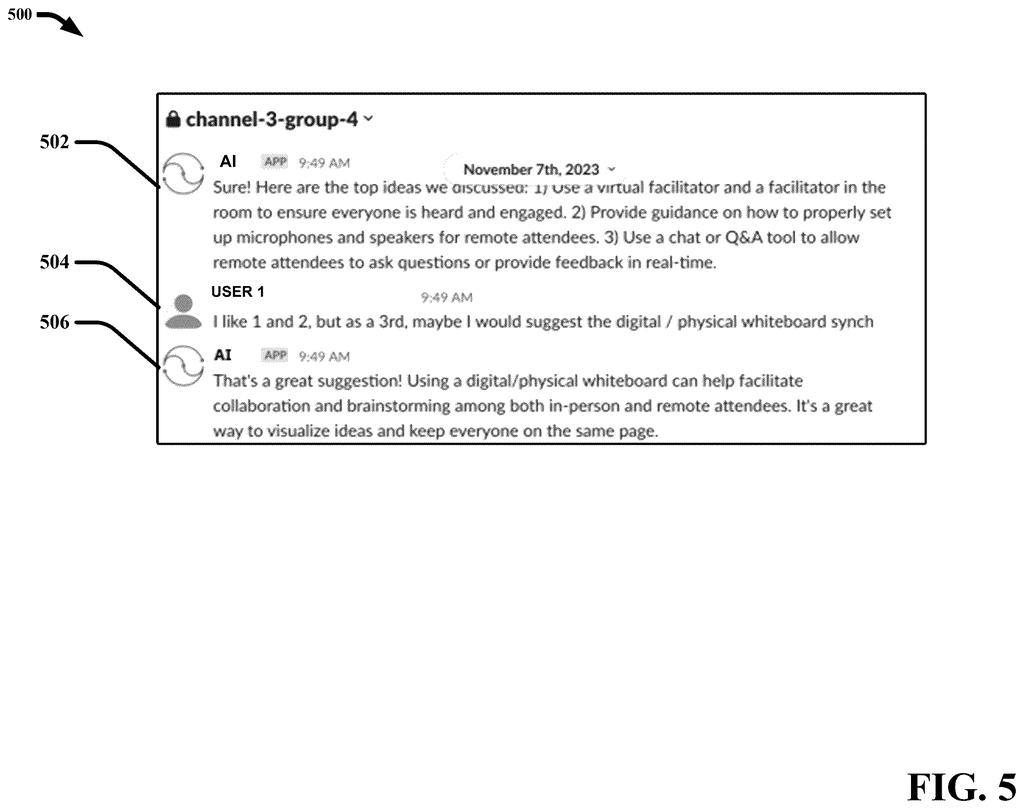
How IBM's AI agent chooses its moment in a group chat
Every time a group meeting goes sideways because someone interrupts at the wrong moment, you feel the cost of bad timing. IBM is trying to teach an AI assistant the same social instinct: not just what to say, but whether to say it at all.
The system described in this patent listens to a conversation as it happens, generates a candidate response, then scores that response before deciding to share it. If the score isn't high enough, the AI stays quiet. That's a meaningful shift from today's chatbots, which respond whenever they're addressed but have no real judgment about whether they're adding anything useful.
The target context seems to be multi-party settings: team meetings, customer service calls with several participants, or collaborative work sessions where an AI agent needs to know when to contribute and when to step back.
… an analysis component that analyzes the multi-party conversation in real time; a generation component that generates a response for the conversational agent; an evaluation component that assigns a value to the generated response; and a decision component that determines whether to contribute the generated response to the multi-party conversation.
Translation: The system listens to the group chat, creates a potential reply, scores its usefulness, and decides if it is worth saying out loud.
How the system scores and filters its own responses
The patent describes a software system built around five cooperating components that work together in real time.
- Analysis component: continuously reads the ongoing conversation, tracking what's been said and building context.
- Generation component: produces a candidate reply that the AI could contribute.
- Evaluation component: assigns a numerical value to that reply, essentially grading it on some measure of usefulness or relevance.
- Decision component: compares that score against a threshold and determines whether to actually send the response into the conversation.
- Conversational agent: the outward-facing participant that interacts with human speakers if and when the decision component gives the green light.
The key idea is the evaluation-then-decide loop. Rather than treating every generated response as something to be delivered, the system treats the response as a draft that has to earn its way into the conversation. The patent doesn't specify exactly what metric the evaluation component uses, leaving that as an implementation detail, but the architecture separates the ability to respond from the decision to respond.
All of this runs in real time, meaning the system has to analyze, generate, score, and decide during the natural pauses and overlaps of a live conversation.
What this means for AI assistants in meetings and group chats
For anyone who has watched an AI assistant blurt out an irrelevant answer in the middle of a meeting, the appeal here is obvious. An AI that knows when to stay quiet could be genuinely less annoying and more trusted in collaborative settings like video calls, group support chats, or shared workspaces.
For IBM, this fits into several IBM filings on conversational AI this year, particularly around enterprise use cases where AI agents need to operate alongside humans without derailing workflows. The practical question is whether a scoring system can capture the subtle social logic of human conversation timing, which is harder than it sounds.
IBM's tenth filing we've tracked since July on our AI agents working for you watchlist follows one that diagnoses and self-fixes and one that summarizes search results with another step in the same direction.
The core bet in this patent is a scoring layer that decides when an AI should speak up in a group conversation. That piece is described as a concept, not a built system, which means the hard work of teaching it what "useful" actually sounds like in context hasn't been done yet.
Everything else here runs on existing software. No new hardware, no specialized chips, no novel training recipe described. The path to a real product is narrow deployment first: a meeting assistant where the conversation stays predictable enough to tune that scoring layer carefully.
Open-ended group chat is a much harder target, and this document doesn't solve it. IBM appears to be aiming at the enterprise meeting room, which is a sensible place to start calibrating something this difficult to get right.
There are more where this came from
We read every patent application Big Tech publishes and send you the ones worth knowing. Plain English, free, every week.
The drawings
8 drawing sheets from US 2026/0278283 A1 · click any drawing to enlarge


Want this weekly breakdown for a company we don't cover? Patentlyze Pro →
Be the first to weigh in