
IBM Files Patent for Letting AI Models Compete to Answer Your Question
Thousands of AI models are available today, and choosing one is left to you. IBM's patent application describes a system that sends your question to several of them and learns from the answer you pick.
What IBM's model-picking patent does for you
Ever asked a chatbot to summarize a long email and wondered whether a different AI would have done a better job? Right now, that choice falls on you. AI platforms list thousands of models, often sorted by what is trending or most downloaded, which says little about whether one fits your task.
IBM's filing describes a system that reads your request, works out what kind of job it is (summarizing, judging sentiment, answering a question), and sends it to a handful of the best-scoring models for that job. You see the answers and pick the one you like best.
Then the system keeps score. Each pick raises that model's ranking for similar jobs, so the lineup gets better as more people use it. You never have to research which model to try first.
… ranking, by the computer, each respective foundation model of particular foundation models that support the use case corresponding to the prompt in a list from a highest ranking foundation model to a lowest ranking foundation model based on a ranking score associated with each respective foundation model; …
Translation: The system sorts available AI models from best to worst based on past performance scores.
How IBM scores and re-ranks AI models
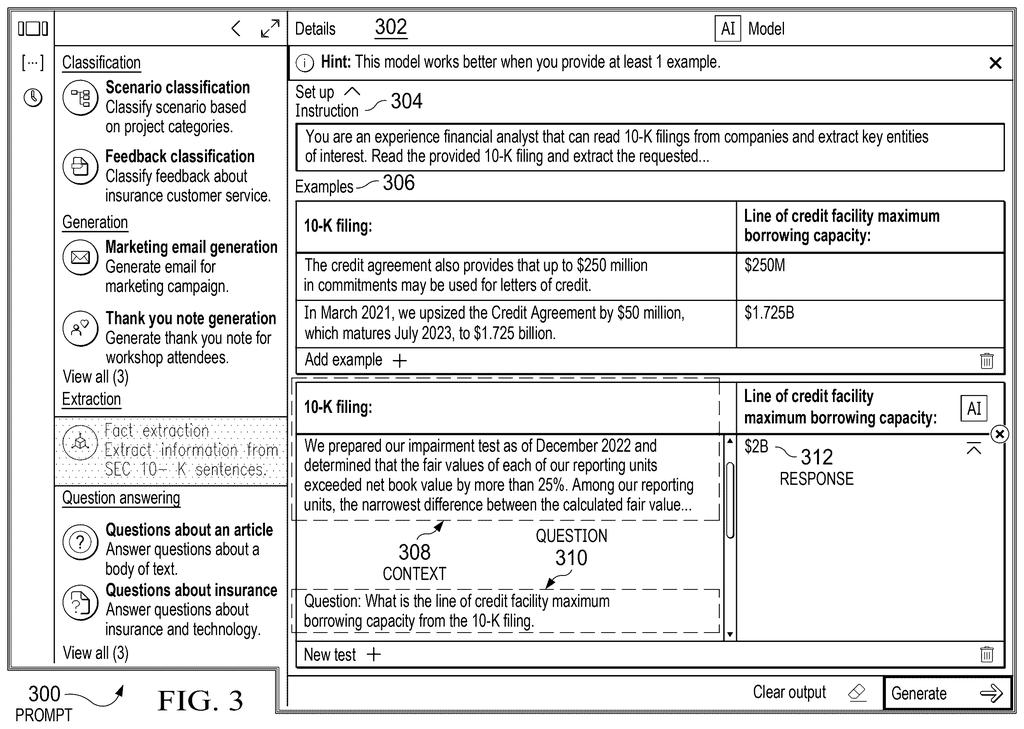
The system starts by taking your prompt apart into up to four pieces: an instruction (the task), a set of examples (sample cases the model learns from), context (background material) and the question itself. It analyzes those pieces to classify the use case, such as summarization or entity extraction (pulling names and facts out of text).
Every model on the platform carries a ranking score, stored in an n-dimension tensor (a multi-layered table of numbers that also tracks details like how the instruction is written and how many examples were given). Starting scores can come from each model's description and tags, from zero, or from an outside source.
The core steps in claim 1:
- Find the models that support the use case and rank them by score.
- Run your prompt against a set number of the top-ranked models.
- Take your choice of response and raise that model's score by a set amount.
- Collect feedback on all the responses and use it to improve future ranking.
The filing also describes extras: a one-to-five star rating for the answers you did not pick, random picks so a few models don't dominate, and a notice if others with similar prompts preferred a different model.
A selection by a user is tracked to identify which foundation model response was most relevant to the use case and prompt. A ranking score of the foundation model generating the most relevant response is increased.
Translation: The system watches which answer you pick and gives that AI a better score for next time.
What IBM's AI model ranking means for users
If you use an AI platform that offers many models, this would take the guesswork out of choosing one. You would type your request, compare a few answers and let your choices teach the system what works. The filing frames it as a fix for platforms that sort models by popularity, which says little about which one suits a specific task.
There is a hurdle. The patent examiner issued a final rejection in October 2026, though IBM can still amend the claims or appeal. Until that is settled, treat this as an idea on paper rather than a feature headed to your screen. The filing also describes the approach as working for generative AI platforms in general, so the stakes are mostly for companies that sell access to many models.
IBM's 20th filing we've tracked since May in our AI models working together group follows earlier applications like one where models debate security alerts and AI that tests its own code.
Claim 1 covers a full loop: break a prompt into its parts, score and rank the available AI models for that job, run the top ones, watch which answer the user picks, and update the scores so future rankings reflect that choice. Every step must be present. A service that only sorts models by popularity, or skips the feedback step, falls outside the claim.
That completeness is what gives the claim its reach. Any platform managing a library of AI models and learning from user choices would need to design around this, because the claim names no specific model or industry, only the mechanism.
If granted, this would matter most to companies building tools that sit on top of multiple AI models and help users choose between them. The underlying idea is simple, ask several experts and remember who gave the best answer, but owning the patent on doing that automatically, at scale, is a different thing entirely.
Get our take in your Top Stories
Liked this breakdown? Add Patentlyze as a preferred source on Google, and our plain-English take shows up more often in your Top Stories the next time IBM patent news breaks.
There are more where this came from
We read every patent application Big Tech publishes and send you the ones worth knowing. Plain English, free, every week.
The drawings
6 drawing sheets from US 2026/0329907 A1 · click any drawing to enlarge


Want this weekly breakdown for a company we don't cover? Patentlyze Pro →
Be the first to weigh in