
Google Files Patent for a Voice Layer That Lets Its Text Chatbots Talk
Google describes a way to make a chatbot that only types back into one you can talk with, and it does it without retraining the chatbot itself. The most relatable trick: while the bot is still thinking, the wrapper starts talking.
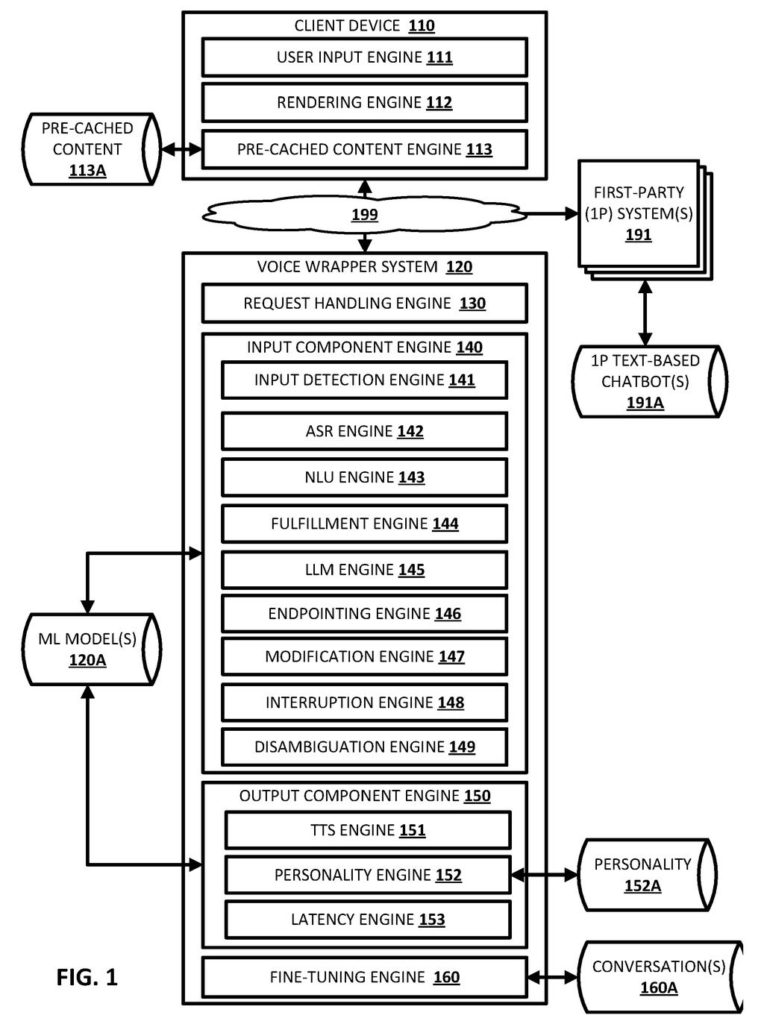
What Google's chatbot voice wrapper actually does
A chatbot sits on a phone, answering typed questions in long, tidy paragraphs. Then someone asks it a question out loud while driving, and the bot has no idea how to listen, or how to say a three-paragraph answer without losing you halfway through.
Google's filing describes a voice wrapper, a layer of helper software that sits around a chatbot Google already runs. It turns your speech into text, hands that text to the chatbot, then turns the reply back into speech. Along the way, it can shorten the reply, give it a personality like a butler or a friend, and pick a voice you chose in settings.
It also covers dead air. If the bot is likely to be slow, the wrapper can play a filler line first, such as a sentence about Rome being a great place to visit, with your trip details dropped in. The filler and the real answer are meant to sound like one reply.
identifying, for an existing first-party text-based chatbot that is managed by a first-party entity, a voice wrapper for the existing first-party text-based chatbot that is also managed by the first-party entity, the voice wrapper including a plurality of components that enable the existing first-party text-based chatbot to engage in corresponding voice-based conversations …
Translation: The system finds a voice extension to help a standard text chatbot talk out loud.
How the wrapper listens, stalls and speaks
The patent's core idea is a bundle of small components that surround an existing text-based chatbot, one that Google itself manages, so it can hold spoken conversations. The chatbot is not retrained or rebuilt. The first independent claim covers the basic loop plus personality: speech recognition (software that turns audio into written words) feeds the chatbot, and text-to-speech (software that reads text aloud) speaks the reply in a chosen persona or voice.
Persona and voice are handled separately. A persona is a vocabulary and speaking style, such as formal like a butler or casual like a friend, and a personality component can rewrite the chatbot's answer to match. A voice is a set of prosodic properties (tone, rhythm, pitch and intonation) that the speech synthesizer applies. The user can choose either ahead of time. The filing also notes that spoken answers should be terser than typed ones, since you can't glance back up the page.
A second independent claim covers latency. A latency component predicts how long the chatbot will take, and if that passes a threshold (the description mentions three or five seconds), it plays pre-cached content, meaning a ready-made line stored in advance. The claims mention that slowness is likely when the chatbot must contact outside systems. Blanks in the line are filled with words from your request while the chatbot works.
The description adds optional extras. The wrapper can decide whether you are talking to the bot (by a wake phrase, a gesture, or a gaze at the screen), cut filler words like "umm" from your request, guess which "Bagdad" you mean from your location, and handle simple interruptions like "say that again" without waking the big chatbot.
… to reduce perceived latency of the existing first-party text-based chatbot, and/or to modify output generated by the existing first-party text-based chatbot in responding to the spoken utterance.
Translation: The voice layer also helps hide frustrating delays while the chatbot prepares its replies.
Why Google wants a talking add-on, not a rebuild
The practical payoff is that a text chatbot could become a voice assistant without a long rebuild. If you have ever asked a bot something out loud and sat through an awkward pause, or had it read back an essay, this patent targets exactly those moments.
There is also a cost angle the filing stresses. The wrapper uses lighter software for simple jobs, like repeating an answer or trimming your request, so the heavy chatbot is called less often. That means fewer expensive computations per conversation, which matters at the scale of a company serving millions of chats. The filing also says the same wrapper could be offered for chatbots made by other companies, though its claims center on Google's own.
Google's 63rd filing in voice and speech AI we've tracked since May adds to a run that includes one on word-timed captions and one on self-teaching recognition.
Waiting several seconds for a voice assistant to respond, then sitting through a robotic reading of three dense paragraphs, is enough to make most people give up and reach for their phone instead. That gap between what voice assistants promise and what they actually feel like has driven millions of people away from the technology.
Google's approach here is to patch exactly those two failures without rebuilding anything from scratch. A short bridging phrase covers the silence while the answer loads, and the response itself gets trimmed to something a person would actually say out loud.
The filler phrase is worth taking seriously because it does not speed anything up, it just makes the wait feel shorter, which turns out to matter enormously to whether someone keeps using a product or abandons it.
Get our take in your Top Stories
Liked this breakdown? Add Patentlyze as a preferred source on Google, and our plain-English take shows up more often in your Top Stories the next time Google patent news breaks.
There are more where this came from
We read every patent application Big Tech publishes and send you the ones worth knowing. Plain English, free, every week.
The drawings
7 drawing sheets from US 2026/0351243 A1 · click any drawing to enlarge


Want this weekly breakdown for a company we don't cover? Patentlyze Pro →
Be the first to weigh in