
Google Patents an AI That Reads Text by Looking at It as a Picture
Google has filed a patent for an AI model that never reads a word as text. It looks at a picture of the words instead, the way you would read a screenshot.
What Google's text-as-picture AI actually does
Today, AI that understands both pictures and words usually runs on two separate parts: one that looks at images and another that reads text. Each part has to be trained on its own, and the text side first chops sentences into small pieces, often built for just one language.
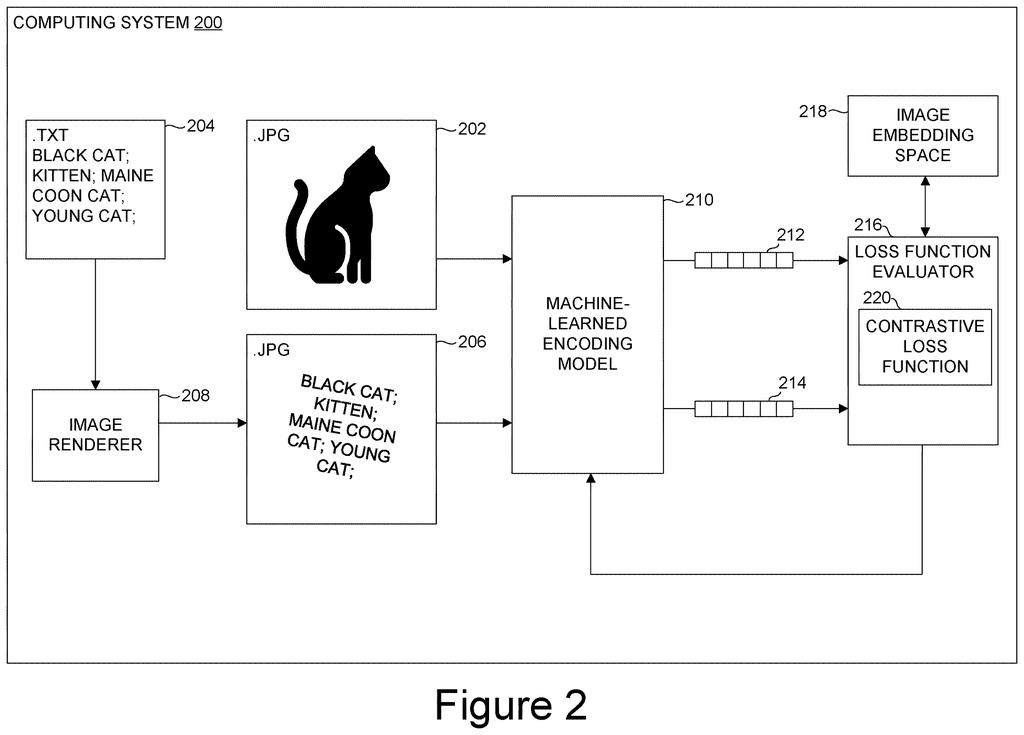
Google's filing skips the second part. It takes the words, draws them onto an image like a screenshot, and hands everything to a single model that only knows how to look at pixels. To teach it, the system pairs a photo of a black cat with a picture of the words "black cat, kitten, Maine coon" and trains the model to treat the two as a match.
Once trained, you could pair a photo with a typed question like what cat breed is this?, and the model would treat the whole thing as one picture and look for the closest match.
obtaining an image generated by rendering website content into image data, the image data comprising textual website content rendered into the image data …
Translation: Converting a standard webpage into a flat picture so the AI can read the text visually.
How the model matches words to pictures
The claims in this continuation focus on web pages. A system takes website content, including its text, and renders it into image data (basically a screenshot). It feeds that image to a transformer (a type of AI model that weighs which parts of its input matter most). The model outputs an embedding, a string of numbers that works like a fingerprint for what the image shows and says.
The system then retrieves a second embedding that is similar to the first and pulls the data tied to it, such as an image, to complete a task. One task the claims name is answering a query, including a multimodal query (a question that mixes text with other content). The filing also says the model could run in a browser application and split the image into patch embeddings (small tiles, each turned into numbers).
The description explains the training. Pairs such as a photo and its alt-text caption are collected from the web. The caption is rendered as a second image, and a contrastive loss (a scoring rule that rewards matching pairs for landing close together and pushes unrelated items apart) tunes the model.
Because text is just pixels, the filing says no tokenizer or machine translation is needed, so a question in one language can still match an answer in another.
A second image that depicts the textual content associated with the first image is rendered. The first image and the second image are processed with a machine-learned encoding model to respectively obtain a first image embedding and a second image embedding …
Translation: The system turns text into images and compares them mathematically to learn how to read visually.
Why one model for words and images matters
If this approach pans out, the biggest winners are tools that match words with images, like asking a question about a photo or searching a web page that mixes text and pictures. One model that handles both could be cheaper to build and maintain than two. The filing also says it avoids the translation step that often adds mistakes. For you, that could mean better answers when you ask in a less common language.
The claims point at browsers and web pages, so the nearest fit is search or browsing tools that read what a page looks like instead of only its underlying text. The filing names no product and gives no accuracy results, so treat it as a research direction Google has put on file.
Google files its 114th patent in our Language AI coverage we've tracked since May, following earlier applications like one on AI math tweaks and one on stale search prices.
Turning words into pictures before reading them is a clever shortcut, but it trades precision for simplicity. A character a computer could read exactly becomes a smudge of colored dots, which means small fonts, unusual lettering, or a long dense page could trip the model up in ways that plain text never would. That is a real cost, and this filing offers no numbers to say how often it bites.
For web pages, where layout and images already live together, the trade looks manageable. A screenshot preserves the visual context that stripping out the words would destroy, and that preserved layout is often what gives meaning to the surrounding content.
For anything requiring exact wording, a legal clause or a product description, the accuracy question matters a great deal. The approach is promising in the right situations and carries real risk in others, and the line between those two cases is not yet drawn.
Get our take in your Top Stories
Liked this breakdown? Add Patentlyze as a preferred source on Google, and our plain-English take shows up more often in your Top Stories the next time Google patent news breaks.
There are more where this came from
We read every patent application Big Tech publishes and send you the ones worth knowing. Plain English, free, every week.
The drawings
6 drawing sheets from US 2026/0350976 A1 · click any drawing to enlarge


Want this weekly breakdown for a company we don't cover? Patentlyze Pro →
Be the first to weigh in