
Google Files Patent for Image AI That Sums Up a Photo From All Its Pieces
Google's image AI chops a photo into tiles, and this filing changes how it reaches a verdict: every tile gets a say, instead of one extra stand-in slot collecting the answer.
What Google's image AI does with photo tiles
Every time your phone labels a photo as "beach" or "dog," an AI has to boil millions of pixels down to a single answer. This Google patent application is about how that boiling-down happens. The AI first chops the photo into small square tiles and studies how the tiles relate to each other.
Older designs add an extra blank slot to the list of tiles, and that slot's only job is to collect the verdict. Google's filing drops it. Instead, a step called attention pooling lets all the tiles weigh in, guided by a single learned "question" that decides which tiles matter most for the final answer.
The company says this helps the AI grow to billions of adjustable settings without eating as much memory, and the bigger model then handles new tasks better, even when it has few examples to learn from.
… processing the plurality of image patches to generate an input sequence comprising a respective input element at each of a plurality of positions, wherein the input sequence includes a respective input element corresponding to each of the plurality of image patches …
Translation: The system chops the picture into pieces and puts them into a specific order.
How the AI pools every tile into one answer
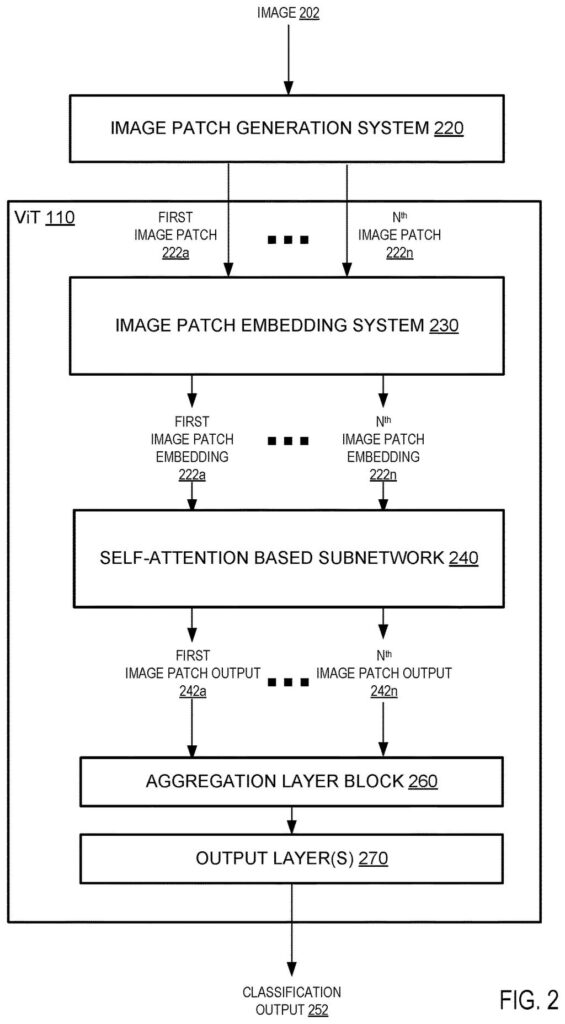
The claimed method starts by cutting an image into patches, small blocks that each hold a different slice of the pixels. Each patch is turned into a list of numbers (a "linear projection," a learned recipe for converting pixels to numbers) and tagged with its position, so the AI knows where in the photo it came from.
The patches then pass through a stack of self-attention blocks, layers where every patch looks at every other patch to decide what matters. Out comes one updated element per patch.
The distinctive step comes last. An aggregation layer applies multi-head attention pooling: a learned query vector (a set of numbers tuned during training, acting like a standing question) is compared against all the outputs to produce one summary vector. That vector feeds the layers that make the prediction, such as a classification. A dependent claim says the input has no extra "class embedding" slot.
The description adds that the model can be huge (around two billion parameters, the adjustable settings inside the AI). It also describes training tweaks: a different weight decay (a penalty that keeps settings small) for the output layers than for the body, momentum values stored at half precision, and a warmup, main and cooldown learning schedule. Those extras come from the description, not the claim shown.
Methods, systems, and apparatus, including computer programs encoded on computer storage media, for training Vision Transformer (ViT) neural networks.
Translation: This technology involves specialized software designed to train advanced computer vision systems.
Why a skipped placeholder saves AI memory
If you use anything that sorts or labels photos, the benefit is indirect. The filing says the change lets image AI grow larger without a matching jump in memory use, and that the bigger model then adapts better to new jobs with limited training examples. The description lists photo categories, medical scans, lidar point clouds and video among the targets.
The examiner's first review rejected the claims as filed, which is routine at this stage and usually followed by amendments, so the final scope could end up narrower. The claim itself already covers a small piece of the model: the pooling step at the end.
Google files its 56th enterprise AI patent we've tracked since May, adding to a run that includes a viewer drop-off predictor and an AI video quality grader.
You will probably never see this change directly. It lives deep inside the training of an image-recognition model, and the best case is that a photo or scan gets labeled correctly a little more often.
The memory savings matter more to Google than to you, since a leaner model costs less to train and run. If those savings reach products, you might feel them as faster or cheaper features, though the filing promises none of that.
The claimed step is a small, specific piece of image-AI design. Verdict: routine engineering with an indirect payoff, useful to the people building these models and invisible to nearly everyone else.
Get our take in your Top Stories
Liked this breakdown? Add Patentlyze as a preferred source on Google, and our plain-English take shows up more often in your Top Stories the next time Google patent news breaks.
There are more where this came from
We read every patent application Big Tech publishes and send you the ones worth knowing. Plain English, free, every week.
The drawings
5 drawing sheets from US 2026/0350975 A1 · click any drawing to enlarge


Want this weekly breakdown for a company we don't cover? Patentlyze Pro →
Be the first to weigh in