
Google Files Patent for Edit Suggestions on Any Passage of an AI Answer
Google's patent application has an AI chatbot second-guess its own answer and hand you one-tap fixes for just the paragraph you highlight. The filing's best example is a resume with a hidden gap in the timeline.
What Google's tap-to-fix AI edits actually do
Every time an AI chatbot hands you a draft, you face the same small choice: live with the parts you dislike, or retype your request and hope the next try is better. A Google patent application describes a third option.
You highlight just the sentence or paragraph that bugs you. Google's system sends that snippet back to the AI with a built-in question: what could make this better? A few short buttons pop up, such as add more detail or, for a resume, fill the gap between two jobs.
Tap one and only that part gets rewritten, with the rest of your answer left alone. The filing also says the AI can prepare those rewrites in the background while you read, so a tap shows the result almost instantly. It can even suggest fixes you would not have thought to ask for.
… receiving, from the client application, an indication of a selected subportion of the rendered first content; determining, based on a mapping between the selected subportion of the rendered first content and the raw first LLM response, starting and ending character indexes of the raw first LLM response that correspond to the selected subportion of the rendered first content; …
Translation: The system pinpoints the exact text you highlighted by matching it back to the original AI output using character indexes.
How Google maps your highlight to the AI's raw text
The patent covers a multi-step loop built around a large language model (LLM, an AI that writes text). First the AI answers your request. The answer arrives as raw text mixed with hidden formatting instructions, and your app displays a cleaned-up version.
When you highlight part of that display, the app works out which stretch of the raw text you picked. It does this with character offsets (position numbers stored with each displayed chunk), giving a start and end point. The system cuts out that exact slice.
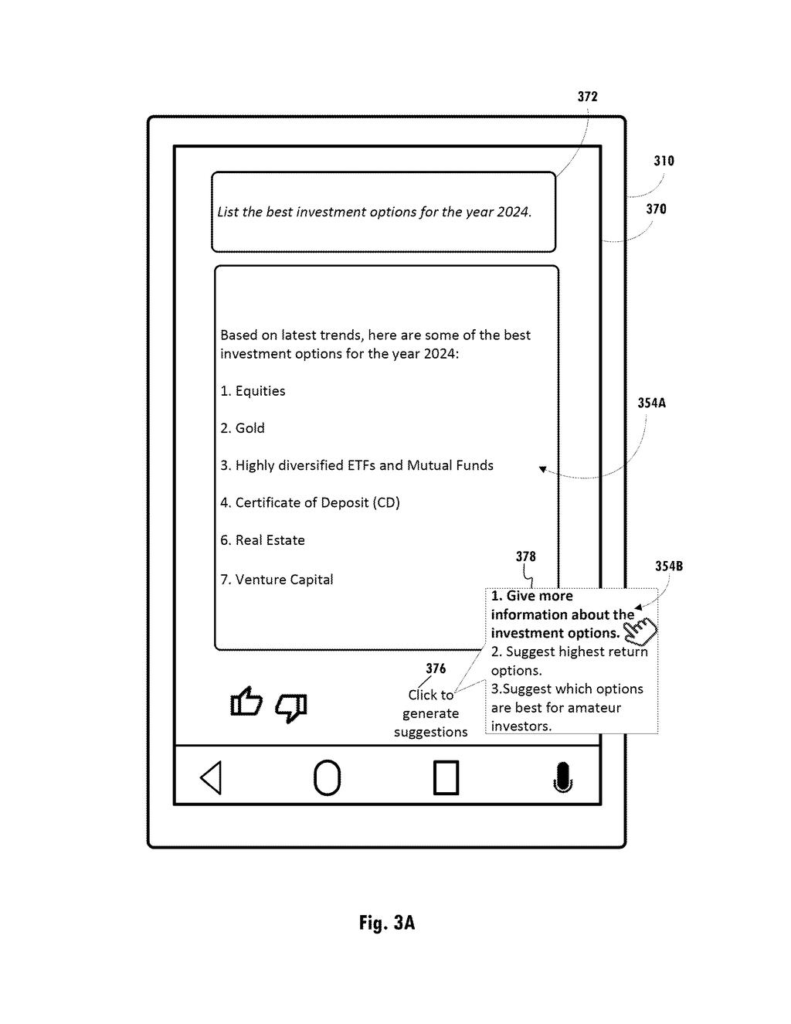
The slice is then sent back to the AI with a request for recommended alterations aimed only at that passage. The reply becomes a set of selectable buttons, each naming one suggested change. The filing's examples include:
- Adding a job to cover a gap on a resume, such as Feb. 2021 to June 2023
- Adding more detail to a list of investment options
- Updating an NBA season summary with last week's games, pulled from a search
The claims and description add several options. The rewrites can be generated in the background and stored on your device. The system can pick among several AI models, and it can hold off on the extra work when servers are busy.
The second LLM response may be operable to cause selectable element(s) to be rendered. Each of the selectable element(s) may: identify a respective recommended alteration, and be operable to cause corresponding modified content to be rendered.
Translation: The AI then generates clickable options that show different ways to rewrite your selected text.
Why one-tap AI edits could change chatbot habits
If you use AI to draft emails, summaries or resumes, the most annoying step is fixing one weak paragraph without breaking the good ones. This design turns that into a tap on a button. It also tries to tell you what is missing, which helps when you do not know what a good version should include.
The filing is also frank about the cost. These models are huge, so running them again for every suggestion is expensive, and the background-preparation idea trades extra computing for speed. Because the patent describes suggestions for typed text as well as AI answers, it could apply to writing tools as well as chat.
Google's 88th filing in the AI assistant & agent patents we've tracked since May follows earlier applications on ads woven into chat answers and images inside chatbot replies.
The big cost is extra work behind the scenes. Every answer can trigger a second round of AI processing for suggestions, and a third round of pre-written rewrites you may never tap. The filing handles this by holding off when servers are busy, a sensible trade that could still leave the feature fast on quiet afternoons and sluggish at peak hours.
The second cost is quality. The suggestions come from the same AI that wrote the flawed answer, so it may share the same blind spots or offer generic buttons like "add more detail." A menu of mediocre ideas is clutter you have to read and dismiss.
The trade still reads as worth it for longer writing, where rewriting one paragraph beats starting over. For a one-line answer, it would be overkill.
Get our take in your Top Stories
Liked this breakdown? Add Patentlyze as a preferred source on Google, and our plain-English take shows up more often in your Top Stories the next time Google patent news breaks.
There are more where this came from
We read every patent application Big Tech publishes and send you the ones worth knowing. Plain English, free, every week.
The drawings
9 drawing sheets from US 2026/0350055 A1 · click any drawing to enlarge


Show the other 1 sheets

Want this weekly breakdown for a company we don't cover? Patentlyze Pro →
Be the first to weigh in