
Google Patents an AI Chatbot That Creates Images Between Lines of Its Answer
Google has filed a patent application for a chatbot whose AI writes the answer and also orders custom pictures, video or audio from a second AI to sit inside it. The aim is to end the hunt up and down the screen for the photo that goes with a paragraph.
What Google's picture-in-the-answer chatbot does
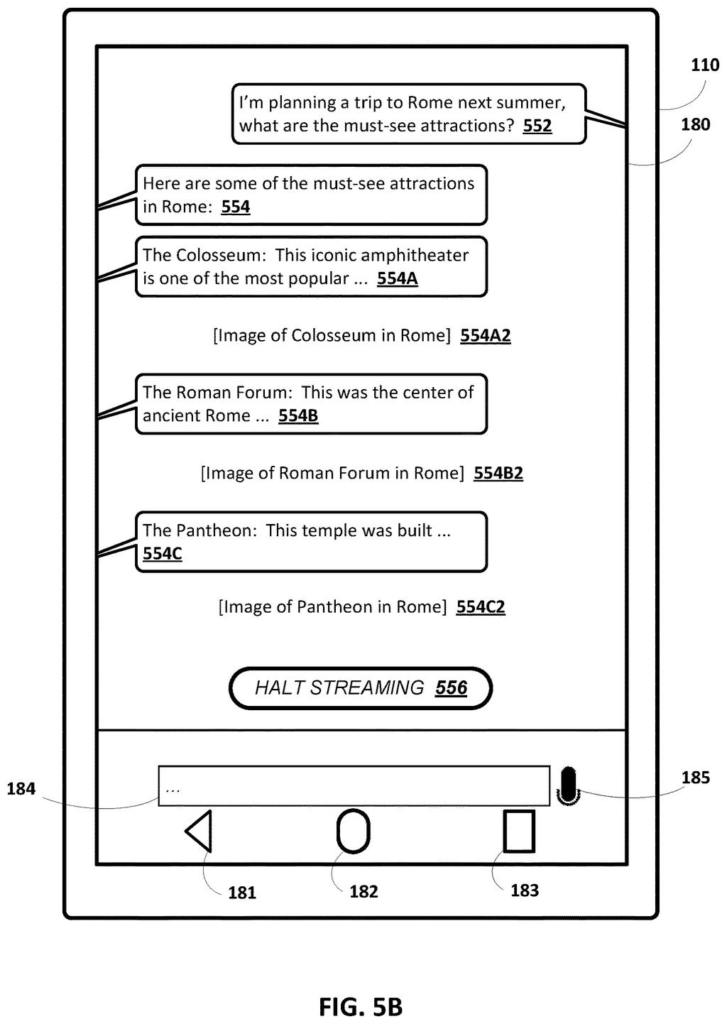
Ask a chatbot for the must-see sights in Rome and the pictures often show up in a clump above or below the text. You read about the Colosseum, the Forum and the Pantheon, then scroll back up to work out which photo belongs to which.
Google's patent application describes a way to fix that. The chatbot's language model writes the answer in pieces, and after each piece it also writes a hidden request for a matching picture. That request goes to an image generator (or a video or audio one), and the finished result drops in right beside the paragraph it belongs to.
The filing also describes an option to put you in the shot, using a photo you supply, so the Colosseum picture could show you standing in front of it. You would never see the hidden request, just the finished answer.
… determining, based on the LLM output, textual content for inclusion in the multi-modal response and a generative multimedia content query; and submitting, to a generative multimedia content model, the generative multimedia content query to obtain generative multimedia content …
Translation: The AI uses its own text output to write a prompt for an image generator.
How the chatbot orders an image from a generator
The method starts like any chatbot exchange: you type or speak a question, and a large language model (the AI trained on huge amounts of text that writes the answer) processes it. What is different is the output. Besides the text, the model produces a generative multimedia content query, which is a written instruction for another AI that makes images, video or audio.
That query goes to a separate generative model, and the result comes back as media created on the spot. Claim 1 ends with both the text and the generated media shown on your device. In a later claim, the text is broken into segments with the generated items placed between them.
The filing also describes several extras:
- Text can appear while the pictures are still being made, with a placeholder holding the spot until each image arrives.
- You do not have to ask for a picture. The system can decide to add one.
- A photo, video or voice clip of you can be passed along so the generated media includes you.
To teach the model where pictures belong, the description says it can be fine-tuned (given extra training) on example answers with markers showing where media should go. The description also covers pulling pictures from image search instead of generating them, though claim 1 is about generated content.
… the multimedia content can be interleaved between segments of the textual content.
Translation: Pictures can be placed directly between chunks of text in the reply.
Why this matters for chatbots on small screens
If you use an AI assistant on your phone, answers with several parts and several images are awkward to read on a small screen. Placing each generated image next to its paragraph, and showing text while the images are still being made, could make long answers feel quicker and easier to follow.
It also points to chatbots that create media on the spot. A travel answer with pictures that match each stop, or that include you, is a different product from a list of links and a few stock photos. The filing names Google's own language models as examples, so it fits the company's chatbot and assistant work, though it describes no specific product.
Google's 35th filing we've tracked in our AI models working together group since May adds to a run that includes a self-correcting speech recognizer and cheaper AI audio generation.
Claim 1 is short and wide. It needs a language model, a text answer, a written request for generated media, a generative model that fills the request, and a screen that shows both.
Look at what it leaves out. Claim 1 does not require the picture to sit between paragraphs, does not require your photo, and does not require streaming text. Those show up only in later claims (6, 2 and 9). The central idea as claimed is any chatbot whose language model orders up its own pictures, video or audio to go with an answer.
As written, that would cover a wide range of chatbots built this way. The part readers would feel most, the layout that saves scrolling, sits in a narrower dependent claim, so the biggest everyday benefit is also the narrowest piece of the filing.
Get our take in your Top Stories
Liked this breakdown? Add Patentlyze as a preferred source on Google, and our plain-English take shows up more often in your Top Stories the next time Google patent news breaks.
There are more where this came from
We read every patent application Big Tech publishes and send you the ones worth knowing. Plain English, free, every week.
The drawings
7 drawing sheets from US 2026/0350323 A1 · click any drawing to enlarge


Want this weekly breakdown for a company we don't cover? Patentlyze Pro →
Be the first to weigh in