
Microsoft Patents a Shadow-Map GPU Trick to Fix VR Reprojection Glitches
When your VR headset redraws a frame a few milliseconds late, the seams show — ghosting, warping, visual tearing. Microsoft's new patent describes a clever GPU trick that exploits shadow-map rendering mode to fix those glitches without adding dedicated hardware.
What Microsoft's VR frame-correction workaround actually does
Imagine you're wearing a VR headset and you move your head slightly between when a frame was rendered and when it actually appears on screen. The headset has to quickly patch up that mismatch — shifting and warping the image to match where your head is now. This process is called late stage reprojection (LSR), and when it goes wrong, you see smearing, ghosting, or warped edges.
Microsoft's patent describes a workaround built around a quirk of how GPUs handle a rendering technique called shadow mapping — normally used to calculate where shadows fall in a 3D scene. By putting the GPU into shadow-map mode, Microsoft's method piggybacks on a data structure the GPU already produces (a Z buffer, which stores depth information per pixel) to recover correction data that would otherwise be lost.
The end result is a corrected color image that lines up properly with where your head actually moved — without needing special GPU features or major software overhauls. It's a clever bit of reuse rather than a ground-up reinvention.
How the Z-buffer rescues discarded UV corrections
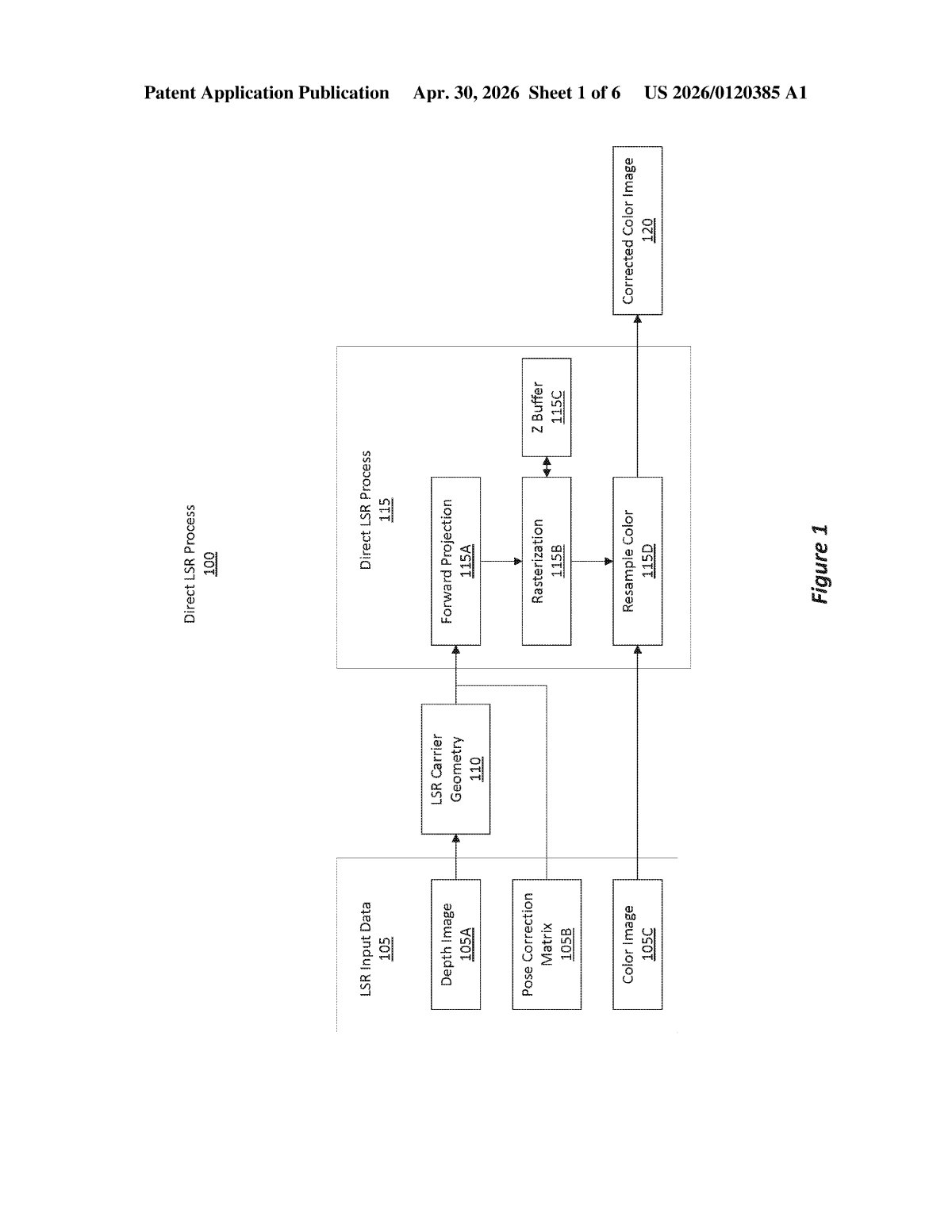
The patent describes a five-step pipeline that runs during late stage reprojection on a standard GPU.
- Extract carrier geometry: The service takes a depth image (a per-pixel map of how far away surfaces are) and converts it into a mesh of 3D vertices — called the LSR carrier geometry.
- Forward project the geometry: Each vertex of that mesh is multiplied by a pose correction matrix — essentially a math transform that encodes how much your head moved since the frame was rendered. This shifts the geometry to match your new viewpoint.
- Rasterize in shadow-map mode: The GPU is put into shadow map mode (a rendering path where the GPU writes depth values but not color). During rasterization (the process of converting 3D geometry into 2D pixels), the GPU naturally generates both a UV map (which pixel maps to which texture coordinate) and a Z buffer (depth per pixel).
- Discard and recover: The UV map is intentionally thrown away — but the per-pixel UV corrections it contained can be reconstructed from the Z buffer alone, because depth and texture coordinates are mathematically linked in this projection.
- Resample the color image: The recovered UV corrections are used to warp the original color frame into a corrected output image.
The key insight is that shadow-map mode is a widely supported GPU path, so this technique can run on existing hardware without driver changes.
What this means for smoother mixed-reality headsets
Late stage reprojection is one of those behind-the-scenes systems that you only notice when it breaks — and on fast-moving VR experiences, it breaks a lot. By routing around the limitations of standard rasterization pipelines using a shadow-map mode trick, Microsoft potentially makes LSR more reliable on a broader range of GPUs, including the kind of lower-power silicon you'd find in a standalone headset.
This feels squarely aimed at Microsoft's mixed-reality platform and any future HoloLens or Windows-based headset work. If LSR can be made more robust without demanding newer or pricier GPUs, that has real implications for cost and device accessibility. For you as a user, it translates to fewer of those subtle warping artifacts that quietly make VR feel wrong without you being able to name exactly why.
This is genuinely clever engineering — not a moonshot idea, but a tight, practical solution to a real problem that ships in every VR frame. Using shadow-map mode as a computational backdoor to preserve depth data is the kind of lateral thinking that tends to actually make it into production. Worth paying attention to if you follow headset or GPU driver development.
There are more where this came from
We read every patent application Big Tech publishes and send you the ones worth knowing. Plain English, free, every week.
Want this weekly breakdown for a company we don't cover? Patentlyze Pro →