
Microsoft Patents an AI System That Reads Your Audience During Video Calls
Imagine getting a live dashboard during your presentation showing which slides landed flat and which made the VP in row three nod along — that's exactly what Microsoft is building into video calls.
What Microsoft's real-time audience sentiment tool actually does
Picture this: you're halfway through a big Teams presentation and you have no idea if anyone is actually following along. People's cameras are on, but you can't read the room the way you would in person. Microsoft's new patent is aimed directly at that problem.
The system watches your audience for you. It pulls in the video feed (facial expressions, head nods), the audio (verbal reactions, tone), and even the chat window and hand-raises, then combines all of that into a real-time sentiment score it can show you while you're still talking. Think of it like a live audience-reaction meter in the corner of your screen.
There's also a longer-term coaching angle. The system can stitch together data from multiple meetings over time and build a kind of personal presentation coach — one that can flag patterns like "your audience consistently checks out during your opening three slides" and suggest fixes before your next pitch.
How the system syncs video, audio, and chat to score reactions
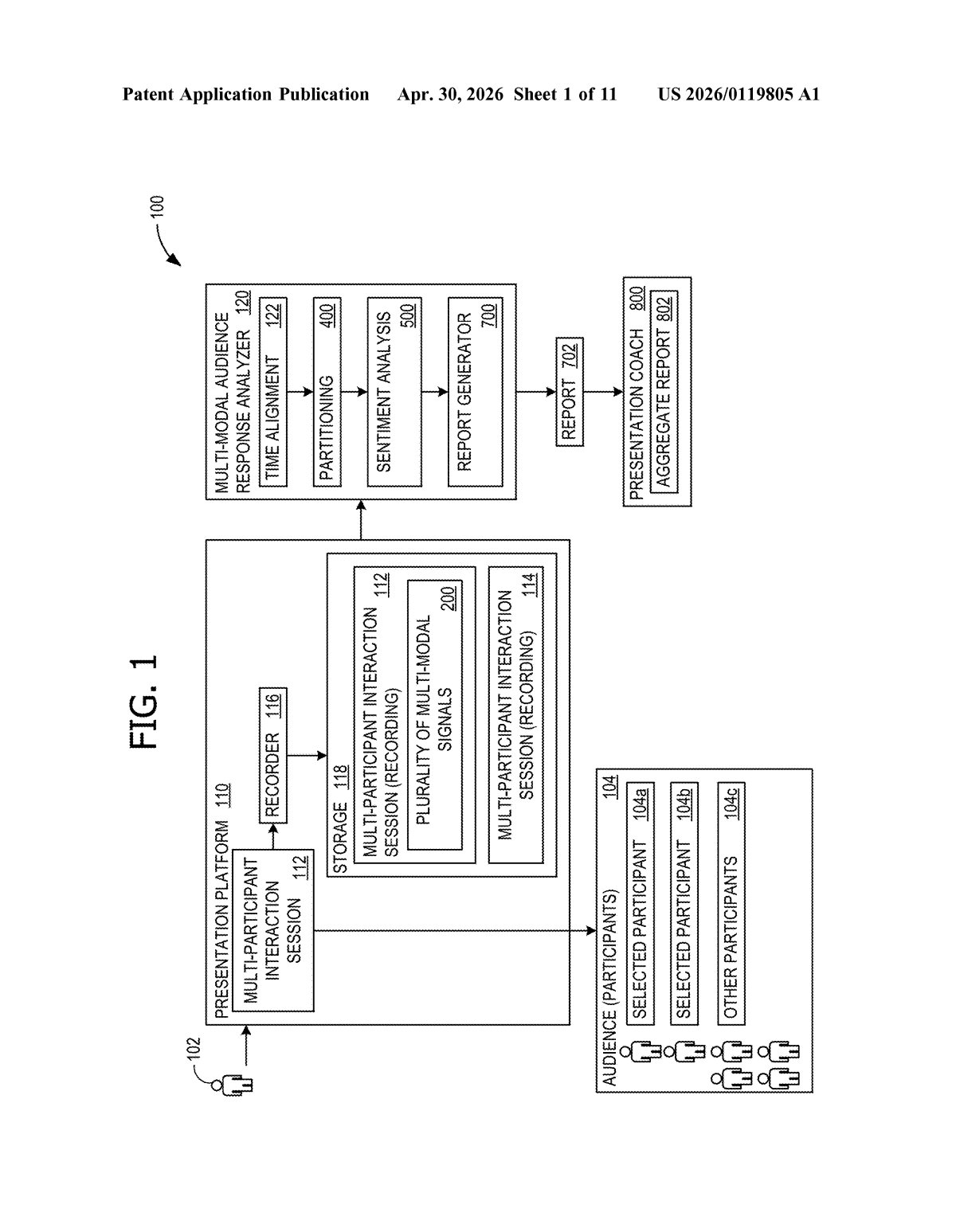
At its core, this patent describes a multi-modal audience response analyzer — a system that ingests several simultaneous data streams from a video call and fuses them together to estimate how the audience is feeling.
The signals it captures include:
- Video feed — facial expressions and head movements (like nodding)
- Audio feed — spoken words converted to a transcript, plus vocal tone
- Image stills — periodic snapshots of participants for expression analysis
- Chat and actions — text reactions, emoji, hand-raises
A key technical step is time alignment — synchronizing all these streams so the system knows that a participant's nod happened at the exact moment a specific sentence was spoken. Without that, you'd just have a pile of disconnected signals. With it, the system can ask meaningful questions like: "When I said X, did the audience react positively?"
Those aligned signals get packaged into a prompt sent to a language model (the same class of AI behind ChatGPT-style tools) which performs the actual sentiment analysis. The result feeds into a report generator that can surface near-real-time feedback to the presenter. Separately, an aggregate report module can pool data across many sessions to power a presentation coach that suggests improvements. The system can also zoom in on specific individuals — say, a VIP or key decision-maker — and track their reactions separately.
What this means for Teams meetings and presentation coaching
For anyone who presents regularly in remote or hybrid environments, this is the missing feedback loop. In a physical room, a skilled presenter reads the crowd constantly — adjusting pace, re-explaining a confusing slide, reading boredom. Video calls stripped most of that away. A system like this could restore some of that awareness, making remote presentations less of a one-way broadcast and more of an actual conversation.
From a product strategy standpoint, this fits neatly into Microsoft's push to make Teams more than a Zoom clone. Copilot is already inside Teams summarizing meetings; adding audience-sentiment coaching would deepen that AI layer considerably. The individual VIP tracking feature is also worth noting — it signals this tool is designed with enterprise sales and executive briefings in mind, not just all-hands calls.
This is one of those patents that describes something genuinely useful rather than something technically impressive for its own sake. The multi-modal fusion idea isn't new, but applying it to live meeting feedback with a language model in the loop is a practical, product-ready concept. If Microsoft ships even a stripped-down version of this inside Teams Copilot, a lot of people will use it.
There are more where this came from
We read every patent application Big Tech publishes and send you the ones worth knowing. Plain English, free, every week.
Want this weekly breakdown for a company we don't cover? Patentlyze Pro →