
Qualcomm
Qualcomm · AI / ML · Filed Jul 22, 2025 · USPTO published Nov 12, 2026 · This week's release
Qualcomm Patents a Small On-Phone AI That Speeds Up Many Bigger Chatbots
Qualcomm's patent application describes a small AI model on your phone that drafts text for many different bigger models to approve, even when those models split words into different pieces.
- Publication number
- US 2026/0359734 A1(US20260359734A1)
- Applicant
- QUALCOMM Incorporated
- Filed · Published
- Jul 22, 2025 · Nov 12, 2026
- Inventors
- Ramchalam KINATTINKARA RAMAKRISHNAN, Zhaocong YUAN, Shaojie ZHUO, Xiaopeng ZHANG
- Status when we published
- Waiting for an examiner
- Document
- 20 claims
- US classification
- 706/12
- Parent application
- Claims priority from a provisional application 63803363 (filed May 9, 2025)
What Qualcomm's one-drafter-fits-all AI does
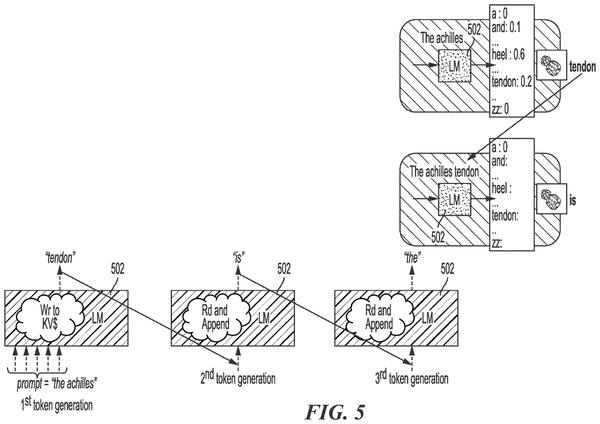
Today, the chatbots that write your replies produce text one small piece at a time, and the bigger the model, the slower and more power-hungry each piece becomes. A trick called speculative decoding helps: a small, cheap model guesses the next several pieces, and the big model checks all the guesses at once.
The catch is that the small model usually has to come from the same family as the big one. Qualcomm's patent application describes one small model on your phone that can team up with many different big ones, whether they run on the phone or in the cloud. It translates between each model's word pieces, adjusts to you and your tasks as it goes, and changes how many words it guesses based on how often it turns out to be right.
It can also mask private details, such as a home address, before the text goes anywhere else.
… map a first token identifier from the second vocabulary associated with an operative second generative machine learning model to at least one second token identifier associated with the input from the first vocabulary …
Translation: Translates words between the smaller helper model and the larger AI.
How the drafter translates between AI vocabularies
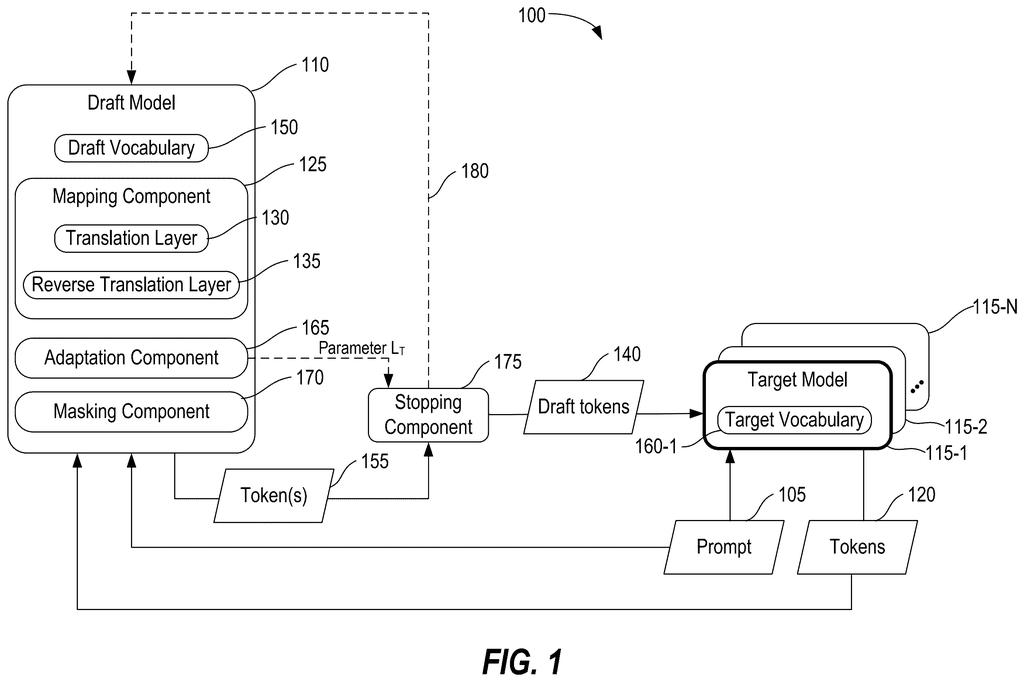
The main claim covers a small draft model (the one that guesses ahead) that can be paired with several larger target models (the ones that give the final answer). Each model has its own vocabulary, meaning its own list of tokens (the chunks of text, often word fragments, that AI models read and write). The same chunk can have a different ID number in each list, or be missing from one entirely.
So the system maps token IDs from one vocabulary to the other. Where both lists share a token, it translates directly. Where the big model's token is missing from the small model's list, an n-gram cache (a lookup table of short token combinations) joins pieces back together, such as 'he' and 'llo' becoming 'hello', so the big model is more likely to accept the guess.
The filing also describes extras, which appear in later claims:
- Small LoRA adapters (compact add-on settings) for each user, task or target model, updated from which guesses were accepted or rejected.
- A trained module that decides when to stop drafting, so the draft length changes over time and per target model.
- Drafts laid out as a branching tree instead of a single line.
- Masking of draft tokens or inputs, such as swapping '123 Main Street' for [ADDRESS].
A set of draft tokens is generated based on processing the at least one second token identifier using the first generative machine learning model.
Translation: The smaller model creates quick preliminary guesses to speed things up.
Why Qualcomm's drafter matters for phone AI
If you use an AI assistant on a phone, laptop or wearable, the practical payoff is speed and battery. The filing says a locally run drafter that wastes fewer guesses can mean faster responses and lower power use, and its worked example shows speculative decoding cutting compute cost by 35 percent against writing one token at a time under illustrative numbers.
The design also splits the work in a useful way. The big model can sit in the cloud for quality while the small one stays on your device and sends less raw data out, with sensitive details masked. The filing says the processing system can sit in a smartphone, laptop, tablet or wearable, which fits the hardware Qualcomm already sells into.
Qualcomm's 28th filing we've tracked since July in our on-device AI privacy watchlist follows earlier applications like one blocking stray touches and one predicting data arrival.
Source: US 2026/0359734 A1 at the USPTO (PDF). Full patent text and figures are in the official publication.
Get our take in your Top Stories
Liked this breakdown? Add Patentlyze as a preferred source on Google, and our plain-English take shows up more often in your Top Stories the next time Qualcomm patent news breaks.
Add Patentlyze on Google
One click.
There are more where this came from
We read every patent application Big Tech publishes and send you the ones worth knowing. Plain English, free, every week.
The drawings · 11 sheets
11 drawing sheets from US 2026/0359734 A1 · click any drawing to enlarge


Show the other 3 sheets


More from Qualcomm
All 624 Qualcomm patents →
More in AI assistant & agent
All 413 AI assistant & agent patents →
Google
A New Google Patent Lets Phone AI Compare Several Answers Before Replying
Google
Google Patents a Way to Train AI Models on Your Phone Without Filling Up Its Memory
OpenAI
OpenAI Files Patent for AI Training That Fits Inside a Phone's Limited Memory
Google
No comments yet