
A New Google Patent Turns Your Browsing History Into a Podcast for Your Commute
Circle a building in a photo, and this Google patent application describes an AI that turns it into a podcast with a synthetic host and guest, timed to fit your drive.
What Google's podcast-from-anything patent does
Every time you read an article you can't finish, it ends up as an open tab you never get back to. Google's filing describes a way to turn that pile into something you can listen to instead.
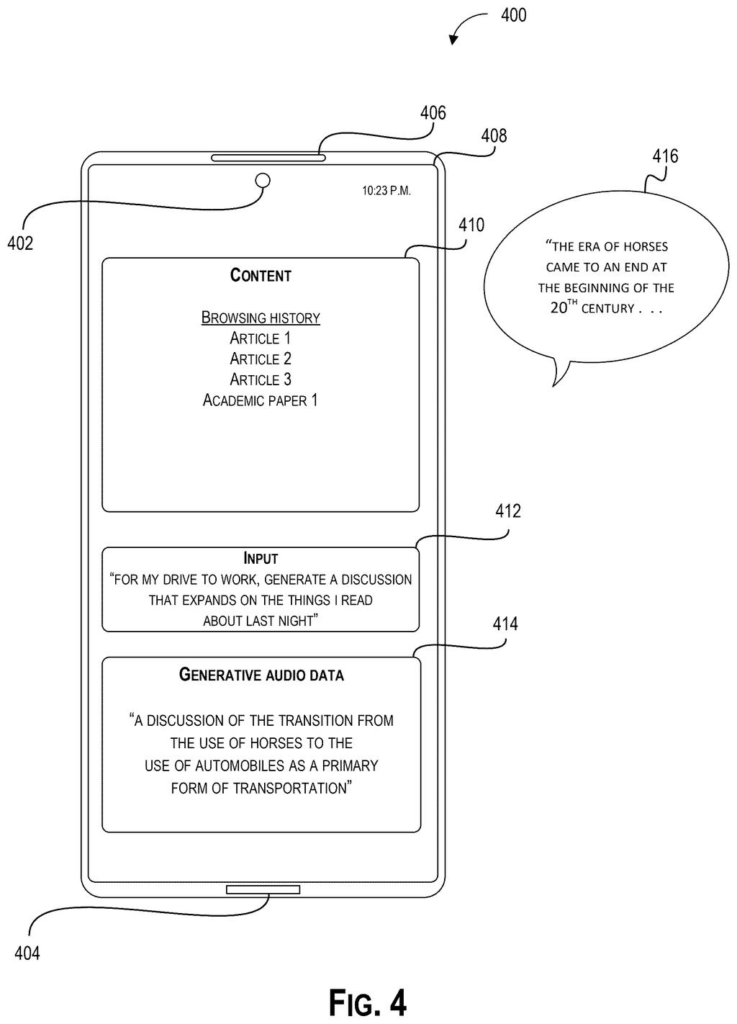
You tap, circle or highlight the part of a photo or article that caught your eye, or just tell your phone what you want. An AI then writes and voices a podcast about it, often with a synthetic host and a synthetic expert chatting. It also looks at things like your browsing history, your location and your calendar. If your navigation says you'll be driving for 45 minutes, the show can run about 45 minutes.
It can adjust to you, too. For a ten-year-old, the filing says, it would use simpler words and skip profanity.
… generating, by the computing system, based on inputting the content data, context data associated with the one or more contexts, and input data associated with the one or more inputs into one or more machine-learned models, generative audio data comprising one or more synthetic language audio segments associated with the content data, the context data, and the input data …
Translation: An AI turns web content and user settings into spoken audio clips.
How the model mixes content, context and taps
The claims cover a three-part recipe. The system takes content (an image, text, audio or video), inputs (a typed or spoken prompt, or a tap, circle or swipe on part of an image) and context (the app you're in, your search history, your location, the time of day). All three go into machine-learned models (AI systems trained on large numbers of examples), which produce synthetic speech tied to what you picked.
The filing describes several add-ons:
- Object recognition: the model can spot a building, painting or animal in a photo and build the audio around it.
- Retrieval augmented generation (RAG): the AI searches documents and web pages for extra material that wasn't in your original content, such as a second article about the same hockey team.
- Tone, tempo and reading level: serious or humorous, faster in the morning and slower in the evening, simpler for a child.
- Duration: calendar or navigation data shows how much free time you have, so the audio is sized to fit.
The output can be a single narrator, a host and expert, a panel, an interview, a documentary, a news-style recap or even fiction with sound effects. The examples include a polar bear podcast, a history of a skyscraper from a skyline photo, and a documentary about a band in your playlist. The filing says any training on a person's own audio would happen only with their consent.
The disclosed technology can include receiving content data associated with content. Inputs associated with the content can be received. Contexts associated with the content or the inputs can be determined.
Translation: The system collects the webpage data, user preferences, and background details before creating the podcast.
Why a commute-sized podcast could matter
If this ever reached a phone, your open tabs and half-read articles could turn into something you listen to while you drive, cook or walk. You would pick the starting point by circling part of a photo, highlighting a line of text or just asking out loud, and the length would adjust to your calendar or your route. The filing also describes tuning the voice and vocabulary for a child, and translating into your native language.
The practical question is how much of your life you will let it read. An examiner's first review rejected the claims as filed, which is routine and usually followed by amendments, so the final scope is open. The big trade is convenience against privacy: the more your searches, location and schedule feed the show, the better it fits.
Google's 59th filing in the Enterprise AI space we've tracked since May adds to a run that includes one on vibration confidence cues and one on captioning a photo region.
The price of this idea is your personal data. To time a podcast to your drive, the system has to read your calendar, your location, your browsing history and sometimes your voice. Each of those signals makes the show fit better, and each is something you have to hand over first.
The second cost is accuracy. A synthetic host and expert sounding confident about a skyscraper's history or a Roman helmet will be wrong sometimes, and a podcast voice gives you no footnotes to check. The filing adds outside sources through search, which helps, but its examples don't show how the facts get verified.
Still, the trade reads as worth making for a commute, where nobody wants to read a screen and a 45-minute show shaped to the trip beats scrolling. The claims are broad, so the real test is how much of your data people will let it use.
Get our take in your Top Stories
Liked this breakdown? Add Patentlyze as a preferred source on Google, and our plain-English take shows up more often in your Top Stories the next time Google patent news breaks.
There are more where this came from
We read every patent application Big Tech publishes and send you the ones worth knowing. Plain English, free, every week.
The drawings
18 drawing sheets from US 2026/0360349 A1 · click any drawing to enlarge


Show the other 10 sheets


Want this weekly breakdown for a company we don't cover? Patentlyze Pro →
Be the first to weigh in