
Disney Files Patent for Game Worlds That Change With Live Events
Disney has described a game world that watches the real world and changes to match it: a parade starts in a physical park, and a virtual plaza fills with floats and confetti at the same moment.
What Disney's live-event virtual world does
Every time you open a game or a virtual park, you get the same world you got last time. A castle stays a castle, the lines never grow, and a real-life fireworks show happening right now is nowhere to be seen.
Disney's patent application tries to fix that. It feeds live information, such as sports scores, weather, crowd levels or ride wait times, into an AI that writes a short description of what the virtual world should look like right now. Something like: "A parade is moving through the central plaza. Confetti is falling."
A second piece of software then turns that description into the actual scene, adding characters, decorations and music. Your own actions in the world feed in too, and a human operator can step in to steer or block anything that looks off-brand.
… generating, using a first trained machine learning model and based on the one or more real-time feeds and the user input, a description of a virtual environment state …
Translation: An artificial intelligence uses live data and player actions to figure out how the game world should change.
How Disney's three AI agents build the scene
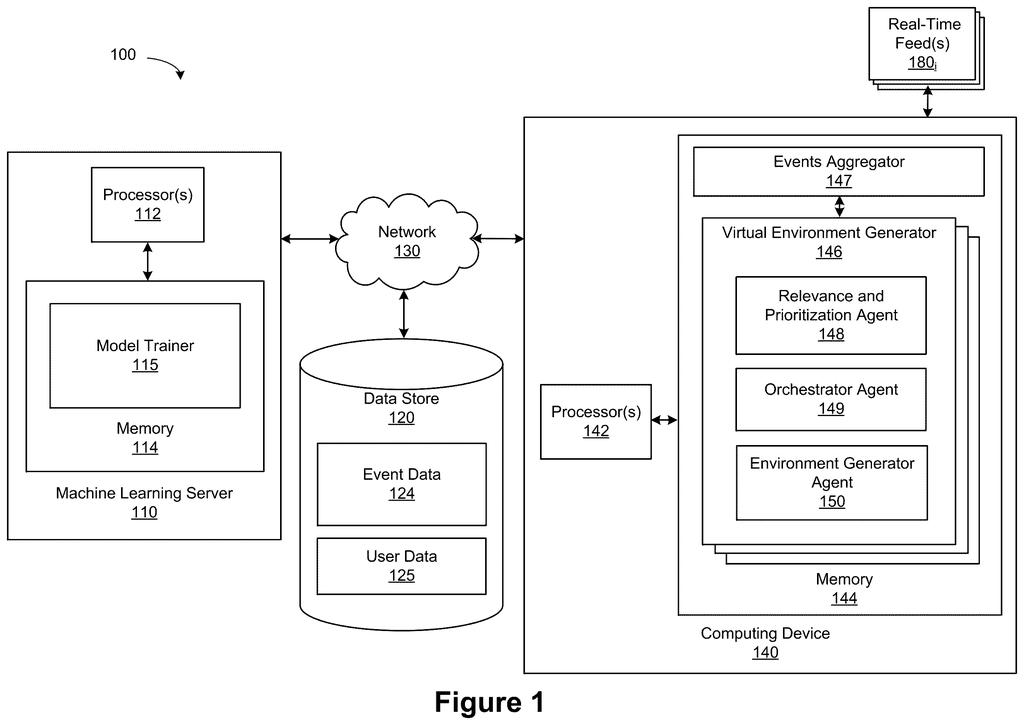
The filing describes a pipeline built from three AI "agents" (software helpers that each handle one job on their own). Here is the flow:
- Events aggregator: collects live feeds, such as theme park sensors, event schedules, sports stats, weather or live video, and turns them into a list of events like "parade starting in park zone A."
- Relevance and prioritization agent: ranks those events and keeps the important ones. In the example, a fireworks show beats a ride queue topping 45 minutes.
- Orchestrator agent: uses a fine-tuned language model (the same family of AI behind chatbots) to read the filtered events, your actions and any operator instructions, then writes a description of the world's current state.
- Environment generator agent: reads that description and works out what to add, remove, change or animate, using a game engine, a rendering engine or a generative AI video model.
The language model is first trained on stories, scripts, gameplay footage and park maps, plus design rules like narrative limits. It is then fine-tuned on user behavior, real-world event data and human operator choices.
The filing also describes optional moderation agents that can alter or block negative events or descriptions before they reach the scene. Changes can map one-to-one (a real goal adds one point) or spread out (a goal unlocks new options).
Why a parade in Orlando could show up in a game
For you, this points to games and virtual park experiences that feel live. Your virtual Disney park could show the same crowds, parades and weather as the real one, or a sports game's story could shift with last night's final score. Disney owns both the physical parks and the characters, which suits this idea well.
The human-override and moderation pieces matter for a brand like Disney, which can't afford a character doing something off-message. As a filing, it is still early: the examiner's first review rejected the claims as filed, which is routine at this stage and usually followed by amendments.
Disney's ninth patent in the Enterprise AI space we've tracked since June adds to a pattern that includes one for cameras that spot falls and one for watching animals for alerts.
The gap between this idea and a real product is mostly software, which makes it closer than it sounds. The building blocks the filing describes, live data feeds, a language model, a rendering system, all exist today, and no new hardware is required on your end beyond a screen or a headset.
What has to come first is a virtual world worth updating and a reliable connection to Disney's real parks. The shortest path to something shippable is probably modest: an app that responds to parade schedules or ride wait times, with a human approving the output before it goes live, which the filing itself allows for.
The fully automatic version, where an AI rewrites a virtual world in real time without anyone checking, is a harder problem and this document only sketches an answer to it. That part is still on the drawing board, but the simpler version is close enough that it matters.
Get our take in your Top Stories
Liked this breakdown? Add Patentlyze as a preferred source on Google, and our plain-English take shows up more often in your Top Stories the next time Disney patent news breaks.
There are more where this came from
We read every patent application Big Tech publishes and send you the ones worth knowing. Plain English, free, every week.
The drawings
7 drawing sheets from US 2026/0360078 A1 · click any drawing to enlarge


Want this weekly breakdown for a company we don't cover? Patentlyze Pro →
Be the first to weigh in