
Sony Files Patent for Precise Round-Trip Time Signal Timing in 5G Networks
Getting a phone's location indoors is hard — and a lot of that comes down to timing. Sony's new patent tries to make the signal-bouncing process that underlies 5G positioning more precise by giving network nodes explicit instructions on *when* to respond.
What Sony's RTT positioning timing patent actually does
Imagine you want to figure out where someone is standing inside a building by bouncing a signal off them and timing how long it takes to come back. That's the basic idea behind round-trip time (RTT) positioning — and it works better the more precisely both sides of that exchange are synchronized.
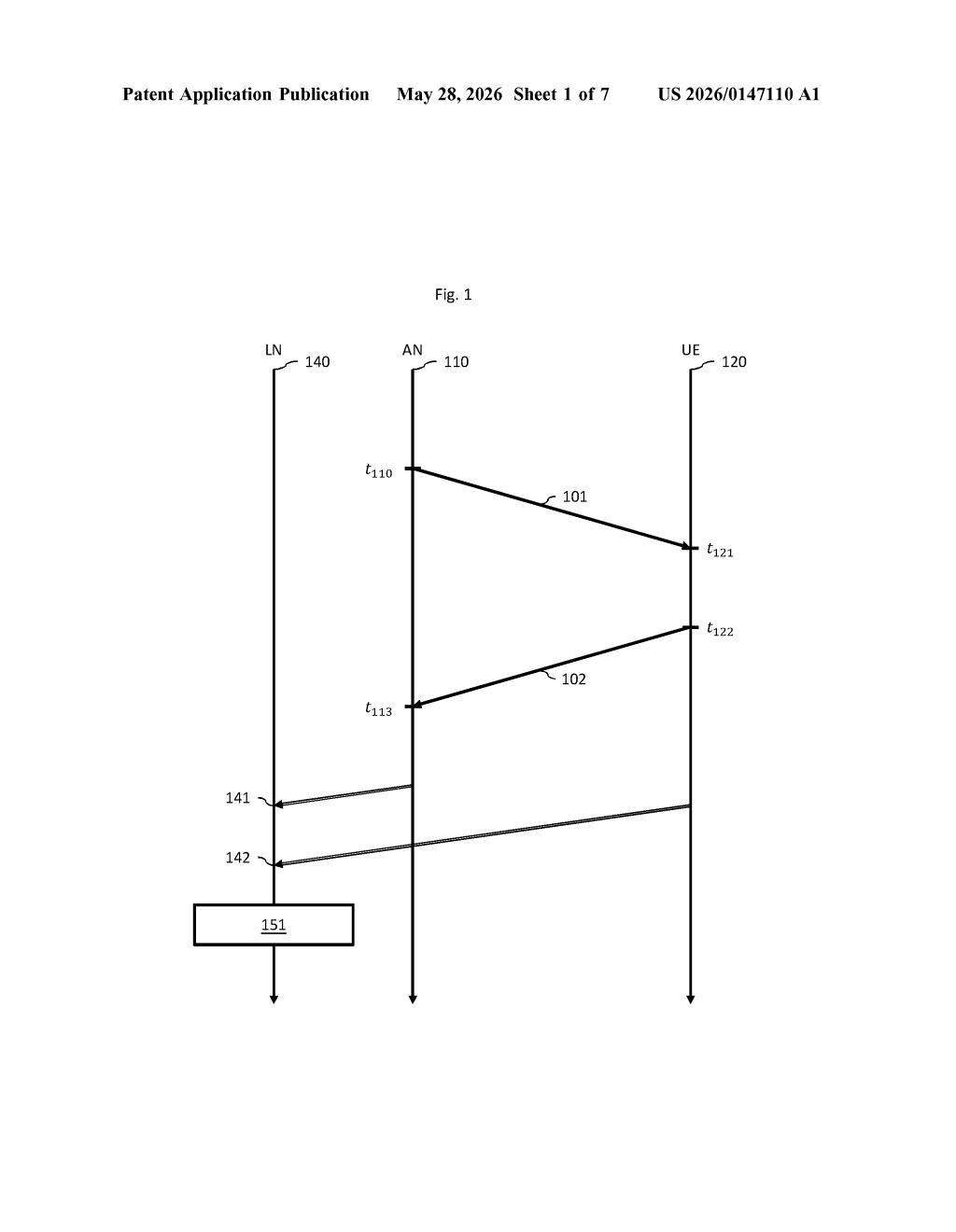
Sony's patent describes a system where one part of the network sends a location reference signal, and a second node — which could be a phone or a base station — is told in advance exactly when it should send its reply signal. That timing instruction is delivered in a message before the exchange even starts.
By pre-coordinating the reply timing rather than letting it happen freely, the system can more accurately subtract out the delay introduced by the responding device and get a cleaner measurement of actual distance. It's a calibration fix for a timing problem at the heart of how 5G networks locate devices.
How Sony's nodes exchange timed location reference signals
The patent covers a method performed by a first communication node (think: a phone, or a network access point) inside a cellular network. The process has three main steps:
- The node receives a message specifying a "timing target" — essentially a precise window or offset that tells it when to fire off its reply signal.
- The node receives a first location reference signal (LRS) — a dedicated positioning signal sent by another node — and records the exact time it arrived.
- The node then transmits a second location reference signal at the time dictated by the timing target, not just as fast as it can.
The key technical insight is that in RTT-based positioning, the response delay at the receiving node (the time between receiving a signal and sending the reply) is normally unknown and variable — which introduces error into the distance calculation. By pre-configuring that delay via a timing target message, the system can account for it or eliminate it, producing a more accurate round-trip measurement.
The patent also covers the second communication node — the one that initiates the exchange and sends that timing target configuration — making it a full system claim covering both ends of the positioning handshake.
What this means for 5G indoor positioning accuracy
5G positioning — especially indoors — is increasingly important for applications like asset tracking, emergency services location, and precise logistics. RTT is one of the core techniques 3GPP has standardized for this, but it's only as good as the timing accuracy on both ends of the signal exchange. A configurable timing target that both nodes agree on before the measurement starts is a practical engineering fix for a real source of positioning error.
This is solidly in the territory of 3GPP standards work, and Sony's filing here likely reflects contributions to or alignment with ongoing NR (New Radio) positioning specifications. It won't show up as a consumer feature directly, but it's the kind of infrastructure detail that determines whether your phone can tell you which floor of a building you're on.
This is a cellular standards patent through and through — the kind of incremental, infrastructure-level work that moves 5G positioning specs forward one timing parameter at a time. It's not exciting on its own, but Sony's positioning patents cluster around 3GPP contributions, so it's worth tracking as a signal of where they're pushing the spec.
There are more where this came from
We read every patent application Big Tech publishes and send you the ones worth knowing. Plain English, free, every week.
Want this weekly breakdown for a company we don't cover? Patentlyze Pro →