
Sony Patent Detects and Corrects False Signals in Image Sensors Automatically
Sony is patenting a clever self-check built into camera sensors: a small set of permanently blacked-out pixels that act as a lie detector, catching phantom motion signals before they corrupt the image.
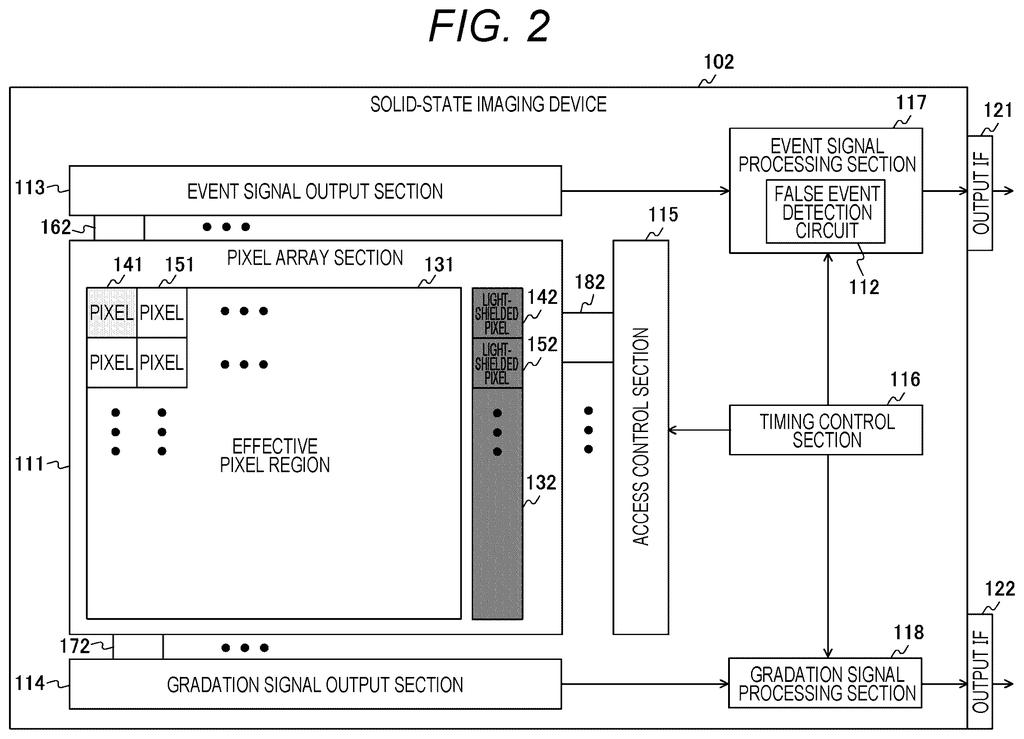
What Sony's light-blocked pixel trick actually does
Imagine a security camera that sometimes reports movement when nothing is actually moving. That's the core problem Sony is trying to solve here.
Sony's patent describes a sensor that mixes two types of pixels: traditional ones that record brightness levels, and a newer type called "event pixels" that only fire when something in the scene changes. Event pixels are useful for capturing very fast motion without blurring, but they have a flaw: they sometimes trigger on their own, even when nothing has changed, producing false alarms.
Sony's fix is to include a third type of pixel in the same chip, one that is physically covered so it can never see light. If that covered pixel still reports motion, you know it's a false signal, not a real one. The chip can then automatically flag or correct those phantom readings across the rest of the sensor.
How the dark reference pixel catches false events
The patent describes a photodetection device that combines three pixel types on a single imaging chip:
- Gradation pixels: standard pixels that measure brightness levels, producing a conventional image frame.
- Event pixels: pixels that only produce output when the light hitting them changes (a concept borrowed from neuromorphic, or brain-inspired, camera designs). These are highly efficient for tracking fast motion.
- Light-shielded event pixels: event pixels that have been physically blocked from receiving any light at all.
Because a light-shielded event pixel is in total darkness, it should never trigger. If it does produce an output, that output is by definition a false event, caused by electrical noise, temperature drift, or manufacturing variation inside the chip itself.
A detection circuit monitors these dark pixels continuously. When a dark pixel fires, the circuit uses that signal as a baseline to identify and flag matching false signals coming from the active event pixels nearby. The patent also describes an optional correction circuit that automatically removes those false events from the data stream, and a notification circuit that can alert downstream systems when false events are detected, rather than silently discarding them.
What this means for fast-moving cameras and robotics
Event cameras are increasingly used in robotics, autonomous vehicles, and high-speed industrial inspection because they can track motion far faster than conventional cameras without generating massive amounts of data. The catch has always been noise: false triggers reduce how much you can trust the output, especially in safety-critical applications.
By building the noise-detection reference directly into the sensor chip, Sony's approach avoids the need to filter false events in software after the fact, which adds processing time and complexity. If this shows up in a future Sony sensor, it could make event-based imaging more practical for products like drone cameras, machine-vision systems, or even next-generation smartphone sensors that borrow event-camera ideas.
This is a focused, practical engineering fix rather than a headline-grabbing concept. Event cameras are a genuinely promising technology held back by reliability concerns, and Sony is one of the few companies with both the sensor expertise and the manufacturing scale to turn this kind of low-level noise-correction patent into real silicon. Worth paying attention to.
There are more where this came from
We read every patent application Big Tech publishes and send you the ones worth knowing. Plain English, free, every week.
The drawings
18 drawing sheets from US 2026/0222701 A1 · click any drawing to enlarge


Want this weekly breakdown for a company we don't cover? Patentlyze Pro →
Be the first to weigh in