
New Patent Uses Stationary Objects to Pinpoint Car Location
GPS is notoriously bad in tight parking garages. Sony's latest patent takes a different approach, using the car's own sensors to spot fixed objects like pillars and walls, then comparing them to a stored map to figure out exactly where the vehicle is.
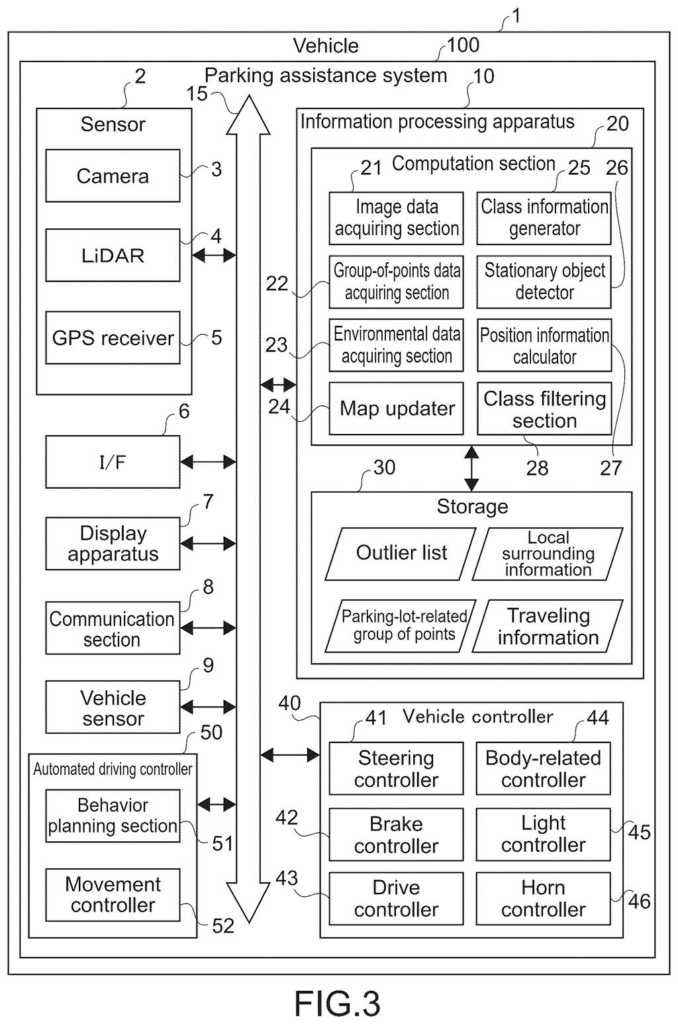
How Sony's parking position system actually works
Imagine you're driving into an underground parking garage. Your phone's GPS cuts out, the signal bounces off concrete walls, and your car's navigation system has no reliable idea where you actually are. That's a real problem for any car trying to park itself or assist you with tight maneuvering.
Sony's patent describes a system that works around this by using the car's sensors to scan the surrounding environment and identify which objects are stationary, things like concrete columns, walls, curbs, and signs. It deliberately ignores people, other cars, and anything else that might move.
Once it has a reliable list of fixed objects and their positions, it compares that picture to a pre-loaded map. The match tells the system where the vehicle is with much greater accuracy than GPS alone. Think of it like a car finding its own location by recognizing familiar landmarks.
… a stationary object detector that detects a stationary object from among the objects on a basis of the class information, the stationary object moving with a probability less than or equal to a specified threshold; …
Translation: The system identifies reliable landmarks that almost never change their location.
How the system filters objects and matches them to a map
The patent describes four main components working together inside a vehicle's onboard computer:
- Sensing information acquiring section: Takes in raw data from the car's sensors (cameras, lidar, radar, or some combination) to build a picture of nearby objects.
- Class information generator: Labels each detected object by category, essentially asking "what is this thing?" The classification step distinguishes between a parked car, a pedestrian, a pillar, and a wall.
- Stationary object detector: Filters out anything likely to move. The threshold here is probabilistic: if an object has more than a set chance of moving, it gets ignored. What's left are reliably fixed landmarks.
- Position information calculator: Takes the positions of those fixed objects and cross-references them against a stored map. The best-fit match tells the system precisely where the vehicle sits in physical space.
The core insight is that moving objects introduce noise into localization. By stripping them out before doing the map-matching step, the system gets a cleaner, more accurate position fix. This is particularly useful in GPS-denied environments like parking structures.
… calculates position information regarding a position of the vehicle on the basis of comparison of position information regarding a position of the stationary object to stored map information.
Translation: It figures out where the car is by matching those landmarks against existing map data.
What this means for autonomous parking and driver assist
Self-parking and driver-assist features in cars today often struggle in enclosed spaces where satellite positioning is unreliable. A more accurate onboard localization method, one that doesn't depend on GPS, could make automated parking more dependable and extend it to environments where it currently fails.
For Sony Semiconductor Solutions, which supplies image sensors and camera systems to major automakers, this patent fits a broader push into automotive sensing intelligence. A system like this would likely run on the same embedded chips Sony already sells, making it a natural upsell to existing customers building advanced driver assistance systems.
This is a competent, incremental solution to a genuine problem in automotive localization. It won't make headlines at a consumer tech show, but the core idea, using object classification to filter out noise before map-matching, is practically sound and addresses a real gap in parking assist systems. Sony's position as a sensor supplier means there's a plausible path from patent to shipping hardware.
There are more where this came from
We read every patent application Big Tech publishes and send you the ones worth knowing. Plain English, free, every week.
The drawings
5 drawing sheets from US 2026/0225584 A1 · click any drawing to enlarge


Want this weekly breakdown for a company we don't cover? Patentlyze Pro →
Be the first to weigh in